Silence hung heavily on the terrace.
Not the usual silence — it felt dense, suffocating, as if the very air had thickened.
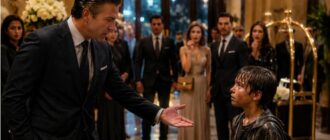
The boy stood barefoot on the cold stone. His hand hovered just inches from the man’s knee — exactly where, as an old medical journal once described, a crucial injury had been missed.
The man in the wheelchair smirked.
— You have fifteen seconds. Then I call the police.
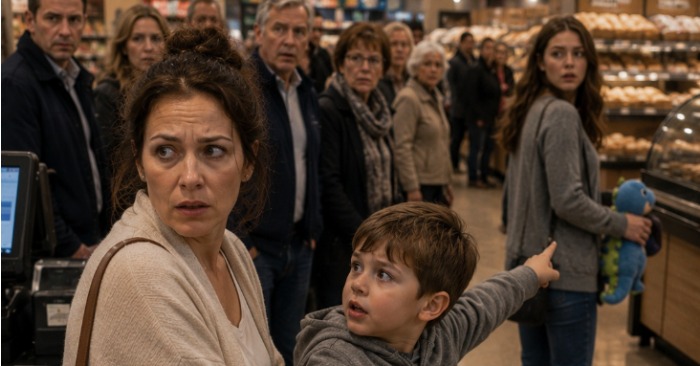
Around them, phones began to rise. Someone murmured that the video would spread online.
The boy closed his eyes.
And pressed.
A scream shattered the night.
— Get your hands off me!
Then everything fell silent.
The man froze. His breath quickened, and his face drained of color.
Something had changed. It wasn’t pain, nor movement.
It was a feeling.
A feeling he hadn’t experienced in eleven years.
— This can’t be… he whispered.
The boy stepped back.
— Try.
Laughter echoed through the crowd, only to stop abruptly.
Because the man’s fingers were trembling.
Eleven years ago, Marcus Hale had been told: he would never walk again.
An accident. A spinal injury. A decision made by doctors who would never have to live with the consequences.
What they didn’t tell him was that his condition wasn’t completely hopeless. It was simply “highly unlikely” to improve.
But unlikely doesn’t sell. Never does. It forces people to accept their fate.
Marcus gripped the armrests of his wheelchair.
— I can’t…
The boy looked at him, unwavering.
— You can.
Marcus tensed. His legs quivered — weak, uncertain.
But they responded.
He stood.
Unsteady. Wobbly.
But he stood.
The check he was holding slipped from his hand.
The crowd didn’t applaud.
They stepped back.
The police arrived, not because of the boy, but because too many questions had been raised.
Doctors’ names. Old records. Cases long buried.
An officer knelt in front of the child.
— What’s your name?
The boy hesitated.
A name leaves a trace.
— No, Marcus interrupted, his voice firm. — He stays with me.
— Are you protecting him? the officer asked.
Marcus swallowed.
— No… I’m afraid of losing him.
That night, Marcus uncovered the truth.
There was no miracle. No magic.
Just a photographic memory. Brilliant intellect. A mother lost in a clinical trial that had been mysteriously closed.
The same company Marcus had invested in.
The very system that had made him wealthy.
And erased the boy from its life.
For so long, Marcus had seen himself as the victim.
But as he watched the boy read complex medical texts, he realized:
He wasn’t the victim.
He was the one who had benefited.
— I’ll give you everything, Marcus said. Money, a house, my name.
The boy looked up at him.
— I don’t need your money.
— Then what do you need?
The boy smiled, barely.
— The truth.
The downfall came quietly.
Reports. Lawsuits. Careers disappearing without a headline.
Years later, a journalist asked the now-adult man:
— Why did you do it?
He answered calmly.
— They laughed at me. And they thought money made them untouchable.
A short pause.
— But it turned out not to be true.