My name is Andrés Morales Vega. I’m 62 years old, and for most of my life I believed being a father meant giving everything so your child could have a better future. On June 26, 2024, in a packed graduation hall in Valencia, I learned how wrong I had been.
My daughter, Beatriz Morales Jiménez, was graduating from medical school after six long years. During those years, I paid for everything—tuition, books, rent, food, extra courses, conferences, every expense she ever had. I worked long days in my construction company so she would never have to worry about money. By the time she graduated, I had spent more than €80,000 on her education. I was proud of every cent.
That afternoon I arrived early, wearing my best navy suit. I had flowers ready, a speech in my pocket, and the keys to a Mercedes I had bought her as a graduation gift. I sat quietly in the fifth row, a few seats away from my ex-wife Pilar, with whom I had kept a civil relationship for Beatriz’s sake. Pilar had always looked down on me for not having a university degree, but I ignored it. That day was supposed to be about our daughter.
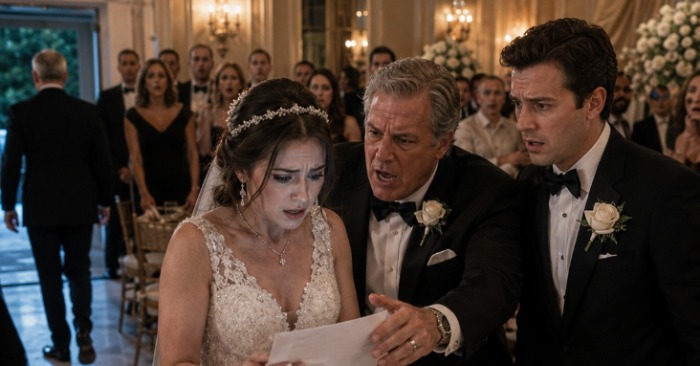
When Beatriz stepped onto the stage, she looked radiant. I waited for the moment she would mention me. She thanked her mother, her professors, her boyfriend, her classmates, and even her late maternal grandparents. I kept waiting. Then she looked into the audience and said, “I want to thank everyone who helped me get here—except my father, who has been a disgrace to our family.”
The entire hall went silent.
Five hundred people turned to look at me. I felt as if something had been driven straight through my chest. I saw pity on some faces, curiosity on others. Pilar wore the faintest smile. I didn’t argue. I didn’t make a scene. I stood up slowly, nodded once toward my daughter, and walked out with whatever dignity I had left.
That night, I sat alone in my study with every receipt, transfer record, and contract I had kept over the years. For the first time, I added everything up properly. My daughter’s education had cost me €83,500. And three weeks earlier, I had already approved a €120,000 loan for her master’s degree in interventional cardiology in Madrid. On top of that, I had saved another €55,000 for her living expenses during the program.
Then I received a message from Beatriz: I hope you didn’t get upset about what I said. I just wanted to be honest. Tomorrow we can have lunch and celebrate like always.
Not an apology. Not even regret. Just entitlement disguised as honesty.
At 11:30 that night, I called my lawyer, Rafael Peña. I told him to cancel the loan, remove Beatriz from every account and policy where she had access, and revise my will. Rafael asked if I was sure. I told him I had spent 24 years thinking, and tonight I was finally acting.
By the next morning, the loan had been canceled. The university had been notified. The funds I had set aside for her master’s had been moved to an account in my name only. She also lost access to the family account I had maintained for her expenses.
By noon, my phone was exploding.
At first Beatriz thought it was a banking error. Then the panic started. She called again and again, texting me that her future was at stake, that the master’s was essential, that I couldn’t do this to her. My ex-wife called, furious, accusing me of ruining our daughter’s life over one “unfortunate comment.” Even Beatriz’s boyfriend, Diego, contacted me, asking me to reconsider.
I sent Beatriz one message: Yesterday, in front of 500 people, you said I was a disgrace to your family. Today I’m acting like one. A disgrace does not pay for a €120,000 master’s degree.
The next day, she came to my house in tears with flowers in her hands. She begged me to reverse the decision. She said she had made a terrible mistake, that she had been nervous, that she hadn’t meant it. But I reminded her that her speech had lasted six full minutes. She had thanked everyone in her life except the man who had paid for everything. That wasn’t nerves. That was deliberate.
Then she said the quiet part out loud. Without the master’s, she wouldn’t be able to specialize. Without specializing, she wouldn’t get a high-paying private hospital job. Without that, she wouldn’t be able to maintain the lifestyle she expected.
That one sentence told me everything.
It wasn’t about medicine. It wasn’t about vocation. It was about status, income, and the future she thought I owed her.
Soon after, I discovered something even worse. Through a contact at a private hospital, I learned that Diego had already been asking about investment opportunities for specialist doctors. He had calculated that once Beatriz finished her master’s, they could invest another €250,000 into a private medical partnership and earn hundreds of thousands a year. He assumed I would provide that money too.
I hired a forensic accountant to look into Diego. What I learned confirmed all my suspicions. He had massive student debt, a financially struggling family, and he had even checked public financial records about my company and property holdings. He hadn’t fallen in love with my daughter’s heart. He had fallen in love with the future wealth he thought came with her.
By September, Beatriz had found work as a general doctor in a public hospital in Valencia. She earned around €3,200 a month, worked exhausting shifts, and for the first time in her life had to pay rent, buy groceries, and manage her own budget. I heard, through mutual contacts, that she was changing. She was working hard, staying late for patients, treating nurses with respect, and slowly discovering what real labor actually costs.
Then, just as I had predicted, Diego left her.
He told her he needed a partner with financial ambition, not someone content with an ordinary salary. He admitted—without quite meaning to—that he had built their future around money he believed would come from me. That night, Beatriz finally understood what I had seen from the beginning.
A few weeks later, she called me. Her voice was different—quieter, humbler. She told me I had been right about Diego. She told me she had started seeing the reality of work in the hospital and that, for the first time, she truly understood what it meant that I had spent years working myself to the bone for her future.
Then, in December, she sent me a handwritten five-page letter.
In it, she admitted everything. She wrote that she had let her mother’s snobbery shape the way she saw me. She remembered the many times she had corrected me, dismissed me, or spoken to me as if I were just a wallet instead of a father. She wrote that she now saw each of those moments differently. Every time she finished a brutal hospital shift, she thought of me coming home tired after working to support her life. Every euro she earned made her realize how lightly she had treated the money I gave her for years.
She also told me she had opened a savings account and had started putting aside money every month to pay me back for her education. The amount was small—just a few hundred euros at a time—but it was enough to tell me something had changed.
So in January, I invited her to my office.
I asked her direct questions. Would she go back to Diego if I restored her funding? No. Was she still listening to her mother’s bitterness? No—she had confronted her. Was she really saving to repay me? Yes, and she showed me the account. It wasn’t much, but it was real.
Then I gave her the money back.
I told her that the amount itself didn’t matter. What mattered was that she had finally understood the value of effort, sacrifice, and respect. I didn’t restore the master’s funding. That lesson had to remain. But I told her I was willing to begin rebuilding our relationship—not as a bank and a spoiled child, but as a father and daughter on honest terms.
For the first time in months, we hugged.
Since then, things have changed completely. Beatriz stayed in public medicine and discovered she genuinely loved emergency care. She no longer speaks about status or salary the way she used to. She visits because she wants to, not because she expects anything. She even defended me when Pilar tried once again to call me selfish and say I had destroyed Beatriz’s future. My daughter looked her mother in the eye and said, “No. He gave me everything. And when he finally took something away, it saved me.”
That was the moment I knew I had truly gotten my daughter back.
I lost the version of her who believed money was love and support was an obligation. But I gained a woman who understands work, loyalty, and gratitude. In the end, canceling that €120,000 loan was the most painful decision I ever made—and also the best one.
Because sometimes the only way to save your child is to stop rescuing them.