Her own son slapped her in the middle of the dance floor because she arrived carrying an old shoebox wrapped in newspaper.
“Take your trash out of my wedding!” he shouted in front of everyone, ashamed of his poor mother.
He thought he had humiliated her forever. He thought the box held nothing but worthless junk.
But he had just made the most expensive mistake of his life.
Because when the old woman opened that dirty cardboard box in the middle of the silence, what was inside blinded the bride, dropped the groom to his knees, and destroyed everything he thought he had built.
Margaret Wilson stared at the bank document trembling in her rough, overworked hands. It was not just paper. It was proof that fate had a twisted sense of humor.
Ten million dollars.
The number seemed to glow under the weak light bulb hanging in her kitchen. She let out a dry laugh with no joy in it. Years earlier, she had sold a patch of barren land her late husband used to joke was too worthless even for lizards. Then a mining company discovered a rich vein underneath it.
The money had changed nothing about her life. Not her worn dresses. Not her cracked hands from years of scrubbing other people’s floors. Not her small house.
It had simply waited.
Waited for this exact day.
The day her son Michael would show her who he really was.
Margaret placed the certified check on the table beside an old grease stain that had never come out. Then she went to the corner where she kept things most people called garbage but she called useful. She pulled out an old shoebox—the one from the pair of shoes Michael had worn when he graduated from university. She had paid for those shoes by washing thousands of floors. He had thrown them away a week later because they were “out of style.”
She ran her hand over the broken cardboard.
It was the perfect test.
She placed the document inside, wrapped the box in old newspaper stained with coffee, and tied it with a piece of string. It looked awful. Like something someone would kick aside in the street.
Perfect.
She put on her navy dress—the one she wore to church, with the frayed hem—and her tight black shoes. In the mirror she saw exactly what others would see: a poor old woman.
Good, she thought.
If Michael could not embrace that woman, he deserved nothing else.
By the time she reached the luxury wedding hall, after a suffocating bus ride and a humiliating walk through the rich neighborhood, her dress was wrinkled, her shoes were dusty, and her courage was the only thing holding her upright.
At the entrance, security guards looked at her once and decided she did not belong.
“This entrance is for guests,” one said coldly. “Suppliers and service staff use the back alley.”
“I’m not staff,” Margaret replied. “I’m the groom’s mother.”
The guard laughed.
“Everyone knows Mr. Michael Wilson is an orphan,” he said. “Now turn around before I call the police.”
Before she could answer, some of the bride’s friends overheard and joined in. They laughed at her clothes, her box, her age.
Then Michael appeared.
For a brief second, Margaret thought her son had come to save her.
He had not.
He rushed down only to silence her.
In front of the others, he forced a smile and called her his old nanny, a confused woman who sometimes imagined she was his mother.
That lie hurt more than any insult.
Then he dragged her through a side entrance into the kitchen and ordered her to stay hidden there until the party ended.
But something inside her had changed.
So she waited.
She waited until the speeches began.
Then she walked out of the kitchen and into the ballroom.
The music stopped.
The guests turned.
There she stood under the wedding lights: small, tired, wrinkled, clutching that ugly box wrapped in newspaper.
Emily, the bride, laughed first.
“Look, Michael,” she sneered. “Your nanny escaped from the kitchen.”
The guests laughed too.
Michael ran to her, pale with fury, and tried to make her leave.
But Margaret stood her ground and held out the box.
“I brought your wedding gift, son.”
“I don’t want your trash!” he screamed.
Then, in front of everyone, he raised his hand and slapped her.
The sound cracked through the ballroom.
Margaret fell hard onto the polished floor. The box slid across the dance floor.
Phones came out.
People started recording.
Blood appeared at the corner of her mouth.
Michael panicked and tried to lie, claiming she had attacked him.
But the room had already turned against him.
Margaret slowly stood up, wiped the blood from her lip, picked up the box, and took the microphone.
“My son says I came here asking for money,” she said. “He says I am an embarrassment. He says this box is garbage.”
She raised it higher.
“For thirty years I worked so he could have everything. And today I came to give him the last gift his father left behind.”
Michael shouted, but she ignored him.
She opened the box and pulled out the document.
$10,000,000.
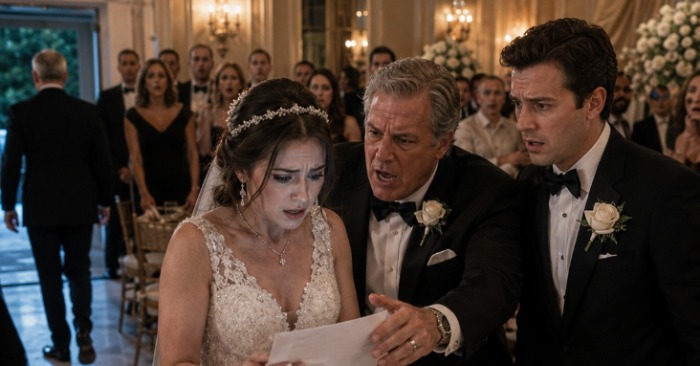
Emily’s father, Richard Carter, stepped forward, examined it carefully—and froze.
“It’s real,” he said. “Ten million dollars.”
Everything changed.
Emily rushed forward, suddenly sweet, calling her “mother,” apologizing, pretending she cared.
Michael dropped to his knees.
“Mama, forgive me,” he begged. “Give me the check. I’ll take care of everything.”
Margaret looked at him calmly.
“You want this?” she asked.
“Yes.”
“More than your dignity?”
“Yes.”
“More than your mother?”
He didn’t hesitate.
“Yes.”
Margaret nodded.
Then she tore the check in half.
Michael screamed.
She tore it again.
And again.
Until ten million dollars turned into scraps.
“This was for the son I raised,” she said quietly. “But that son died the moment you hit me.”
She threw the pieces over him.
“There’s your inheritance. Pick it up.”
He dropped to the floor, desperately trying to collect them.
Nobody helped.
Then Margaret delivered the final blow.
“If I didn’t deposit this check within twenty-four hours,” she said, “every dollar goes to a shelter for abused mothers and to an orphanage.”
Michael froze.
Margaret turned and walked away.
Behind her, everything collapsed.
Emily left him. Richard fired him. The wedding was canceled. The guests spread the video everywhere.
Within hours, Michael lost everything.
His job.
His home.
His reputation.
He became exactly what he had always feared—someone with nothing.
Days later, sick, starving, and broken, he dragged himself back to his mother’s small house.
He collapsed at her door.
When Margaret opened it, she saw him—dirty, barefoot, barely alive.
For a moment, she stood still.
Then she pulled him inside.
Because no matter what he had done…
She was still his mother.
And sometimes, losing everything is the only way a person finally learns what truly matters.