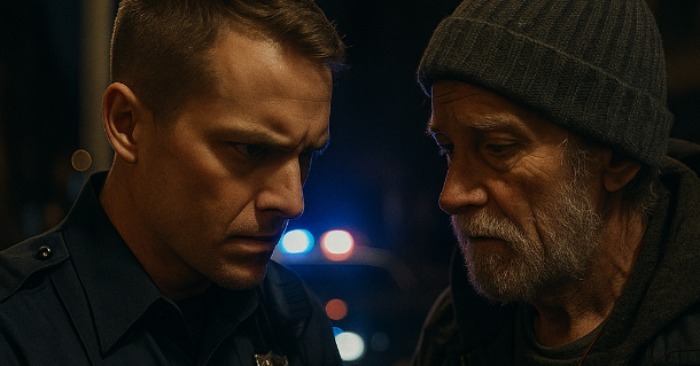
Patrick had been working in the police force for ten years. Stern, composed, principled. He believed in order and the law, even when it clashed with compassion.
“If you break the rules — you face the consequences,” he often told his partners.
That evening, they were patrolling an old neighborhood. In an alleyway, behind trash bins, they noticed a homeless man rummaging through boxes near a store.
“Hey, buddy,” Patrick called out, “what are you doing there?”
The man turned around. His face was weathered, his eyes dull, his clothes ragged, his hands trembling.
“Just looking for something to eat, sir,” he answered quietly.
Patrick sighed. According to protocol, he had to bring the man to the station. He cuffed him and placed him in the car. The man didn’t resist — he only kept clutching a small locket on his neck.
At the station, while the paperwork was being filled out, the locket slipped out from under his shirt. Patrick glanced at it absentmindedly — and froze. Inside was an old photo. A woman. Smiling, with kind eyes. His mother.
He grabbed the locket.
“Where did you get this?!”
The man looked confused.
“She… she gave it to me. Many years ago. When I helped her with her car. She said she had a son — a police officer — and that I reminded her of him.”
Patrick stepped back, feeling a lump rise in his throat. For a moment, he felt ashamed — of the coldness, the indifference, of how easily he had judged others.
He removed the handcuffs and quietly said:
“Come on. I’ll take you to dinner.”
Sometimes the most important thing isn’t order — it’s humanity.