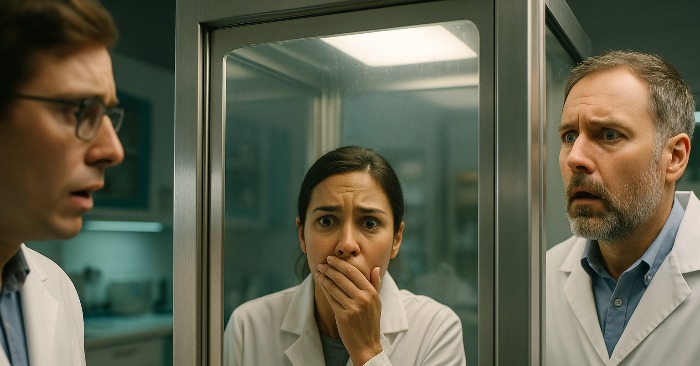
The lab was quiet except for the steady hum of machines. Dr. Collins adjusted his glasses as he peered into the glass chamber. Years of research had led to this moment: a successful clone. Not just any clone, but the promise of a breakthrough that could change the future of science.
They had chosen a sheep — simple, unthreatening, the same species that had once brought the world Dolly. If it worked, it would prove their process was flawless. The embryo had grown perfectly, the development charts looked normal, and every test had come back clear.
But as the time for the birth approached, unease settled over the team.
“Doesn’t that heartbeat look… fast?” one assistant asked, staring at the monitor.
“Every mammal has variations,” Collins dismissed, though his stomach tightened.
When the moment finally came, they gathered around the sterile chamber, breath held. The incubator beeped, the machines whirred, and then — a cry. High-pitched, strange, not like the bleat of a sheep at all.
The creature emerged small and wet, its body trembling. At first, they thought it was just the angle, the light. But then it turned its head.
And everyone froze.
It wasn’t a sheep.
Its eyes were too large, too human, with pupils that seemed to widen as it looked at them. Its limbs were thin, bent at awkward angles, ending in something that looked more like fingers than hooves. Its mouth opened, and instead of a bleat, it made a sound halfway between a cry and a laugh.
The room was silent.
“What… what is it?” one of the assistants whispered.
Collins stepped forward, his hands shaking. “It should have been a sheep,” he said hoarsely. “It should have been.”
Over the next few days, the creature grew at an unnatural pace. Its skin thickened, its body stretched, and the resemblance to a sheep vanished entirely. It mimicked sounds it heard — voices, footsteps, even the beep of the machines. When the lights went out, the assistants swore they saw its eyes glowing faintly in the dark.
News of the birth spread quickly among the staff. Some refused to go near the chamber. Others stared for hours, unable to look away. A few wanted it destroyed immediately.
But Collins couldn’t bring himself to end it. “This is history,” he insisted. “Even if it’s a mistake, it’s proof of what’s possible.”
On the seventh night, the cameras caught something no one could explain. The creature stood upright, wobbling slightly, pressing its hands against the glass. Then it formed a word, clear as day.
“Why?”
The assistants fled the lab. Collins stood frozen, the weight of his ambition crushing him. They had tried to create life they thought they could control. Instead, they had made something they couldn’t understand.
By morning, the chamber was empty. The locks were intact, the glass unbroken. The only trace left behind was a small handprint smeared on the inside of the glass.
No one ever saw the creature again.
But months later, farmers near the edge of town reported strange sounds in the fields at night. Not the bleat of sheep, but laughter — high-pitched, echoing, carried by the wind.