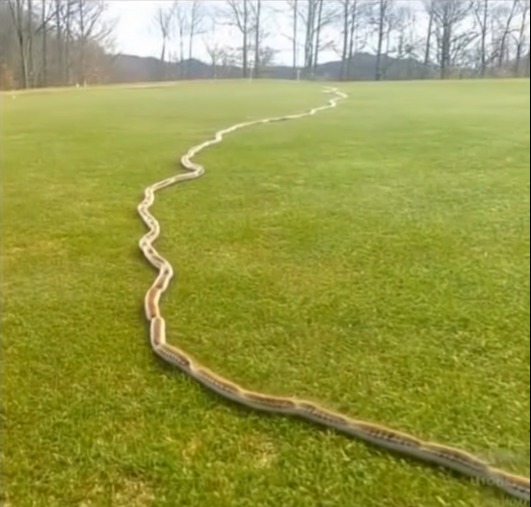
“It looked like a rope… until it breathed.” 🪱👁️ I stepped closer—and the line began to move. Not a snake. Not a hose. But something alive… and perfectly synchronized, like a single mind guiding hundreds of bodies. Even experts were baffled. What did I really witness that morning? The truth might be stranger than you think. Full story in the article below 👇
It was a quiet morning like any other. The sun had just started warming the backyard when I noticed something stretched out along the edge of the grass—a long, pale, twisted line. I assumed it was a rope. Maybe an old hose. Nothing worth a second glance.
Then it shifted.
I froze.
My heart kicked up. Was it a snake? A branch caught in the breeze? I grabbed my phone and took a quick photo, not quite sure what I was seeing. Then I stepped closer—slowly, cautiously. And the closer I got, the stranger it became.
It wasn’t a rope.
It wasn’t a snake.
It was alive.
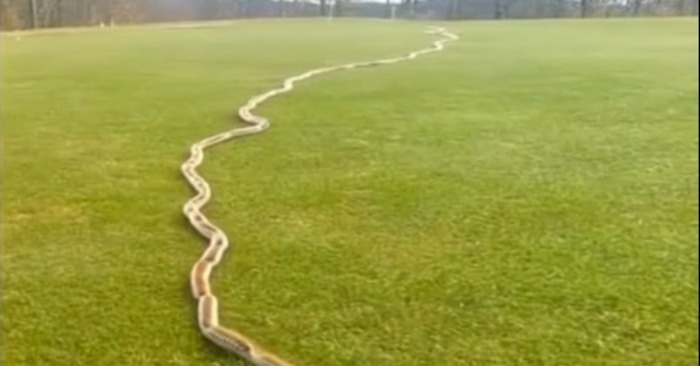
What lay before me was a long, perfectly organized chain of tiny caterpillars—at least 150 of them—crawling in a seamless line. No gaps. No chaos. Just a single, moving column like a living thread across the lawn.
For 30 minutes, I stood there, completely mesmerized. They moved head-to-tail with eerie precision, as though connected by some invisible code. No one broke formation. No one strayed.
Where were they going? And why like this?
Curiosity took over, and I started searching for answers. What I found only deepened the mystery.
Scientists call this behavior “processionary movement,” something seen in a few specific species like pine processionary or bag-shelter caterpillars. But to see this many? In a backyard? That’s rare. Some experts believe it’s a survival tactic—by moving as one, they appear larger and more intimidating to predators.
Others suggest it’s a navigational tool. The lead caterpillars leave behind a pheromone trail, and the rest follow. But that still doesn’t explain the almost mathematical accuracy in their spacing—or the way they moved in such perfect sync, like a creature made of parts.
Another theory? Energy conservation. The caterpillars in front push through the resistance, while those behind benefit from the path cleared. Some researchers think they might even rotate positions over time, though I didn’t see that happen.
What really unsettled me was this:
No one else around had seen anything like it. Not my neighbors. Not local wildlife forums. Not even a few entomologists I contacted could give a clear explanation for why it was happening here and now.
Some said it could be climate-related—an unusually large hatch triggered by temperature shifts. Others pointed to changes in soil chemistry or migration due to habitat loss. A few suggested it was simply nature doing something we still don’t fully understand.
But none of it was definitive.
Even now, I think back to that surreal morning: the quiet, the movement, the feeling that I was witnessing something out of step with the everyday world. Not dangerous. Just… unknown.
What I thought was a rope turned out to be a riddle—one that crawled across my backyard and disappeared into the grass. And it left me wondering:
How many other incredible things do we miss each day, simply because we don’t look twice?