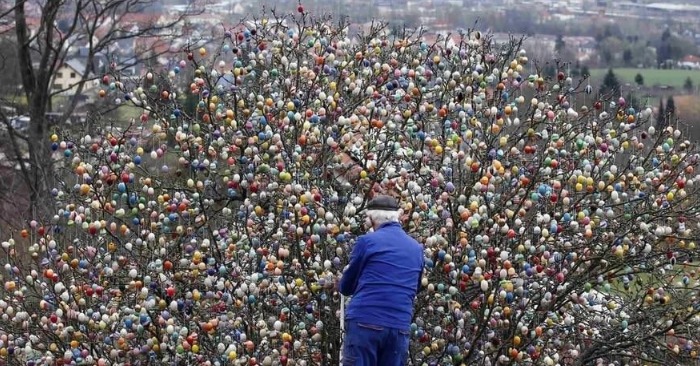
Every spring, something truly unusual appears in the German town of Saalfeld. In what once looked like an ordinary garden, a single apple tree becomes completely covered in colorful Easter eggs — not dozens or even hundreds, but thousands of them.
And the strangest part? It all started with one family who simply kept saying the same thing every year: “Let’s add a few more.”
According to a story often shared by locals, a young boy named Volker Kraft once passed a bush decorated with Easter eggs on his way to school shortly after World War II. The image stayed in his memory for decades. Whether every detail of the story is true no longer really matters — because the idea clearly never left him.
Years later, in 1965, Volker finally had a family of his own. A young apple tree stood in the yard of their home, and one Easter, the family decided to decorate it with just 18 eggs.
That was the beginning of something nobody expected to become famous around the world.
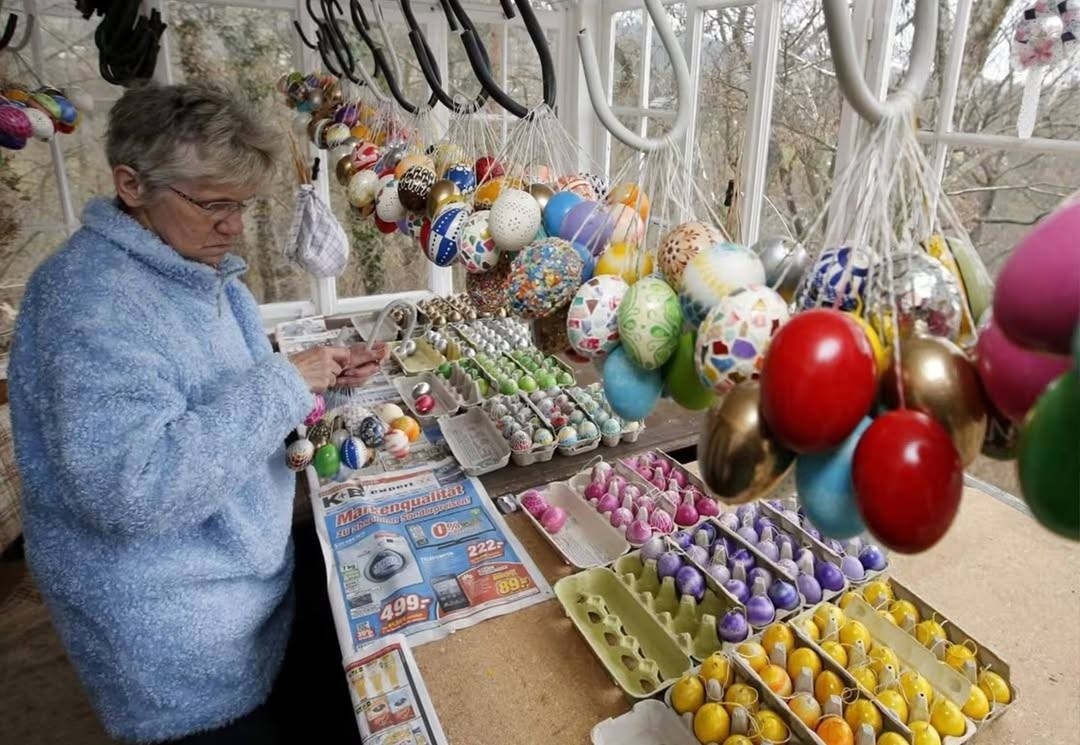
At first, it was simply a fun family tradition. Volker, his wife Christa, and their daughter Gabriela spent time together blowing out eggs, painting them, decorating them by hand, and hanging them carefully on the tree every spring. Some looked beautiful, while others looked more like messy children’s art projects — but none of that mattered to them.
Over time, however, the hobby became far more serious.
Christa eventually began crocheting decorative egg covers by hand, creating more than a thousand unique designs, some even decorated with pearls. Gabriela focused on painting tiny detailed scenes onto the eggs, including landscapes, buildings, flowers, and animals. Each ornament slowly became its own miniature work of art.
The only problem was that the family never stopped adding more.
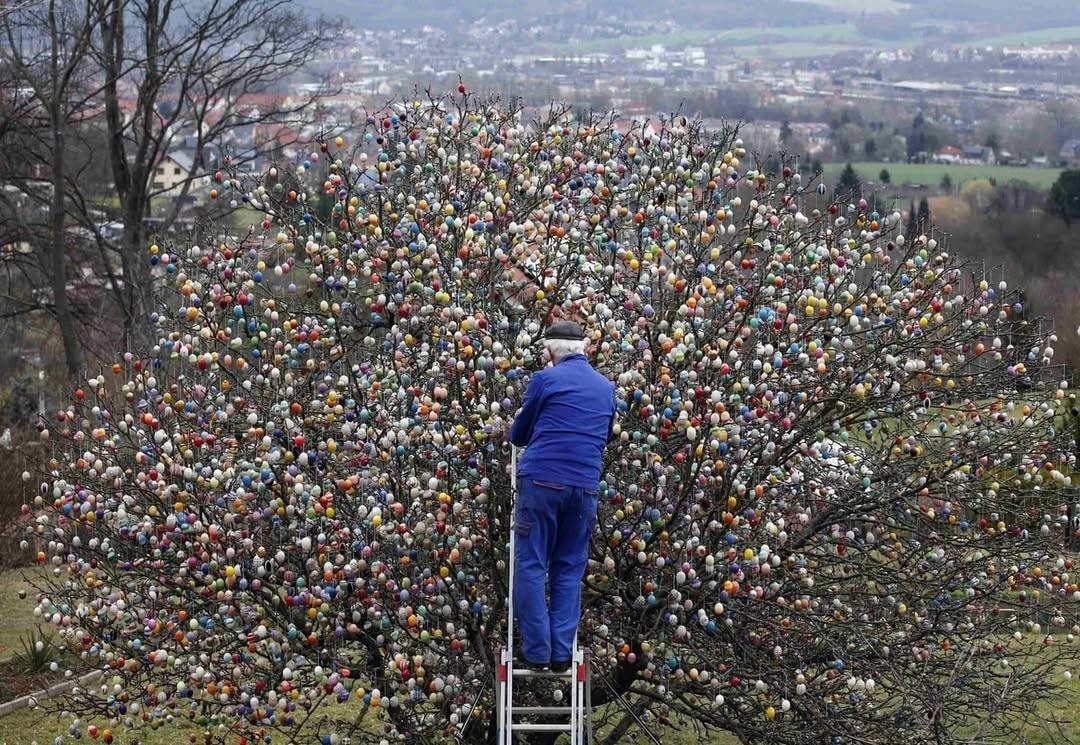
Every year the number grew larger. First dozens, then hundreds, then thousands. Eggs broke, birds damaged them, strong winds blew them away — but somehow the following Easter always brought even more decorations.
By 2012, the tree carried more than 10,000 eggs.
At that point, even Volker reportedly admitted the project had become almost impossible to manage. The family needed ladders, ropes, storage boxes, and nearly two full weeks of work every year just to decorate the tree properly. The eggs were not placed randomly either — they carefully arranged everything from the trunk outward so the entire tree looked balanced and visually organized.
And after Easter ended, every single egg had to be removed one by one, packed away carefully, and stored until the next spring.
The tradition continued for an incredible 50 years.
For a long time, it remained nothing more than a private family project. But in the 1990s, more people began noticing the strange tree after a nearby training center opened close to the property. Curious visitors stopped to look. Then journalists arrived. Then television crews. Soon, photographs of the unbelievable tree spread around the world.
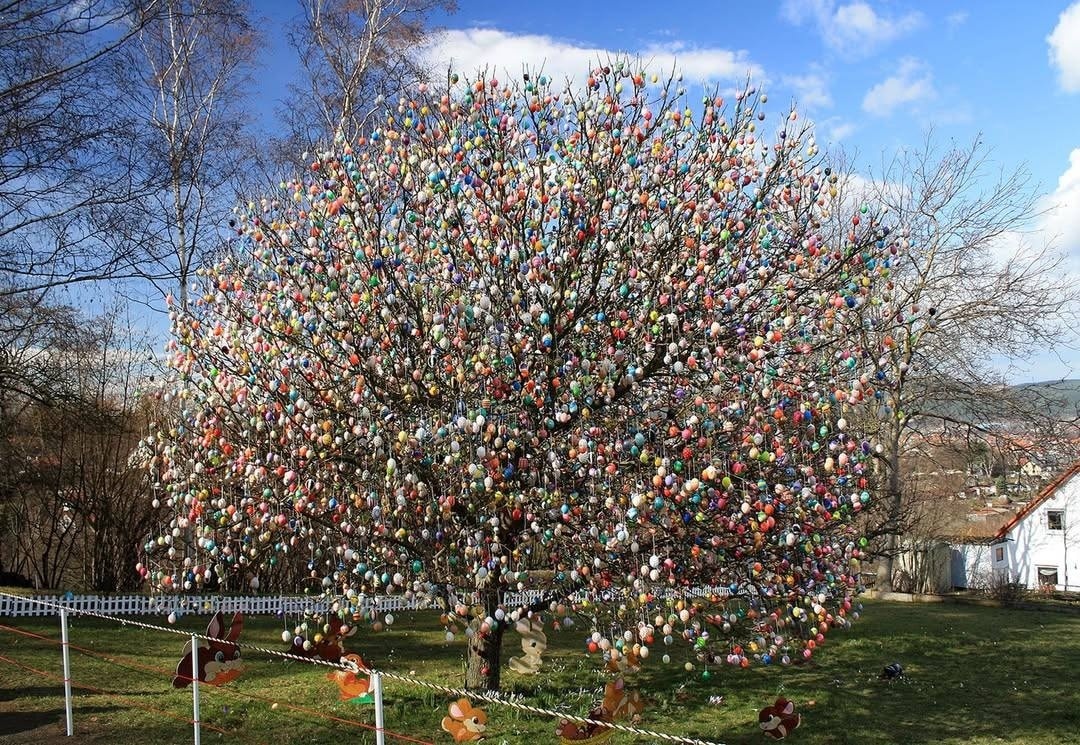
Before long, tourists were traveling to Saalfeld just to see the famous Easter tree for themselves. During peak seasons, thousands of visitors would gather simply to admire the bizarre sight of an apple tree covered in over ten thousand colorful eggs.
In 2015, the Kraft family finally decided to stop. After half a century, climbing ladders and handling such a massive display had become physically exhausting. What once brought joy had slowly turned into a responsibility too difficult to maintain.
But surprisingly, that was not the end of the story.
Local volunteers and residents refused to let the tradition disappear. The project was eventually moved into a public park, where the town continued the decoration process with some modern help and equipment — while keeping the original spirit alive.
Today, the Easter tree is no longer just a family tradition. It has become a symbol of the entire town.
What began as one childhood memory eventually turned into one of Germany’s most unusual seasonal attractions — proving that sometimes the strangest traditions are the ones people refuse to let die.