The phone rang four times before I answered.
I had already seen Dad’s name flashing across the screen six times.
Then Mom’s.
Then Dad again.
I ignored every call.
At 12:17 a.m., another number appeared.
Local area code.
Unknown caller.
Something told me to answer.
“Hello?”
A man’s voice came through over heavy rain.
“Is this Audrey?”
“Yes.”
“My name is Daniel Price. I live across from your parents.”
I sat up.
Lightning flashed across my bedroom window.
“What happened?”
There was a pause.
“This isn’t about the roof.”
My stomach tightened.
“What do you mean?”
“Your father fell.”
I was already reaching for my jeans.
“Where?”
“Upstairs.”
“What was he doing upstairs during a storm?”
Daniel hesitated.
“Trying to move something before the water reached it.”
I closed my eyes.
Of course.
Not buckets.
Not towels.
Something valuable.
“Is he conscious?”
“Yes. Paramedics are here.”
“Then why are you calling me?”
Another pause.
“Because your mother gave them your number.”
I almost laughed.
Even now.
Even after everything.
Audrey would fix it.
Audrey would come.
Audrey would make the problem disappear.
“What exactly happened?”
Daniel lowered his voice.
“The tarp came loose on one side. Water started getting into the upstairs bedroom. Your father tried climbing into the attic.”
I gripped the phone harder.
“And?”
“He slipped off the folding stairs.”
For a moment, all I heard was rain.
“Is he seriously hurt?”
“They’re taking him to the hospital.”
I got dressed.
Not because I had forgiven them.
Because I wasn’t cruel.
There was a difference.
When I reached the hospital, Mom was sitting beneath fluorescent lights with wet hair plastered against her forehead.
She stood the moment she saw me.
“Audrey.”
I stopped several feet away.
“How is he?”
“Broken wrist. Possible concussion.”
Relief came first.
Then anger returned.
Mom looked exhausted.
“The roof is ruined.”
I stared at her.
“Dad is in the emergency department and that’s your next sentence?”
She blinked.
“I didn’t mean—”
“You did.”
She looked away.
Water dripped from the hem of her cardigan.
Then she said quietly:
“You left it unfinished.”
There it was.
Not concern.
Accusation.
I almost couldn’t believe it.
“I covered the unfinished section.”
“The tarp ripped.”
“Because there was a severe storm.”
“You knew storms were coming.”
I stared at her.
“So did you.”
Mom’s expression hardened.
“We depended on you.”
“No.”
My voice came out calmer than I expected.
“You used me.”
She flinched.
“Don’t make this dramatic.”
That sentence almost made me laugh.
Dad had fallen from the attic.
Water was pouring into their bedroom.
And somehow I was dramatic.
“You had enough money for first-class flights, private transfers, and six weeks in Europe.”
“That money was already allocated.”
“So was my body?”
She went silent.
I continued.
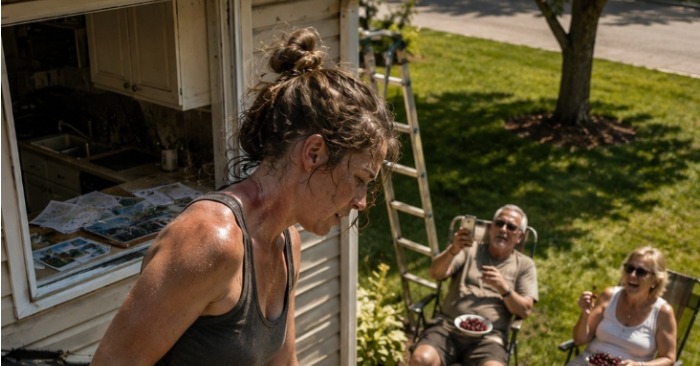
“You sat outside while I worked in dangerous heat.”
“We brought you water.”
“You filmed me struggling.”
“It was a joke.”
“You sent it to the family.”
“Everyone thought it was funny.”
“I didn’t.”
Mom folded her arms.
“You’ve always been sensitive.”
There it was again.
The family word for any pain they didn’t want to acknowledge.
Sensitive.
Difficult.
Dramatic.
Unreasonable.
Words that meant:
Stop asking us to feel guilty.
A doctor appeared before I could respond.
Dad was stable.
No surgery required that night.
Mom immediately relaxed.
Then she looked at me.
“Can you come back tomorrow and finish the roof?”
I stared at her.
Actually stared.
“You cannot be serious.”
“We’ll pay you.”
That surprised me.
“How much?”
She hesitated.
“A few hundred.”
I laughed.
Not because it was funny.
Because sometimes the truth is so insulting that laughter becomes the only available reaction.
“The professional quote was twelve thousand.”
“You’re not a professional company.”
“No.”
I nodded.
“I’m your daughter.”
Mom didn’t understand what I meant.
That hurt more than I expected.
I left.
The next morning, Dad called.
“Audrey, this has gone far enough.”
His voice was weak but still carried the same authority he had used my entire childhood.
“What has?”
“This tantrum.”
“Dad, you fell trying to save something upstairs while the roof leaked.”
“That wouldn’t have happened if you’d finished.”
I closed my eyes.
“What were you trying to save?”
Silence.
“Dad?”
“Documents.”
“What documents?”
“Personal things.”
I knew instantly he was lying.
“What was in the attic?”
Another pause.
“Nothing you need to worry about.”
That sentence had controlled me for decades.
Not anymore.
“Then hire someone.”
“We can’t find anyone immediately.”
“That’s unfortunate.”
“Audrey.”
“No.”
He went silent.
I had almost never said that word to him without explanation.
“No?”
“No.”
His breathing changed.
“You’re seriously abandoning your parents over a vacation?”
“No. I’m refusing to be unpaid labor for people who lied to me.”
“We didn’t lie.”
“You said you couldn’t afford the roof.”
“We couldn’t afford the roof and Europe.”
“That is not the same sentence.”
He had no answer.
I hung up.
By afternoon, my sister Claire called.
I knew the family meeting had begun without me.
“Mom says you’re refusing to help.”
“Correct.”
“Dad got hurt.”
“I know.”
“You could at least finish what you started.”
“Why don’t you?”
Claire laughed.
“I don’t know anything about roofing.”
“Then hire someone.”
“You know they can’t afford it.”
“Ask them about Florence.”
Silence.
Then:
“Oh.”
Apparently Mom had omitted that detail.
Within two hours, my uncle called.
Then my cousin.
Then another relative.
The jokes disappeared remarkably quickly once the travel itinerary became part of the story.
My uncle, the same man who had sent the meme of me carrying shingles, sounded embarrassed.
“I didn’t know they were making you do the whole thing.”
“They weren’t making me.”
I corrected him.
“I volunteered because they lied.”
That distinction mattered.
A person can be generous.
That doesn’t give someone else permission to turn generosity into obligation.
Two days later, I received a text from Dad.
A photograph.
Water-stained drywall.
Then another.
A collapsed section of bedroom ceiling.
Underneath:
Happy now?
I stared at it for a long time.
Old Audrey would have driven over immediately.
She would have brought tools.
She would have apologized.
She might even have paid for the damage.
Instead, I typed:
Call your insurance company.
Dad replied immediately.
They won’t cover all of it.
I wrote:
Then use the Europe money.
No response.
The next morning, Mom appeared at my house.
She looked smaller somehow.
Not physically.
Certain people shrink when they realize guilt no longer works.
“We canceled the trip.”
I said nothing.
She held out a folder.
Refund confirmations.
Not everything was refundable.
They had lost thousands.
“You didn’t have to show me.”
“I wanted you to know.”
“Why?”
Her eyes filled.
“Because your father and I made a mistake.”
I waited.
She seemed surprised I didn’t rescue her from the silence.
“We took you for granted.”
“That isn’t the whole mistake.”
She lowered her eyes.
“We laughed at you.”
“Yes.”
“We shouldn’t have.”
“No.”
“And we lied.”
There it was.
Finally.
“Yes.”
Mom wiped her eyes.
“I think we convinced ourselves it wasn’t really lying because technically we didn’t have enough for both.”
“You chose the vacation.”
She nodded.
“And assumed I’d cover the roof with my labor.”
Another nod.
“Why?”
She struggled with the answer.
Then said the only honest thing she had said in years.
“Because you always did.”
That hurt.
But it also freed me.
They hadn’t misunderstood me once.
I had trained them.
Every time I rushed in.
Every time I said yes when I meant no.
Every time I accepted ridicule because confronting it felt harder.
I had helped build the pattern.
That didn’t excuse them.
But it told me how to stop it.
Mom placed the folder on my kitchen counter.
“Your father wants to apologize too.”
“Then he can.”
“He’s embarrassed.”
“I was embarrassed on your roof while you filmed me.”
She winced.
“I know.”
For once, I didn’t soften the truth.
A week later, Dad came over.
His wrist was in a cast.
He stood awkwardly at the door.
“I deleted the videos.”
“Good.”
“I told everyone I shouldn’t have sent them.”
“Good.”
He stared at the floor.
Then he said:
“I was cruel.”
That surprised me.
My father almost never used precise words about himself.
He preferred phrases like misunderstanding.
Joke.
Bad timing.
But cruel was accurate.
“I thought because you were capable, asking you was harmless.”
“You didn’t ask me after the first day.”
He looked up.
“What?”
“You watched me burn myself out and laughed.”
His eyes dropped again.
“Yes.”
Then he said:
“I’m sorry.”
I believed he meant it.
That didn’t erase anything.
An apology isn’t a time machine.
But it can be the first honest brick in something new.
They hired an actual roofing crew.
Insurance covered part of the storm damage.
The canceled trip paid for much of the rest.
I didn’t climb the roof again.
When the work was finished, Dad sent me a photograph.
No joke.
No caption.
Just the completed roof.
Several months later, my parents invited me to dinner.
Dad grilled.
Mom made pie.
Nobody asked me to repair anything.
Halfway through dinner, the kitchen faucet started dripping.
Three people automatically looked at me.
The old silence appeared.
Then Dad caught himself.
He laughed once.
Not at me.
At himself.
“I’ll call a plumber tomorrow.”
I smiled.
“Good plan.”
It was a tiny moment.
But sometimes tiny moments prove that something really changed.
I spent most of my life believing being needed was the same as being loved.
It isn’t.
Love does not require you to destroy yourself so someone else can remain comfortable.
And the day I packed my tools wasn’t the day I abandoned my family.
It was the day I finally stopped abandoning myself.