“Your son.”
The words didn’t make sense.
Dottie stared at Carl.
Then at the photograph.
Then back at Carl.
“My son died.”
Carl’s eyes lowered.
“I know that’s what you were told.”
Dottie gripped the edge of the table.
Fifty-three years earlier, she had been nineteen.
John was twenty-one.
They were newly married and had almost nothing.
Their first baby arrived prematurely.
A boy.
Dottie remembered holding him for only a few minutes before nurses rushed him away.
Then came complications.
Medication.
Hours disappearing into darkness.
When she finally woke properly, John was sitting beside her hospital bed.
He was crying.
Their baby, he told her, hadn’t survived.
There had been no funeral Dottie could remember.
John said the hospital had handled everything because of the baby’s condition.
She had questioned it.
But she had been nineteen, grieving, frightened, and physically exhausted.
Eventually, life moved forward.
They had three more children.
But Dottie never forgot her first son.
She looked at the bracelet.
“His name was Samuel.”
Carl nodded.
“My father’s name was Samuel.”
The diner seemed to tilt beneath her.
“No.”
Carl pulled another photograph from the envelope.
A man in his early fifties stood beside him.
Dottie covered her mouth.
The resemblance to John was unmistakable.
Not identical.
But the eyes.
The jaw.
The crooked smile.
“That’s my father,” Carl said.
Dottie couldn’t speak.
“He died two years ago.”
Tears filled Carl’s eyes.
“He spent most of his life believing his biological parents abandoned him.”
“Abandoned?”
Dottie’s voice cracked.
“I never abandoned him.”
“I know.”
“No.”
She struck the table with her palm.
Coffee jumped inside the cups.
“I buried that child every day for fifty-three years.”
Several customers turned around.
Dottie didn’t care.
“I kept his hospital bracelet in my jewelry box until it disappeared. John told me it must have been lost when we moved.”
Carl looked down at the silver bracelet.
“John had it.”
That hurt more than anything else.
Dottie stared at him.
“Tell me everything.”
Carl took a breath.
“About six months before John died, he contacted me.”
“How?”
“My father had submitted DNA to an ancestry service before he died. He wanted to know where he came from.”
Carl paused.
“I kept the account active.”
One morning, a match appeared.
Close family.
The name connected to it eventually led Carl to John.
At first, Carl assumed there had been a mistake.
Then John agreed to meet him.
“Where?”
“Here.”
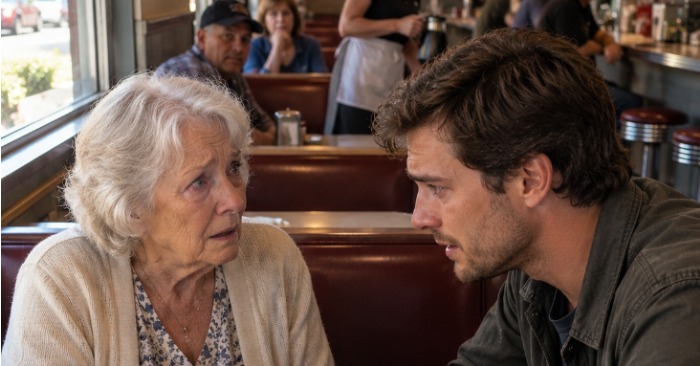
Dottie looked around the diner.
Her diner.
The same place where she’d spent a month telling Carl stories about the husband who had apparently hidden an impossible truth from her.
“They sat at this table?”
Carl nodded.
“More than once.”
Dottie felt sick.
“What did John tell you?”
Carl hesitated.
“That your baby didn’t die.”
The sentence landed harder the second time.
Dottie closed her eyes.
“Why?”
“Your mother.”
Dottie’s eyes opened.
“My mother?”
According to John, Dottie’s parents had never approved of their marriage.
John came from a poor family.
No university education.
No money.
No future, as Dottie’s father liked to say.
When Dottie became pregnant almost immediately after the wedding, her parents believed the marriage was doomed.
Then the baby arrived prematurely.
While Dottie was unconscious from complications, her mother approached John.
She told him the infant had severe medical problems.
She claimed Dottie might die if she discovered the truth.
Then she offered John money.
Dottie’s face hardened.
“John would never sell his child.”
“He didn’t.”
Carl pushed another folded letter across the table.
“He said your mother told him the baby had already been transferred to another hospital and placed with a family capable of paying for his medical treatment.”
Dottie unfolded the letter.
John’s handwriting.
Dottie, there is no version of this confession that makes me innocent.
Her vision blurred.
She kept reading.
John had panicked.
He had believed her mother.
By the time he discovered the baby had actually been placed for private adoption, weeks had passed.
He tried to locate him.
Dottie’s parents threatened him.
If he told Dottie, they would expose debts John had accumulated paying her medical expenses and claim he had voluntarily abandoned the child.
John was young.
Poor.
Terrified.
And he made the worst decision of his life.
He stayed silent.
Years passed.
Then more years.
Eventually, confessing became harder than maintaining the lie.
Dottie lowered the letter.
“He had fifty-two years.”
Carl said nothing.
“Fifty-two years to tell me.”
Her voice broke.
“And he waited until he was dying?”
“He was ashamed.”
“Good.”
Carl looked surprised.
Dottie’s tears finally spilled.
“He should have been.”
She stood abruptly.
For fifty-two years, she’d loved John.
That love didn’t disappear.
But suddenly it had another shape.
A darker one.
Grief mixed with anger.
Tender memories collided with betrayal.
The man who had held her when her parents died had also protected their secret.
The man who had comforted her whenever she mentioned Samuel knew Samuel might still be alive.
“I need air.”
Carl followed her outside.
They stood beneath the diner’s faded awning.
Rain had begun falling.
Dottie almost laughed at the cruelty of it.
John had proposed to her in rain.
Their first house had flooded in rain.
And now, apparently, her marriage was being rewritten in it.
“There is something else,” Carl said.
Dottie turned sharply.
“How can there possibly be something else?”
Carl reached into his coat.
Another envelope.
This one carried Dottie’s name.
“John gave this to me.”
“Why didn’t you give it to me immediately?”
“He told me not to.”
Her expression hardened.
Carl continued quickly.
“He wanted me to meet you first.”
“Why?”
“He was afraid.”
“Of what?”
“That if you learned everything immediately, you’d look at me and see only what he’d done.”
Dottie stared at him.
“He wanted you to know me before you knew who I was.”
“And you agreed?”
“At first.”
Carl looked ashamed.
“Then I met you.”
He swallowed.
“You kept talking about how much you loved him.”
“And every day I felt worse.”
Dottie took the envelope.
Inside was a second letter.
John’s final confession.
He apologized without asking forgiveness.
That mattered.
He admitted that fear had become cowardice.
Cowardice became habit.
And habit consumed half a century.
But near the bottom was another revelation.
John had found Samuel only months before Samuel died.
Dottie stopped reading.
“You said your father died two years ago.”
“Yes.”
“John knew him?”
“For three weeks.”
Dottie pressed the letter against her chest.
Carl explained.
Samuel had been sick.
John discovered his identity too late.
They met privately several times.
Samuel was furious.
Then curious.
Eventually, they talked.
Samuel refused to meet Dottie.
Not because he hated her.
Because he was afraid.
“He thought you had abandoned him,” Carl explained.
“John eventually convinced him you hadn’t.”
“Then why didn’t he come?”
“He was dying.”
Dottie covered her mouth.
“He didn’t want your first memory of your son to be watching him disappear.”
Her knees weakened.
Carl caught her arm.
For several minutes, they stood beneath the awning without speaking.
Finally, Dottie asked:
“Did he know about me?”
Carl nodded.
“My father knew your name.”
“Did he ever see my picture?”
“All the time.”
Carl smiled sadly.
“John gave him photographs.”
Dottie began crying.
Not quietly this time.
Carl held her.
It felt strange.
This young man was almost a stranger.
And yet when Dottie closed her eyes, she could feel something familiar in the way he held her shoulders.
Perhaps imagination.
Perhaps blood.
Perhaps grief simply searching for somewhere to land.
Months passed.
DNA testing confirmed what both already knew.
Samuel had been Dottie and John’s biological son.
Carl was their grandson.
Dottie told her other children.
There was anger.
Disbelief.
Arguments.
One daughter refused to believe John could have hidden something so enormous.
Her eldest son punched a hole through his garage wall after reading John’s confession.
Nobody emerged unchanged.
Neither did Dottie.
She stopped idealizing her marriage.
She also refused to pretend fifty-two years of love had been meaningless.
John had loved her.
John had also betrayed her.
Both things could be true.
That was perhaps the hardest lesson.
One Sunday afternoon, Carl visited Dottie’s house carrying a cardboard box.
“My father kept these.”
Inside were photographs.
School pictures.
Birthday cards.
A baseball glove.
Samuel’s wedding photograph.
Pictures of Carl as a baby.
An entire life Dottie should have known.
She spent hours looking through them.
Finally, Carl handed her one photograph.
Samuel was perhaps fifty.
He stood beside a lake.
On his face was John’s crooked smile.
Dottie touched the photograph.
“What was he like?”
Carl smiled.
“Stubborn.”
Dottie laughed through her tears.
“That appears to run in the family.”
“He loved terrible jokes.”
“Also inherited.”
“And whenever he was nervous, he did this.”
Carl rubbed his thumb against the side of his coffee mug.
Dottie froze.
Then she smiled.
She finally understood why that tiny gesture had unsettled her during their first lunch.
It wasn’t John she had been seeing.
It was Samuel.
A son she had never been allowed to know, surviving in the movements of his own child.
The following Tuesday, Dottie returned to the diner.
The waitress automatically led her toward the window.
Two bowls of soup arrived.
Carl sat opposite her.
For once, neither went cold.
They talked about Samuel.
Not John.
Not secrets.
Not guilt.
Samuel.
The baby Dottie lost.
The man he became.
The father Carl remembered.
Dottie could never recover those fifty-three years.
Some losses cannot be repaired by discovering the truth.
But the truth gave her something grief had denied her.
Samuel had lived.
He had loved.
He had laughed.
And part of him was sitting across from her.
Carl reached for the old silver bracelet lying beside Dottie’s coffee.
“You should keep it.”
Dottie closed her fingers around it.
Then she shook her head.
“No.”
She pushed it toward him.
“Your father carried this story longer than I did.”
Carl looked at her.
“Are you sure?”
Dottie smiled.
“Completely.”
Then she reached across the table and squeezed her grandson’s hand.
“Besides, I don’t need a bracelet to prove he existed anymore.”
Carl’s eyes filled with tears.
Dottie looked around the little diner where a stranger had once asked to share her table.
“Now,” she said, opening the menu, “tell me something about my son I don’t know.”
Carl smiled.
“That might take a while.”
Dottie smiled back.
“I have time.”
And after fifty-three stolen years, those three words meant everything.