“Anna Cole.”
Adrian stopped breathing.
For twenty years, he had trained himself not to react when he heard that name.
Tonight, a homeless child had just spoken it.
The boy remained seated at the piano.
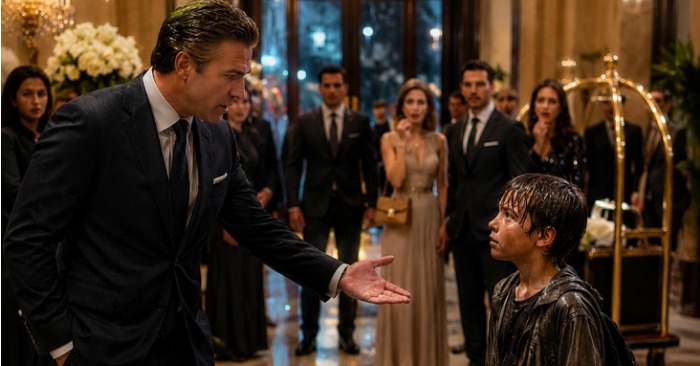
Around them, the hotel lobby had become unnaturally quiet.
Adrian looked down at the photograph.
It was old.
Bent at the corners.
A crease ran directly through the middle.
But the woman smiling in it was unmistakable.
Anna.
His younger sister.
She looked perhaps twenty-five.
Beside her stood a little boy of about three.
Adrian slowly looked toward the child sitting at the piano.
“How old are you?”
“Ten.”
“What’s your name?”
“Eli.”
Adrian swallowed.
“And Anna?”
The boy’s expression changed.
“My mother.”
Someone behind Adrian gasped.
Adrian barely heard it.
He turned the photograph over.
There was handwriting on the back.
He recognized it instantly.
Anna’s.
His hands began trembling.
He had received birthday cards in that handwriting.
Christmas notes.
Ridiculous little messages she’d leave on his refrigerator whenever she visited.
Then, twenty years ago, the messages had stopped.
Adrian had told everyone his sister had chosen to disappear.
That wasn’t entirely true.
They had fought.
Their father had recently died, leaving Adrian control of the family’s struggling company.
Anna wanted nothing to do with it.
She wanted music.
She wanted to teach.
Adrian had called her irresponsible.
Anna had called him exactly like their father.
The final argument ended with Adrian saying words he had regretted almost immediately.
“If you walk out, don’t come asking me to rescue you.”
She walked out.
And never returned.
Adrian spent years quietly searching.
Eventually, there were fewer leads.
Then none.
Now her son was sitting three feet away.
Adrian lowered himself into the chair beside the piano.
“Where is your mother, Eli?”
The boy didn’t answer.
Instead, he touched the keys again.
The melody continued.
Adrian closed his eyes.
Anna had composed it when she was seventeen.
She called it Home Before Dark.
She had never finished the final section.
Adrian remembered sitting beside her while she struggled with it.
“You always make everything too complicated,” he’d teased.
Anna had laughed.
“And you make everything sound like business.”
Now Eli was playing the missing ending.
Adrian’s eyes opened.
“That part…”
Eli stopped.
“What?”
“She never wrote that.”
Eli looked confused.
“She did.”
“No.”
Adrian moved closer.
“The final part. Anna never finished it.”
Eli looked down at his hands.
“She finished it for me.”
That sentence broke something inside Adrian.
“Where is she?”
Eli’s eyes filled with tears.
“She died last winter.”
Adrian lowered his head.
For the first time in years, Adrian Cole didn’t care who was watching him.
He cried.
Not dramatically.
Not loudly.
He simply covered his mouth while tears ran down his face.
Eli watched him.
“She talked about you.”
Adrian looked up.
“What did she say?”
The boy hesitated.
“That you were stubborn.”
A strange laugh escaped Adrian through his tears.
“That sounds like her.”
“She said you loved her.”
Adrian’s expression collapsed again.
“Did she?”
Eli nodded.
“But she said both of you waited too long.”
Adrian stared at the photograph.
Twenty years.
Two stubborn people.
Each apparently waiting for the other to make the first move.
“Why didn’t she contact me?”
“She tried.”
Adrian looked up sharply.
“What?”
Eli reached into his backpack.
This time he removed something else.
A bundle of envelopes.
Perhaps fifteen.
Maybe twenty.
Every envelope carried Adrian’s name.
None had stamps.
“What are those?”
“Letters.”
“Why weren’t they mailed?”
Eli shrugged.
“Mom kept changing her mind.”
Adrian took them carefully.
Some were more than a decade old.
Others were recent.
Then he noticed the final envelope.
Unlike the others, it had been sealed.
Across the front, Anna had written:
For Adrian, if Eli ever finds him.
Adrian stared at it.
“Did you read this?”
Eli shook his head.
“No.”
Adrian opened it.
The letter was short.
Anna explained that life had not gone according to plan.
She had married.
Her husband had died when Eli was very young.
She had taught piano lessons to support them.
Then she became ill.
By the time she finally decided to contact Adrian, pride had become shame.
And shame had become fear.
The final paragraph made Adrian grip the piano for support.
Anna had not sent Eli to find money.
She had sent him to find family.
If he ever reaches you, Adrian, don’t punish him for the years we wasted.
He has your stubbornness and my music.
Please give him what neither of us was brave enough to ask from the other.
A second chance.
Adrian lowered the letter.
“Where have you been sleeping?”
Eli looked toward the glass entrance.
“Different places.”
“Alone?”
A nod.
“How long?”
“Since they closed the shelter.”
Adrian looked around.
Only then did he remember his own words.
Play the piano and I’ll give you a home.
He had said them as a joke.
The lobby guests knew it.
Eli probably knew it too.
But Adrian no longer found anything funny about them.
He stood.
“Get your backpack.”
Eli didn’t move.
“Why?”
Adrian looked at him.
“Because I made you a promise.”
Eli’s expression remained guarded.
“You didn’t mean it.”
“No.”
The honesty surprised everyone.
Adrian crouched until they were eye level.
“I didn’t.”
He paused.
“But I mean it now.”
Eli stared at him.
“I don’t want your money.”
Adrian almost smiled.
Definitely Anna’s son.
“Good.”
“Then what?”
Adrian looked toward the photograph.
“I have a large house where almost nobody laughs.”
He looked back at Eli.
“And apparently I have a nephew who plays piano better than his mother did.”
Eli immediately frowned.
“No, I don’t.”
Adrian laughed.
For the first time that evening, it wasn’t forced.
“There she is.”
“Who?”
“Your mother.”
Eli’s expression softened.
But he still didn’t take Adrian’s hand.
Trust could not be purchased like a hotel.
And Adrian finally understood that.
The following weeks were difficult.
There were social workers.
Documents.
Court hearings.
Questions about Eli’s previous living arrangements.
Adrian underwent every required background check without complaint.
For perhaps the first time in his adult life, money couldn’t make the process move at his preferred speed.
That was probably good for him.
Eli initially stayed in temporary care.
Adrian visited constantly.
Sometimes they talked.
Sometimes they didn’t.
Whenever conversation became uncomfortable, they found a piano.
Three months later, Eli finally entered Adrian’s home carrying the same battered backpack.
Adrian had prepared an enormous bedroom.
Eli stood in the doorway.
“This is too big.”
“We can change it.”
Eli noticed a piano beside the window.
Not new.
Anna’s old upright piano.
Adrian had kept it in storage for twenty years.
Eli approached it slowly.
He touched one key.
Then another.
On top of the piano stood the faded photograph.
Beside it was Anna’s final letter.
Eli sat down.
“Do you still remember the beginning?”
Adrian stared at him.
“Of the song?”
Eli nodded.
Adrian sat beside him.
“I haven’t played in twenty years.”
“That’s not what I asked.”
Adrian smiled.
Then placed his fingers on the keys.
He played the first three notes.
Eli joined him.
For the first time, Adrian heard his sister’s unfinished melody exactly as she had eventually intended it.
Not performed in a luxury hotel.
Not surrounded by strangers.
But inside a home.
When they reached the final note, neither spoke.
Eli looked toward the photograph.
Then quietly asked:
“Do you think Mom would like this?”
Adrian stared at his sister’s smiling face.
“I think she’d complain that we’re playing it too slowly.”
Eli laughed.
Adrian laughed with him.
The house didn’t feel empty anymore.
Adrian had once believed success meant building something so large that nobody could take it away from him.
Anna had understood something he hadn’t.
A home wasn’t the building.
It wasn’t the piano.
It wasn’t even the promise.
It was having somewhere to return to—and someone who would still open the door.
And the richest man in that hotel had needed a homeless ten-year-old boy to teach him that.