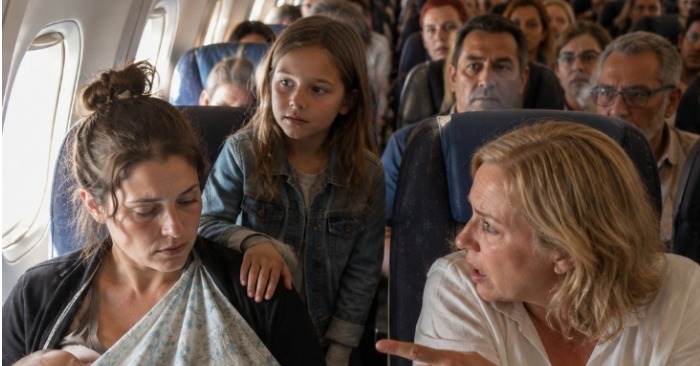
“Would you treat her like my mom?”
The woman stared at Louise.
For the first time since boarding the aircraft, she had nothing to say.
The photograph trembled between her fingers.
The young woman pictured in it was perhaps thirty.
She held a newborn against her chest.
Her tired face carried the unmistakable expression of someone who had gone days without proper sleep.
“My daughter,” the woman finally whispered.
Her voice sounded completely different now.
No arrogance.
No irritation.
Just shame.
“And that’s my grandson.”
Louise looked at the photograph again.
Then she looked toward me.
“Does she feed him when he’s hungry?”
The woman swallowed.
“Of course.”
“Even when other people are around?”
A few passengers nearby exchanged glances.
The woman nodded.
“Yes.”
Louise didn’t smile.
She simply asked:
“Then why is my mom different?”
Silence.
The question was so simple that there was nowhere for the woman to hide.
I wanted to call Louise back.
Part of me worried she’d already said too much.
But another part of me—the part that had spent the previous month apologizing to everyone for crying, for forgetting things, for not returning messages, for simply being exhausted—couldn’t make myself stop her.
The woman slowly lowered herself into her seat.
“What’s your name?” she asked.
“Louise.”
“Louise…”
She looked at me.
“I behaved terribly.”
I said nothing.
Perhaps she expected me to immediately reassure her.
I couldn’t.
Not yet.
She looked down at her photograph.
“My daughter had her baby seven weeks ago.”
Her thumb moved across the edge of the picture.
“She lives across the country. I’m flying to meet my grandson for the first time.”
Louise frowned.
“Then you should know babies get hungry.”
A passenger across the aisle covered a smile.
The woman nodded.
“Yes.”
“I should.”
Then her expression changed.
She looked toward my empty seat.
“Where is your husband?”
The question hit harder than she could have known.
I looked down at my son.
“He died last month.”
Her face collapsed.
“Oh.”
Louise immediately looked away.
She hated hearing the word.
So did I.
Four weeks earlier, my husband Daniel had kissed Louise goodnight.
He’d rocked our baby until he fell asleep.
Then he went to bed complaining about pressure in his chest.
By sunrise, I was a widow.
There had been no warning.
No long goodbye.
Just one ordinary night that divided our lives into before and after.
The woman’s hand covered her mouth.
“I didn’t know.”
“No,” I said quietly.
“You didn’t.”
The distinction mattered.
She hadn’t known my story.
But she hadn’t needed to know it to treat me kindly.
Louise apparently understood that better than either of us.
“My daddy was supposed to sit there,” she said, pointing toward the woman’s seat.
The woman’s eyes filled.
Louise continued.
“He always held the baby when Mom got tired.”
I saw her chin trembling.
“Louise.”
She looked at me.
“It’s okay, sweetheart.”
But she wasn’t finished.
“Mom cries when she thinks we’re sleeping.”
That one broke me.
I turned toward the window.
Clouds stretched endlessly beneath the aircraft.
For weeks, I’d tried to hide my grief from my children.
Apparently, children notice far more than adults imagine.
A tissue appeared beside me.
The woman was holding it out.
I hesitated.
Then accepted it.
“Thank you.”
She nodded.
“My name is Margaret.”
I wiped my eyes.
Margaret looked at Louise.
“You were right.”
Louise said nothing.
“I saw your mother and your baby, and I thought only about whether I was comfortable.”
Margaret looked at her daughter’s photograph.
“But if someone spoke to my daughter the way I spoke to your mother…”
She couldn’t finish.
Louise finally softened.
“You can still be nicer.”
Margaret laughed through her tears.
“I suppose I can.”
The flight attendant returned.
“Everything all right here?”
Margaret nodded.
“Actually, I owe you an apology too.”
The attendant raised an eyebrow.
Margaret explained briefly.
When she finished, the flight attendant looked at Louise.
“Well.”
She smiled.
“Sounds like somebody handled my job before I got here.”
Louise smiled for the first time.
“I didn’t yell.”
“No,” Margaret said quietly.
“You didn’t need to.”
I eventually returned to my original seat.
Margaret offered to move into Louise’s seat instead.
That surprised me.
“You don’t have to.”
“I know.”
She looked embarrassed.
“But I’d like your daughter to sit beside you.”
Louise immediately climbed into the seat.
For the first time since takeoff, my two children were beside me.
My son slept against my chest.
Louise leaned her head against my shoulder.
Margaret sat behind us.
The next two hours passed peacefully.
Then turbulence began.
Nothing severe.
But enough to shake the cabin.
My son woke crying.
I felt my body tense automatically.
Before I could even reach for the diaper bag, Margaret leaned between the seats.
“Do you need anything?”
I turned around.
She looked almost nervous asking.
“His pacifier is in the side pocket.”
“I’ll get it.”
She found it and handed it forward.
“Thank you.”
A few minutes later, my son calmed down.
Margaret smiled at him.
“He’s beautiful.”
“His father’s eyes,” I said.
The words came out before I could stop them.
Margaret didn’t respond with pity.
Instead, she said:
“Then I’m glad you get to see them every day.”
That stayed with me.
Near the end of the flight, Margaret showed Louise more photographs of her grandson.
Louise showed her pictures of our family.
One showed Daniel holding both children on our couch.
Margaret stared at it for a long moment.
“He looks happy.”
“He was,” Louise said.
Then she corrected herself.
“We were.”
I squeezed her hand.
“We still can be.”
Louise looked at me.
It was the first time I’d said anything like that since Daniel died.
Not that we would forget him.
Not that everything would return to normal.
Only that happiness wasn’t necessarily buried with him.
When the aircraft began descending, Margaret returned the tablet.
Then she reached into her handbag.
She removed the photograph that had started everything.
“I almost didn’t bring this,” she said.
“Why?” Louise asked.
Margaret smiled sadly.
“My daughter and I argued before the baby was born.”
“About what?”
“Everything.”
Louise nodded seriously, as though this were a perfectly reasonable answer.
Margaret laughed.
“I thought she was making bad choices. She thought I criticized everything she did.”
“Did you?”
Margaret paused.
“Probably.”
Louise gave her a look.
“Definitely.”
We all laughed.
Even Margaret.
She explained that her daughter had nearly canceled the visit.
The photograph had arrived with a handwritten note asking Margaret to come anyway.
Margaret had been carrying it ever since.
“I’ve spent this entire flight worrying about whether my daughter will forgive me.”
She looked toward me.
“And then I behaved exactly like the person she says I am.”
Nobody knew what to say to that.
Then Louise did.
“Maybe don’t do it again.”
Margaret smiled.
“That sounds like excellent advice.”
The plane landed twenty minutes later.
Passengers stood.
Overhead compartments opened.
Everyone reached for bags and phones.
As we moved toward the exit, Margaret stopped beside us.
Her daughter was apparently waiting beyond security.
Margaret looked frightened now.
Far more frightened than she’d looked while arguing with me.
“Louise?”
My daughter turned.
“Do you think I should apologize before I hold the baby?”
Louise considered this carefully.
“Yes.”
Margaret nodded.
“Anything else?”
“Don’t tell her what she’s doing wrong.”
I almost laughed.
Margaret smiled.
“I’ll try.”
Then she looked at me.
“I’m sorry.”
This time, there was no explanation attached.
No excuse.
Just the apology.
I nodded.
“Thank you.”
We separated after leaving the aircraft.
I assumed we’d never see her again.
But near baggage claim, Louise suddenly tugged my sleeve.
“Mom.”
Across the terminal stood Margaret.
A young woman was running toward her while pushing a stroller.
Margaret stopped.
Her daughter stopped too.
For a second, neither moved.
Then Margaret said something we couldn’t hear.
Her daughter began crying.
Margaret began crying.
And then they embraced.
Louise smiled.
“She apologized.”
“Looks like it.”
A moment later, the young woman lifted a tiny baby from the stroller.
Margaret held her grandson for the first time.
The expression on her face was nothing like the woman we’d met six hours earlier.
Louise leaned against me.
“Daddy would’ve liked that.”
I looked down.
“What?”
“That she fixed it.”
My throat tightened.
“Yes.”
“He always said people should get another chance if they’re really sorry.”
I stared across the terminal at Margaret holding her grandson.
Daniel had said that.
Many times.
I’d forgotten.
I wrapped one arm around Louise while holding her baby brother with the other.
For the first time since Daniel’s funeral, the future didn’t look empty.
It looked difficult.
Uncertain.
Painful in places.
But it was there.
Louise took my hand.
“Ready to see Grandma?”
I smiled.
“Ready.”
We walked toward the exit together.
That day, an eight-year-old child hadn’t defeated an angry stranger.
She had done something much harder.
She had made an adult see herself clearly.
And sometimes one quiet question can accomplish what anger never will.