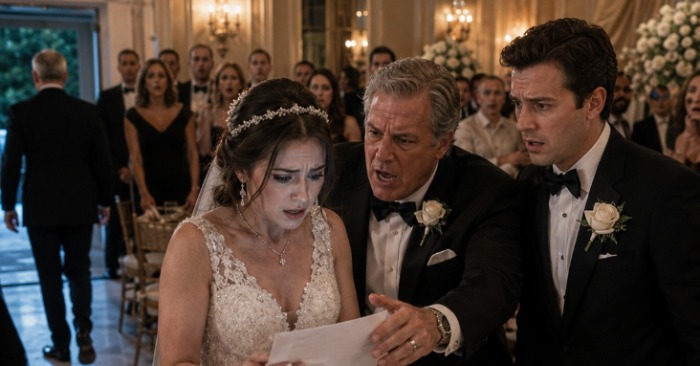
Derek stared at the deed as though the letters might rearrange themselves if he waited long enough.
They did not.
“Iris Holloway,” he repeated.
Melissa gave a nervous laugh.
“That cannot be right.”
I pulled out the chair at the end of the table and sat down.
“It is completely right.”
One of Melissa’s guests slowly lowered her champagne glass.
Derek looked at me.
“You told Mom the house was hers.”
“I bought it for her to live in.”
“That is not the same thing as owning it,” Melissa snapped.
“No,” I answered. “It is safer.”
Her expression hardened.
“Safer from whom?”
I looked directly at her.
The silence answered before I did.
My mother remained near the kitchen doorway, still holding the serving tray.
I stood again, crossed the room, and gently took it from her hands.
“Sit down, Mom.”
Melissa immediately objected.
“She agreed to serve dinner.”
My mother flinched.
That tiny movement was enough.
I placed the tray on the sideboard.
“No. She learned that refusing you came with consequences.”
Derek pushed back his chair.
“You cannot walk in after six years and pretend you understand this household.”
“I understand that Mom sleeps beside the laundry room.”
“She cannot safely use the stairs,” he said.
“Then why is your mother-in-law sleeping upstairs in the room Mom chose for herself?”
Darlene, who had remained silent until then, shifted uncomfortably.
Melissa folded her arms.
“My mother has back problems.”
“And my mother had knee surgery.”
No one responded.
I opened the yellow folder again.
“The deed is only the beginning.”
Derek’s eyes dropped toward the three sealed envelopes.
“What did you do?”
“I protected Mom.”
I placed the first document before her.
“The house is now held in a trust. Mom has the legal right to live here for the rest of her life.”
My mother stared at me.
“What does that mean?”
“It means no one can remove you, pressure you to leave, sell the house around you, or use your home as leverage.”
Tears gathered in her eyes.
Melissa shook her head.
“This is ridiculous. We were never forcing her out.”
I reached into my handbag and removed the senior-apartment application.
My mother’s handwritten answers filled every line.
A receipt for the deposit was stapled to the front.
I placed it beside Melissa’s plate.
“She was preparing to leave.”
Derek looked at Mom.
“You applied for an apartment?”
She lowered her eyes.
“I thought everyone might be happier.”
“You were going to abandon the house Iris gave you?” Melissa asked.
Mom’s face tightened.
“I was trying to stop being a burden.”
I turned toward Melissa.
“You convinced a woman living in her own home that she was a burden.”
“That is not fair.”
“Neither was taking six hundred dollars from her Social Security payment every month.”
Derek went still.
Melissa’s eyes narrowed.
“What are you talking about?”
I removed copies of the bank statements.
“Fourteen identical withdrawals. Always the day after her payment arrived.”
Derek looked at the figures.
His mouth opened, but no explanation came.
I continued.
“Eight thousand four hundred dollars.”
“It was for groceries,” he said finally.
“Then why was Mom buying groceries herself?”
No answer.
“And why does her credit card show almost four thousand dollars in restaurant, salon, boutique, and spa charges?”
Melissa glanced toward her guests.
“This is a private family matter.”
“You made it public when you invited people into my house and lied about owning it.”
The woman sitting beside Melissa slowly moved her chair away from her.
Melissa noticed.
Her face flushed.
“We took care of Ellen.”
I looked toward the black apron lying on the sideboard.
“You gave her a work schedule.”
“She needed structure.”
“She needed recovery.”
Derek slammed his palm against the table.
“Enough.”
The guests jumped.
He pointed toward the deed.
“You were not here.”
“I was paying Dad’s medical debt.”
“You chose to leave.”
“I chose the job that paid three times my Ohio salary so our family would not drown in debt.”
“You missed everything.”
“Yes.”
My voice remained calm, but my hands had begun to shake.
“I missed birthdays. Holidays. Aunt Ruth’s funeral. I lost a relationship. I worked nights in an intensive-care unit thousands of miles away.”
Derek looked down.
“I did all of that so Mom could have a safe home.”
I glanced toward the roses visible through the dark window.
“And while I was gone, you turned that home into a place she wanted to escape.”
No one spoke.
My mother began crying quietly.
Derek finally looked at her.
“Mom, why didn’t you tell me?”
She raised her eyes.
“I tried.”
His face changed.
“When?”
“The first time Melissa moved my clothes downstairs.”
Melissa interrupted.
“That was for safety.”
“The first time Darlene took my room.”
“She needed privacy.”
“The first time you used my bank card.”
Derek’s jaw tightened.
“You agreed to help us.”
“I agreed to groceries,” Mom said. “Not restaurants. Not salons. Not handbags.”
Melissa stood abruptly.
“This is humiliating.”
My mother looked at her with an expression I had not seen since returning.
Not fear.
Anger.
“You had me serve your friends while telling them this was your house.”
Melissa grabbed her handbag.
“I will not stay here and be attacked.”
“That brings us to the final documents,” I said.
She stopped.
I slid one sealed notice toward her.
Another toward Derek.
The third toward Darlene.
Derek stared at his name.
“What is this?”
“Formal withdrawal of permission to occupy the property.”
Melissa looked confused.
“Speak normally.”
“You have thirty days to leave.”
Her face went blank.
Then she laughed.
“You cannot evict family.”
“I am not removing family.”
I looked directly at her.
“I am removing people who exploited my mother.”
Derek rose slowly.
“Where are we supposed to go?”
“The same place you expected Mom to go.”
He looked toward the senior-apartment application.
His shoulders dropped.
“You planned all this before dinner.”
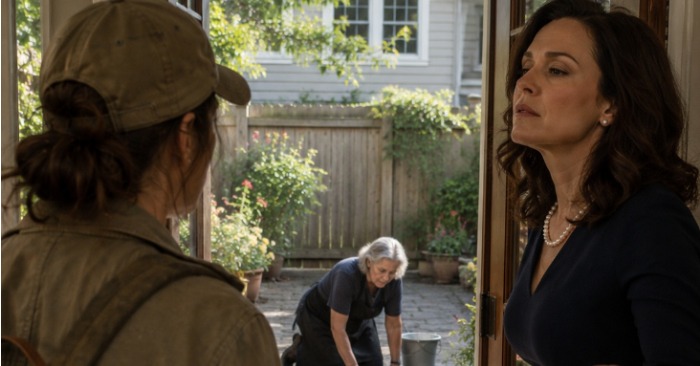
“I started planning when I found her scrubbing your patio.”
“It is not our patio,” one of the guests whispered.
Melissa turned sharply toward her.
The woman looked away.
Darlene quietly stood.
“I think I should pack.”
Melissa stared at her mother.
“You are taking her side?”
“I am taking the side that owns the house.”
Darlene left the room without another word.
The dinner ended almost immediately.
Guests murmured awkward goodbyes and hurried toward the door.
Within minutes, only our family remained.
The candles still burned.
Dessert sat untouched.
The house felt larger without the false laughter.
Derek sank back into his chair.
“I lost my job.”
“I know.”
“I was ashamed.”
“I know.”
“Melissa said we only needed time.”
“You had fourteen months.”
He rubbed both hands over his face.
“I did not know how bad things had become for Mom.”
“You did not want to know.”
That hurt him.
It was supposed to.
Not because I wanted revenge.
Because every excuse he made created another hiding place from the truth.
Melissa stood near the staircase.
“You have always thought you were better than us.”
“No,” I said. “I thought I could trust you.”
Her anger faltered.
“I sent money. I paid the mortgage. I paid Dad’s debt. I allowed you to stay here because you promised to care for Mom.”
I pointed toward the apron.
“You used my trust as free housing.”
Then I pointed toward my mother.
“And you used her love as free labor.”
Melissa had no answer.
Over the next thirty days, the house changed slowly.
Darlene left first.
Derek found a small rental apartment near Dayton.
Melissa stayed angry until the final morning.
She supervised the moving crew as though leaving were another injustice committed against her.
Before she stepped into the car, she turned toward Mom.
“You will regret choosing Iris over your son.”
Mom stood beside me on the porch.
For years, she had tried to keep peace by making herself smaller.
This time, she lifted her chin.
“I did not choose one child over another.”
She glanced toward the house.
“I chose to stop disappearing.”
Melissa drove away without replying.
Derek remained beside his car.
He looked toward me.
Then toward Mom.
“I am sorry.”
Mom’s expression softened, but she did not move toward him.
“For which part?”
He looked ashamed.
“All of it.”
“That is a beginning,” she said.
Not forgiveness.
Not yet.
But a beginning.
That autumn, we transformed the cramped downstairs room into a small reading room.
Mom returned to the bright bedroom upstairs.
A contractor installed a safer railing and a chair lift so her knee would not limit her.
We canceled the stolen credit card and disputed the charges we could prove were unauthorized.
The bank could not recover everything.
Derek eventually repaid part of the money through a written payment plan.
Some losses remained.
Trust was one of them.
One morning, I found Mom outside among the rose bushes.
She wore gardening gloves and a wide straw hat.
No black apron.
No schedule.
No one calling from inside for iced tea.
She touched a deep red rose and smiled.
“I thought I would only have two flowerpots.”
“You have twelve bushes.”
“Thirteen.”
I looked toward the newest plant beside the fence.
“When did that happen?”
“Yesterday.”
She smiled.
“I decided there was room for another.”
I stayed in Ohio.
Not because the six years overseas had meant nothing.
They had paid debts, purchased a home, and given my mother security.
But money could not replace presence forever.
I accepted a position at a hospital near Dayton and moved into a small apartment nearby.
Every Sunday, Mom and I ate lunch together.
Sometimes Derek joined us.
He came alone.
He listened more than he spoke.
Our family did not return to the way it had been.
Some relationships should not.
We built something slower.
More careful.
More honest.
The yellow folder remained in a locked cabinet in my mother’s room.
She once asked whether I planned to keep it forever.
“Yes.”
“Why?”
“Because people forget what documents remember.”
She laughed.
Then she looked around the sunny room and toward the roses outside.
For six years, I believed I was buying my mother a house.
I was wrong.
A house is only walls, wood, and legal ownership.
What she needed was a place where no one could make her earn the right to belong.
And sometimes the most important document on a dinner table is not the one proving who owns the property.
It is the one reminding everyone that kindness, sacrifice, and family should never be confused with permission to take control.