The door to my apartment creaked open just like always, but that afternoon, it sounded like something had broken in half. Maybe it was me. Maybe it was the life I had held together for years, with my back bent, my mouth shut, and the absurd habit of calling everything that destroyed me “love.”
I entered first, one hand clutching my right side, where the stitches pulled like the skin was still remembering that I’d been urgently cut open only five days earlier. The hallway smelled of old humidity, rancid oil, and warm beer. I still wore the loose clothes Jimena had brought me at the hospital: gray sweatpants, a black sweatshirt, my hair poorly tied up, and the pale look of someone who had stared too closely at the edge between life and never coming back.
Behind me was Ricardo, my supervisor, holding a bag with my medications and a small suitcase. He didn’t say anything as he entered. He didn’t need to. The apartment’s smell spoke for us.
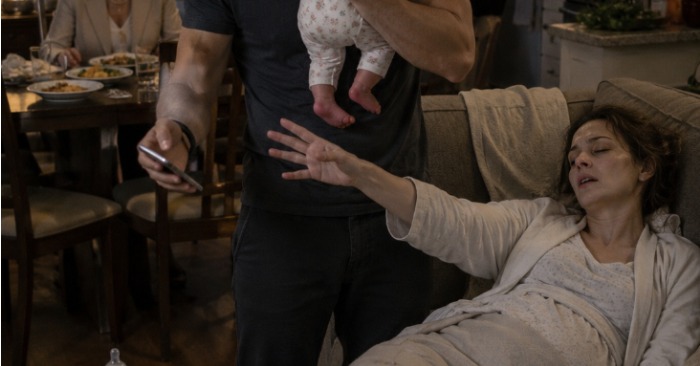
My brother Diego was lying on the couch, one leg hanging, the game controller in one hand and his phone in the other. The TV blared gossip about someone else’s infidelity, while on the coffee table were three empty beer cans, an open pizza box with one hardened slice, and two plates with dried sauce that seemed like part of the furniture. He didn’t even sit up when he saw me. He just turned his head, scanned me up and down, and casually said, in the tone of someone who thinks the world is there to serve him:
“Good thing you’re done pretending. Make dinner.”
It wasn’t the pain of the wound that took my breath away. It was that.
Five days in the hospital. Emergency surgery. Peritonitis. Drains. IVs. Antibiotics. The doctor staring me in the eyes the morning before to tell me, with a coldness only those who see death daily can have, that a few more hours without attention and the outcome would’ve been different. And the first thing my brother says when I come back is not “Are you okay?” or “Sorry,” or even “What happened?” It was an order. Make dinner.
I felt the door frame push back. I didn’t fall because I’d spent years training myself not to fall in front of them.
I took two steps inside, and then Diego’s eyes jumped over my shoulder.
He saw Ricardo.
I saw the exact moment his face drained of color. The arrogance that had been thrown at me for five years like kitchen garbage deflated in an instant. His back straightened. He lowered the controller. He adjusted his shirt. He even smiled. A quick, fake smile he always used when someone appeared in front of him whom he wanted to seem decent for.
“Oh… I didn’t know you had company,” he mumbled.
Ricardo closed the door behind us gently. He was wearing rolled-up sleeves, with a calm look, and that stillness some people have when they no longer need to prove authority because it comes naturally. He didn’t respond. He just scanned the apartment: the overflowing trash in the kitchen, the sticky floor, Diego’s clothes scattered across the hallway, the sour smell of chicken that had spoiled on the counter.
I was still standing with my hand on my side.
“Five days,” I said.
My own voice surprised me. It came out low, steady, clean. As if the pain had swept the fear inside me and left only a straight line.
Diego blinked.
“What?”
“Five days,” I repeated. “Five days, and you didn’t wash a single dish.”
The TV continued screaming. One of the hosts let out a loud laugh. Outside, in the building, someone slammed a door. Inside my home, for the first time in years, no one rushed to correct me, belittle me, or tell me I was exaggerating. Maybe because this time there was a witness. Maybe because this time I came back from the hospital, not from work. Maybe because almost dying ripped off the politeness.
I slowly walked into the kitchen. Every step tugged at my wound. The sink was filled with dishes caked in food. A pot blackened inside. A glass with a circle of sour milk at the bottom. The trash can open, overflowing with wrappers, peels, and used napkins. Near the fridge was the grocery bag I had left prepared before the pain doubled me over in the bathroom: soft vegetables, stiff tortillas, a pack of chicken draining in brown liquid.
My apartment smelled like the perfect portrait of what I had been to them: someone who cleaned, cooked, paid, and solved problems, whose absence was only noticed when the service was interrupted.
I turned to the living room.
Diego was still there, but he no longer seemed like the owner of the couch. He seemed like an intruder surprised in broad daylight.
“Sit down,” I said.
“Camila, you’re overreacting…”
“Sit down.”
I didn’t raise my voice. It wasn’t needed.
And something changed.
Maybe it was the tall, silent man standing by the door. Maybe it was that I wasn’t crying. Maybe it was that my stitched belly and swollen face made it impossible to pretend this was just a whim. But Diego obeyed.
He sat down.
That’s when I understood that some scenes split a story in two. Not because they’re the loudest, but because after them, you can’t call what you once tolerated normal anymore.
And mine began exactly at that moment: when I came back, stitched up and opened from the hospital, and the man who had lived off me for five years demanded dinner… until he saw who was behind me.