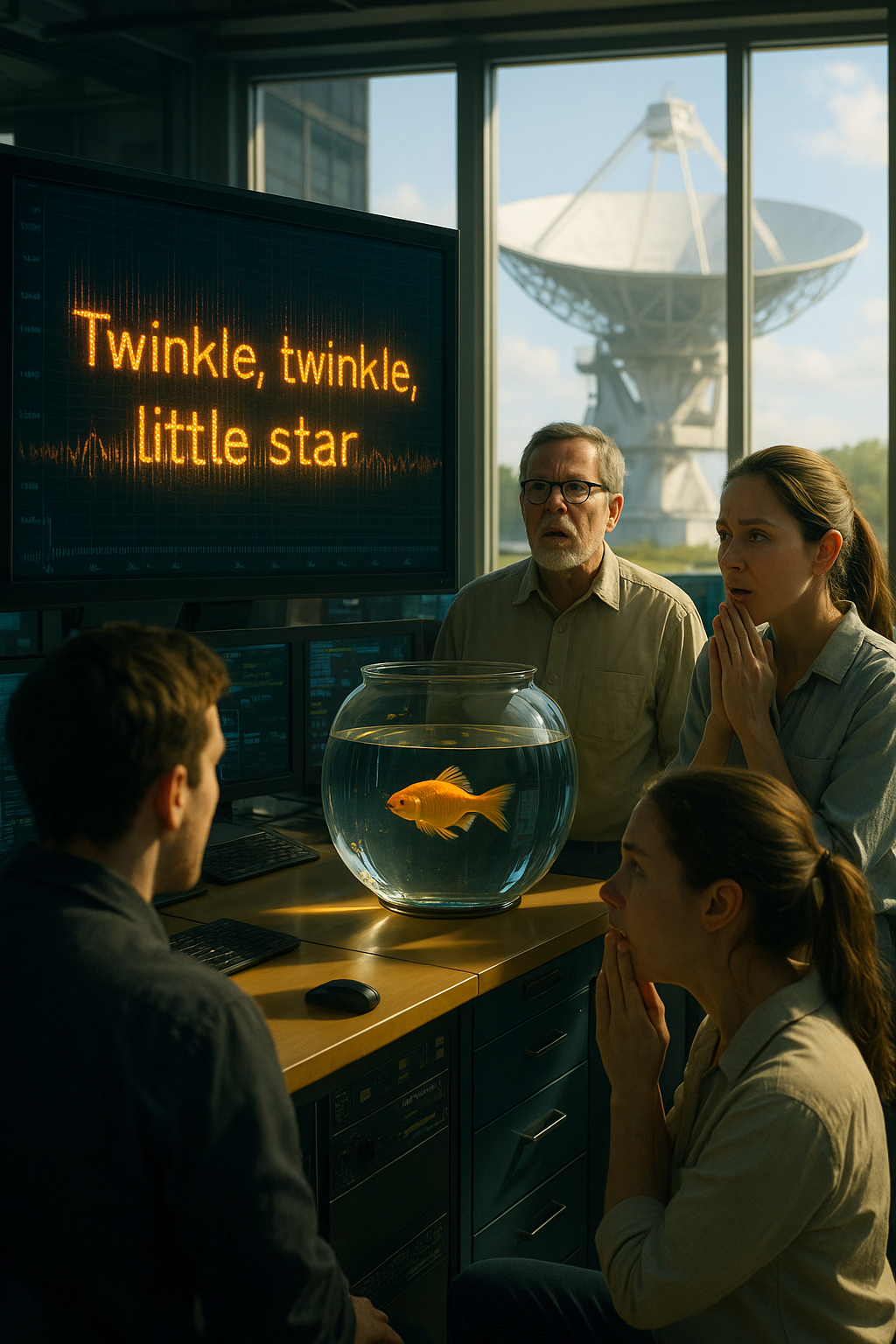
The radio telescope arrays had picked up strange bursts before — static, pulses, and coded messages that often turned out to be interference. But this one was different.
It came late one night, a clean signal, evenly spaced. At first, the team thought it was just another fast radio burst. Then the data translated into words. Simple, rhythmic, familiar words.
It was a nursery rhyme.
The computers spelled it out line by line, each phrase repeated in the same singsong pattern. One of the younger researchers whispered it aloud, pale-faced:
“Twinkle, twinkle, little star…”
The lab grew silent. How could a children’s rhyme be traveling through space?
They checked for pranks, hacked systems, interference from broadcasts. Nothing fit. The signal originated from well beyond the Milky Way, a distance so far that no human transmission could have carried it there.
And then the rhyme changed. It wasn’t the version they knew. The words twisted, lines rewritten. Instead of gentle verses about stars, the signal described falling skies, burning oceans, and children who “never wake.”
The astronomers recorded everything, but by dawn, the transmission cut off. When they reviewed the tapes, the first half of the rhyme was there, but the darker verses were gone — as if erased from the data. Only those in the room swore they’d heard it.
Now, every few months, the same signal returns. Always a nursery rhyme. Always ending differently.
And no one knows if the voice behind it is trying to soothe — or warn.