Calder Finch stepped out of a black SUV, carrying a thick cashmere coat.
At sixty-one, his silver hair and composed expression made him look naturally authoritative. But when he saw me trembling outside the mansion, his face darkened.
“Maeve! What on earth are you doing out here?”
He hurried over and wrapped the coat around my shoulders.
“How long have you been standing in this weather?”
“Long enough,” I whispered.
“Does Graham know you’re outside?”
I laughed bitterly.
“He helped his mother lock me out.”
Calder shook his head.
“Your father would have been furious.”
“He would have broken down the door,” I replied.
Calder guided me into the warm SUV, and we drove away.
I watched the mansion disappear behind us.
For three years, I’d convinced myself that love meant patience, sacrifice, and endless forgiveness.
I’d accepted humiliation because I was terrified of losing the family I’d finally found.
I met Graham Pritchard at a charity event in Boston.
He was handsome, confident, and charming. Unlike the wealthy businessmen I usually encountered, he spoke about ordinary things: family dinners, children, and building a happy home.
At the time, my company, Harborlight Collection, had become a multimillion-dollar hotel business.
Professionally, I had everything.
Personally, I felt terribly alone.
My parents had died when I was nine, leaving me with a lifelong fear of abandonment.
Graham seemed to offer the family I’d always wanted.
When he asked about my career, I told him I worked in hospitality management and investments.
I didn’t mention that I owned the company.
He never asked.
Before our wedding, I insisted on a prenuptial agreement.
Graham barely read it.
“I’m marrying you, sweetheart, not your money.”
I believed him.
A year later, I purchased a magnificent mansion through Kessler Residential Holdings, a company I’d established before our marriage.
Legally, the property belonged entirely to my company.
Graham had no ownership rights.
Nevertheless, I allowed him to treat it as his home.
Soon, he began telling friends that he’d bought the mansion himself.
I never corrected him.
I thought protecting his pride was part of being a good wife.
Then his family moved in.
His parents, Judith and Leonard, claimed they were having financial difficulties.
His sister, Brielle, arrived for a temporary visit and never left.
Gradually, I became a stranger in my own home.
Judith controlled the kitchen.
Brielle borrowed my belongings without permission.
Graham expected me to satisfy every demand.
I paid the bills, maintained the property, and financed their expensive lifestyles.
Yet they treated me like an unpaid servant.
On New Year’s Eve, Judith demanded an elaborate feast featuring twenty-eight dishes.
“A proper wife knows how to entertain her husband’s family,” she announced.
I suggested hiring professional caterers.
She refused.
So I started cooking at four in the morning.
For eighteen exhausting hours, I prepared meat, seafood, vegetables, desserts, and everything else she requested.
Around noon, Judith entered the kitchen wearing a silk robe.
“Goodness, Maeve. You smell like a dishwasher.”
Brielle examined the crab cakes.
“These don’t look expensive enough for my friends.”
When Graham appeared, I hoped he would defend me.
Instead, he complained.
“Mom’s right. Clean yourself up before the guests arrive. This kitchen smells like a cheap restaurant.”
Judith laughed.
I stood there wondering what had happened to the considerate man I’d married.
By late evening, the feast was finally ready.
I hadn’t eaten properly all day.
Just as I sat down, Judith ordered me to take out the garbage.
“Could it wait until after dinner?” I asked.
Graham snapped.
“Stop disrespecting my mother!”
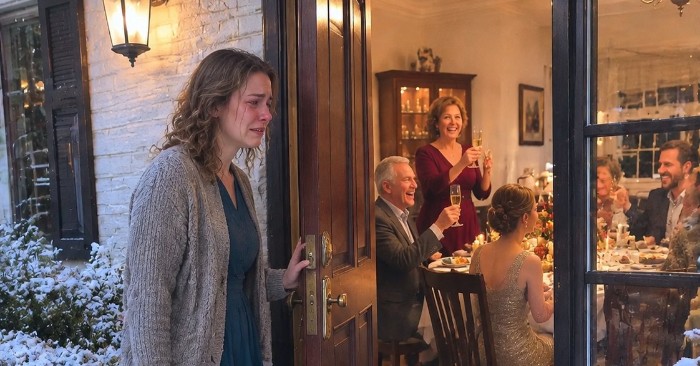
Shortly afterward, I found myself outside wearing thin pajamas and slippers.
The electronic lock clicked behind me.
I tried opening the door.
Nothing.
Through the glass, I saw Graham holding a champagne glass beside his mother.
“Graham! Open the door!”
He looked at me without moving.
“Go find yourself a cheap motel. Maybe you’ll learn some respect.”
Judith laughed.
Then they returned to their celebration.
I stood in the forty-one-degree weather, shaking with cold.
What they didn’t know was that I owned the mansion, paid every household bill, and controlled the credit cards they used so freely.
And I was finally finished supporting them.
Calder, my longtime business adviser, arrived with three black SUVs.
He brought me to the Alder Grand, the flagship hotel of Harborlight Collection.
My hotel.
The general manager, Simone Ellis, greeted me discreetly.
“Your suite is ready, Ms. Kessler.”
She noticed my slippers but asked no questions.
That simple kindness nearly made me cry.
Upstairs, I showered, changed into warm clothes, and sat beside the fireplace.
Then Graham sent a message.
Mom says you embarrassed everyone. Don’t come home tonight. We’ll discuss your behavior after New Year’s.
I read it twice.
Then I opened my banking application.
Graham, Judith, and Brielle each had additional credit cards connected to my account.
Together, they’d spent more than $280,000 during the previous year.
I’d paid every bill.
One by one, I suspended their cards.
Then I canceled their personal allowances.
Their own bank accounts remained untouched.
But my money would no longer finance their extravagance.
I also removed their administrative access to the mansion’s management system, leaving essential services and normal entry functions operational.
I wasn’t trying to endanger anyone.
I simply wanted them to understand that enjoying a luxurious home didn’t mean owning it.
Minutes before midnight, Graham texted again.
What’s the wine cellar password? Mom wants another bottle.
I ignored him.
As fireworks illuminated Boston Harbor, I raised my glass.
“Happy New Year, Mom and Dad.”
For the first time in years, I felt free.
Then Graham began calling.
By his seventh attempt, he’d left an angry voicemail.
“Maeve, my credit card isn’t working! Mom’s isn’t either! Fix this immediately!”
I deleted it.
A few minutes later, Calder knocked on my suite door.
He was carrying a leather folder.
“Maeve, there’s something else you need to see.”
He’d been investigating a suspicious business loan Graham had requested months earlier.
My husband had borrowed $120,000, claiming he needed the money for an investment opportunity.
I’d agreed because I wanted to support him.
Now Calder showed me photographs.
In the first, Graham stood outside an expensive condominium with a blonde woman in a red coat.
In another, they were kissing beside a Mercedes.
A third showed him carrying luxury shopping bags into her apartment.
I recognized the expensive watch on his wrist.
It was my anniversary gift to him.
“Who is she?” I asked.
“Vanessa Marlowe. She used to work as a marketing consultant for Westbridge Interiors.”
That was Graham’s employer.
Calder explained that the supposed investment company was registered in Vanessa’s name.
Its official address was her condominium.
There were no meaningful business operations or confirmed contracts.
Instead, the money appeared to have funded luxury purchases, apartment expenses, and expensive trips.
For months, Graham had claimed he was working late to secure our future.
Apparently, he’d been building another future with someone else.
“Does his mother know?” I asked.
“We haven’t confirmed that.”
I closed the folder.
Strangely, I didn’t cry.
I felt completely calm.
“Contact Nora Bellamy tomorrow,” I told Calder.
“Your attorney?”
“Yes. I’m filing for divorce.”
“And the loan?”
“We’ll recover whatever we legally can.”
Calder studied me.
“Are you certain?”
“My husband used my money to support another woman, then locked me outside my own home while enjoying the dinner I’d spent all day preparing.”
I looked at him.
“What exactly is left to save?”
By the following morning, Graham had called twenty-three times.
Judith had called eleven.
Brielle had sent seventeen messages.
Her latest complained that her credit card wasn’t working and she might miss the holiday sales.
I blocked her.
Then I enjoyed breakfast overlooking the harbor.
For once, nobody criticized the food.
Later, Graham sent another message.
My relatives are coming for lunch. The kitchen is a mess. Come home and clean it.
He hadn’t asked whether I was safe.
He hadn’t apologized.
He hadn’t even wondered where I’d slept.
He simply wanted his servant back.
That morning, Nora Bellamy arrived.
She’d handled my business legal affairs for nearly a decade.
After reviewing the evidence, she explained our options.
The mansion belonged to my company, but Graham and his relatives had occupancy rights that needed to be respected.
We would propose a voluntary move-out agreement and pursue legal procedures if necessary.
The prenuptial agreement also provided substantial protection for my premarital assets.
Nora prepared the initial divorce documents.
I signed them.
Then I asked Calder to arrange the vehicles.
It was time to return home.
Shortly after noon, three black SUVs entered Briar Hollow Estates.
Several of Graham’s relatives were gathered outside the mansion.
Judith was loudly complaining.
“That woman has lost her mind! She disappeared because I asked her to take out the trash!”
Graham nodded.
“She abandoned us.”
Then I stepped out of the SUV.
I wore an ivory pantsuit and a camel-colored coat.
Calder followed with my briefcase.
Nora emerged from the next vehicle.
Everyone stopped talking.
Judith stared.
“Maeve? Where did those cars come from?”
“They’re company vehicles.”
“What company?” Graham demanded.
“My company.”
He laughed nervously.
Nora stepped forward.
“I’m Nora Bellamy, legal counsel for Ms. Kessler and Kessler Residential Holdings.”
Judith frowned.
“What is Kessler Residential Holdings?”
“The company that owns this mansion.”
Graham’s uncle Russell turned toward him.
“I thought you bought this house.”
“I did,” Graham insisted.
“No,” I replied. “You didn’t.”
Nora produced certified property documents.
She explained that I’d purchased the mansion through a company established before my marriage.
Graham had no ownership interest.
The driveway fell silent.
“You told everyone you’d spent nearly four million dollars on this place!” Russell exclaimed.
Graham couldn’t answer.
Judith looked furious.
“So what are you supposed to be? Some secret millionaire?”
Calder opened my corporate profile on his tablet.
Nora answered.
“Ms. Kessler founded Harborlight Collection and remains its majority owner.”
Graham stared at the screen.
“The hotel company?”
“Yes.”
“The company that owns the Alder Grand?”
“Among several other properties.”
Judith grabbed the porch railing.
Russell shook his head in disbelief.
“You mean Graham’s wife owns that hotel empire?”
Nora nodded.
Brielle glanced at her designer handbag.
For once, she had nothing insulting to say.
But Nora wasn’t finished.
She opened another folder.
“These documents concern Mr. Pritchard’s personal loan.”
Graham immediately looked nervous.
“Maeve, can we discuss this privately?”
I raised an eyebrow.
“Last night, you had no problem humiliating me in front of your family.”
Judith interrupted.
“A good wife supports her husband!”
“I did,” I replied. “With $120,000.”
Russell looked confused.
I explained that Graham had borrowed the money for a supposed business venture.
The company belonged to Vanessa Marlowe.
Brielle suddenly looked uncomfortable.
“Do you know her?” I asked.
“No!” she answered too quickly.
Judith turned toward Graham.
“Who’s Vanessa?”
“A business consultant,” he muttered.
I showed him a photograph of himself kissing her.
“Do your business consultants usually kiss you outside their apartments?”
His face hardened.
“You had me investigated?”
“I investigated where my money went.”
Judith suddenly shouted.
“Maybe if you’d treated my son better, he wouldn’t have needed another woman!”
Everyone froze.
Even Brielle looked horrified.
I stared at Judith.
“Thank you.”
She blinked.
“For what?”
“For finally showing everyone exactly what you’ve taught your son.”
Graham tried to silence his mother.
But I continued.
“Yesterday, I spent eighteen hours preparing your celebration. You insulted me, criticized everything I cooked, and locked me outside in the cold.”
Graham lowered his head.
“Maeve, I made a mistake.”
“A mistake is forgetting groceries,” I replied. “You spent months lying to me.”
Russell demanded an explanation.
Graham remained silent.
That was enough.
His aunt Diane picked up her handbag.
“We’re leaving.”
Judith protested.
“You’re turning your backs on family?”
Diane looked at her.
“Being family doesn’t mean we have to excuse cruelty.”
One by one, the relatives departed.
Nobody stayed for lunch.
Nobody admired the mansion.
The house Graham had used to impress everyone had become the setting for his humiliation.
Nora handed him an envelope.
“These are preliminary divorce papers and a proposed separation agreement. Have your attorney review them.”
Graham stared.
“Divorce?”
“Yes,” I replied.
“No. We’re not getting divorced!”
“You don’t get to decide whether I remain your wife.”
He began pleading.
“Maeve, we can fix this!”
“Can you give me back the years I spent trying to please your mother? Can you undo last night? Can you explain why you borrowed my money to support another woman?”
His eyes filled with tears.
“I was insecure,” he admitted. “You were so successful. I never felt good enough.”
“So you decided to make me feel worthless?”
He covered his face.
Nora explained that we were proposing a voluntary departure within twenty-one days.
If they refused, we would follow the appropriate legal process.
Judith gasped.
“You’re evicting us?”
“I’m ending an arrangement you’ve abused for years.”
Leonard finally spoke.
“Where are we supposed to live?”
“You have retirement income. Graham has a salary. Brielle can work. You’ll have to make your own arrangements.”
Brielle began crying.
“But I have no savings!”
“You spent almost $38,000 on shopping and entertainment last year using my credit card.”
“Those were gifts!”
“Then keep them. I’m not asking for anything back. But I won’t pay for more.”
Graham stepped forward.
“What about my Mercedes?”
“It’s leased through my company. We’ll arrange its return according to the agreement.”
He looked devastated.
“Please don’t leave me.”
I glanced toward the oak front door.
Only hours earlier, I’d been standing outside it, freezing.
“Last night, you told me to find a cheap motel. You didn’t care whether I had somewhere safe to sleep.”
Tears rolled down his cheeks.
“Maeve, please.”
I stepped back.
“You abandoned our marriage long before I walked away from that door.”
Then I turned to Calder.
“Take me back to the hotel.”
As I approached the SUV, an urgent email arrived.
It was from the compliance director at Westbridge Interiors.
The subject concerned internal audit findings involving Graham.
My husband thought losing access to my money was his greatest problem.
He had no idea what his employer had discovered.
After New Year’s, Graham arrived at Westbridge wearing his expensive suit and luxury watch.
He still believed he was one of the company’s most important executives.
What he didn’t know was that Harborlight Collection had recently acquired Westbridge’s financially troubled parent company.
The acquisition had been negotiated for months and had nothing to do with punishing him.
But it triggered an independent audit.
The auditors discovered serious irregularities in Graham’s department.
Some reported sales lacked signed contracts.
Several supposedly secured accounts had never resulted in actual agreements.
Certain expenses were improperly documented.
Most troubling was a consulting arrangement involving Meridian Concept Partners.
Vanessa’s company.
I’d instructed the compliance team to investigate independently and give everyone involved an opportunity to respond.
I wouldn’t use my position for revenge.
But I wouldn’t protect Graham from legitimate consequences either.
He was summoned to a meeting with management, human resources, and compliance representatives.
They informed him that he was being placed on administrative leave.
According to the report I later received, he became furious.
“I’ve brought millions into this company!”
The interim president placed documents before him.
“Then perhaps you can explain why several of your reported contracts don’t exist.”
Graham threatened legal action.
Then he demanded to meet the new majority owner.
Someone handed him an organizational chart.
At the top was my photograph.
Beneath it were my name and title: Founder and Chief Executive Officer of Harborlight Collection.
Graham stared.
“That’s my wife.”
Nobody responded.
“She owns this company?”
“Harborlight owns our parent organization,” the interim president explained.
Graham sank into his chair.
For years, he’d pretended to be a wealthy businessman supporting an ordinary working wife.
Now he discovered that the woman he’d treated as insignificant was one of the most successful people in his industry.
He left the meeting without another word.
But Judith wasn’t ready to surrender.
A few days later, Calder entered my office.
“Maeve, there’s a situation outside.”
“What happened?”
“Graham and his family are protesting in front of headquarters.”
I stared at him.
“Protesting what?”
“Apparently, your cruelty.”
He showed me a livestream.
Judith stood outside holding a sign accusing me of stealing her son’s home.
Brielle was filming.
Leonard looked uncomfortable.
Graham addressed a small crowd.
“My wife is using her wealth to destroy an innocent family!”
Judith began crying dramatically.
“We treated her like our own daughter!”
I almost spilled my coffee.
“She locked me outside in freezing weather,” I reminded Calder.
He nodded.
“The irony is remarkable.”
Their accusations spread online.
Some people criticized me without knowing the facts.
Reporters began contacting our communications department.
Nora advised me not to release private financial information or photographs of Vanessa.
Instead, we would respond using evidence we could legally disclose.
At noon, I walked outside with Nora and Calder.
Graham looked relieved when he saw me.
He apparently believed the publicity had forced me to negotiate.
I stepped toward the microphones.
“Good afternoon. My husband and his relatives have made several serious accusations about me.”
Judith shouted.
“Tell everyone how you stole our home!”
“Judith, the ownership records are public.”
A reporter asked whether I intended to make the family homeless.
“We’ve offered a voluntary departure agreement and will follow all applicable legal procedures. Nobody has been unlawfully locked out or deprived of essential services.”
Another reporter asked what happened on New Year’s Eve.
I looked into the camera.
“I spent eighteen hours preparing twenty-eight dishes for my husband’s family. Later, my mother-in-law locked me outside in forty-one-degree weather while I was wearing pajamas. My husband refused to let me back inside.”
The crowd became quiet.
Judith shouted that I was lying.
Nora explained that relevant security footage and messages had been preserved for legal proceedings.
Then I read Graham’s message aloud.
Mom says you embarrassed everyone. Don’t come back tonight.
I continued with his next message.
What’s the wine cellar password? Mom wants another bottle.
A reporter turned toward Graham.
“Did you send those?”
He stared at the pavement.
Judith grabbed his arm.
“Don’t answer!”
But Brielle had made an even bigger mistake.
During the celebration, she’d uploaded a public video showing Judith laughing about locking me outside.
Someone found it.
Within minutes, the recording was circulating again.
In the video, Judith raised her champagne glass.
“Tonight is for real family! Outsiders don’t belong at our table!”
Graham’s voice could be heard agreeing.
Then Brielle laughed.
“Maybe she’ll finally understand who’s in charge!”
A reporter played the video aloud.
Judith’s expression changed from anger to panic.
“Delete it!” she shouted at Brielle.
“Mom, it’s already everywhere!”
I returned to the microphone.
“I won’t discuss private marital accusations publicly. Those matters belong with our attorneys.”
Then I looked toward Graham.
“But I will say this: generosity isn’t permission to mistreat someone. Marriage doesn’t give one person ownership over another. And dignity should never depend on wealth.”
I turned to leave.
Graham hurried after me.
“Maeve, please. If you don’t cancel the divorce, my parents could lose everything.”
And suddenly, I understood.
Even now, he wasn’t asking whether he’d hurt me.
He wasn’t concerned about my suffering.
He simply wanted me to rescue him again.
“No, Graham. You and your family will have to learn to live without my money.”
I walked inside.
Behind me, Judith continued protesting.
Brielle was crying.
Graham stood beneath the glass headquarters, finally realizing how much of his luxurious lifestyle I’d financed.
The following months brought legal proceedings, investigations, and difficult decisions.
Eighteen days after New Year’s Eve, Graham and his family moved out of the mansion under a voluntary agreement.
Nobody forcibly removed them.
They packed their belongings and returned the company-leased Mercedes.
Judith cried throughout the move.
But I didn’t change my mind.
Graham rented a modest apartment outside Boston.
His parents temporarily moved in with him.
Brielle found a job selling furniture after realizing her designer clothes couldn’t pay her bills.
Their lives had changed dramatically.
But they still had the ability to rebuild.
What they no longer had was unlimited access to my money.
The investigation at Westbridge eventually concluded.
It documented repeated expense-policy violations and significant inaccuracies in Graham’s sales reports.
After receiving an opportunity to respond, he was dismissed.
Separately, Nora pursued repayment of the $120,000 loan.
Graham’s attorney initially argued that the money had been a gift.
But we had a signed agreement, transfer records, and a repayment schedule.
After months of negotiations, Graham agreed to a structured settlement.
The money didn’t return overnight.
There was no miraculous courtroom victory.
But he finally had to take responsibility for his decisions.
I later heard that Vanessa had ended their relationship after his financial problems became public.
Apparently, their romance hadn’t survived the loss of his expensive lifestyle.
I didn’t celebrate.
I was simply relieved that his lies were no longer my problem.
Our divorce was finalized in September.
The prenuptial agreement and ownership records protected my principal business assets.
The remaining marital matters were settled through negotiations.
When I left the courthouse, Calder was waiting beside the car.
“How do you feel?” he asked.
“Strange.”
“Sad?”
“A little.”
He nodded.
“That’s understandable.”
I looked back at the courthouse.
“I spent years trying to make those people love me. Somewhere along the way, I forgot how to enjoy my own life.”
Calder opened the car door.
“Your parents would have wanted you to be happy.”
I looked at him.
“Do you really think so?”
“I knew them well, Maeve. Your father admired your intelligence, and your mother loved your compassion.”
He smiled.
“Neither would have wanted you to believe that being kind meant allowing others to destroy you.”
I climbed into the car.
And finally, I cried.
Not because I wanted Graham back.
Not because I regretted the divorce.
I cried for the frightened little girl I’d once been.
The child who stood at her parents’ funeral, terrified she’d never belong to another family.
That fear had followed me for twenty-six years.
It was why I’d tolerated Judith.
Why I’d made excuses for Graham.
Why I’d kept paying for people who rarely cared about my happiness.
I’d been so afraid of losing another family that I’d lost myself trying to keep one.
But love shouldn’t demand the surrender of dignity.
And belonging shouldn’t require begging for a place at your own table.
The following spring, I sold the Briar Hollow mansion.
It was beautiful, but every room held painful memories.
Instead, I bought a smaller waterfront home outside Boston.
It had large windows, a comfortable kitchen, a stone fireplace, and a wooden dining table with twelve seats.
There were no extravagant chandeliers.
No decorations chosen to impress strangers.
Everything reflected my own taste.
I began spending more time with friends.
I traveled without constantly checking work emails.
I finally allowed myself to rest.
I also joined a grief support group and began speaking openly about losing my parents.
Understanding that old pain helped me understand why I’d tolerated so much as an adult.
Through Harborlight Collection, I established a program providing temporary hotel accommodation for families facing unexpected housing emergencies.
During its first winter, the program arranged hundreds of emergency overnight stays.
I didn’t create it to embarrass Graham.
I created it because I remembered standing outside that locked door.
The cold against my skin.
The terrible feeling of being unwanted.
I wanted fewer people to experience that helplessness.
Exactly one year after Judith locked me outside, I hosted another New Year’s Eve celebration.
This time, I invited people who genuinely cared about me.
Calder arrived with his wife.
Nora brought her husband.
Simone, the Alder Grand’s general manager, came with her family.
My closest friends arrived carrying flowers, desserts, and wine.
Professional caterers prepared the dinner.
They were paid generously and finished early enough to celebrate with their own families.
There were twenty-eight dishes again.
Roasted turkey.
Prime rib.
Crab cakes.
Baked salmon.
Macaroni and cheese.
Garlic mashed potatoes.
Honey-glazed carrots.
Apple pie.
Chocolate cake.
And enough wonderful food to fill the entire table.
But unlike the previous year, I hadn’t spent eighteen hours exhausting myself in the kitchen.
I’d spent the afternoon laughing with friends.
Shortly before midnight, Calder approached me beside the fireplace.
“Maeve, there’s something I should tell you.”
“What is it?”
“It’s about Graham.”
My chest tightened slightly.
“He sent a letter through his attorney. It’s a personal apology, not a legal demand.”
Calder handed me an envelope.
I recognized Graham’s handwriting immediately.
Maeve,
I know I have no right to expect an answer.
I’ve spent the past year thinking about everything I did.
I resented your success because I couldn’t accept my own insecurity.
I allowed my mother to humiliate you because defending you would have meant confronting her.
I convinced myself that your money made me important. Eventually, I believed I deserved everything you gave me.
The night we locked you outside, I knew how cold it was.
I knew you weren’t wearing a coat.
I knew you’d spent the entire day cooking.
And I still chose to shut the door.
There is no excuse.
I finally understand that you weren’t trying to control us with money.
You were trying to feel loved.
I’m sorry I made you believe you had to earn that love.
I don’t expect forgiveness.
I only wanted you to know that I understand what I destroyed.
Graham.
I read the letter slowly.
Then I folded it and returned it to the envelope.
Calder watched me.
“Would you like to answer?”
I shook my head.
“No.”
“Are you still angry?”
I thought for a moment.
“Not anymore.”
“Then why not respond?”
I looked toward the dining room.
My friends were laughing around the table.
Someone was telling a terrible joke.
Nora and Simone were arranging champagne glasses.
The fireplace crackled behind us.
“Because I don’t need Graham to understand me anymore.”
Calder smiled.
“That’s a good answer.”
A few minutes before midnight, everyone gathered near the windows.
Boston Harbor shimmered beneath the night sky.
I raised my glass.
“Before we begin the countdown, I’d like to say something.”
The room became quiet.
“One year ago, I believed I’d lost my family.”
I paused.
“I thought being rejected by people I loved meant there was something wrong with me.”
Nora squeezed my hand.
“But this year taught me something important.”
I looked around at the familiar faces.
“Family isn’t simply about blood or marriage. It’s about people who welcome you without demanding that you make yourself smaller to deserve their love.”
Calder raised his glass.
“I’ll drink to that.”
Everyone smiled.
“Here’s to the people who stand beside us when we need them. To kindness that doesn’t depend on what we can provide. And to remembering that generosity never obligates us to accept cruelty.”
“Cheers!” Simone called.
Our glasses touched.
Then the countdown began.
“Ten!”
“Nine!”
“Eight!”
I remembered Judith laughing behind the locked door.
“Seven!”
“Six!”
I remembered Graham telling me to find a cheap motel.
“Five!”
“Four!”
I remembered the black SUVs arriving to take me away.
“Three!”
“Two!”
I looked at the smiling faces around me.
“One!”
“HAPPY NEW YEAR!”
Fireworks exploded above the harbor.
Everyone cheered.
Music filled the room.
Calder embraced me.
Nora laughed when someone accidentally spilled champagne.
And for the first time in years, I didn’t feel the need to prove my usefulness before allowing myself to be happy.
Later that night, I stepped onto the covered terrace.
The winter air was cold.
Almost as cold as the night Judith had locked me outside.
But this time, I wore a warm coat.
This time, I’d chosen to step outside.
And this time, the door behind me remained open.
Through the windows, I watched my friends laughing around the table.
Twenty-eight beautiful dishes.
Twelve comfortable seats.
Not one person questioning whether I belonged.
I looked toward the stars.
“Happy New Year, Mom.”
I smiled.
“Happy New Year, Dad.”
Then I walked back into my warm home.
Because I’d finally understood that the greatest revenge wasn’t watching Graham lose his wealth, his career, or the lifestyle I’d provided.
It wasn’t seeing Judith leave the mansion.
It wasn’t the public embarrassment or the financial settlement.
The greatest revenge was realizing I could walk away from people who treated me as worthless and still have everything that mattered.
I’d lost a husband.
I’d lost the family I’d desperately wanted.
But I’d found something far more valuable.
My dignity.
My freedom.
And a life that finally belonged to me.