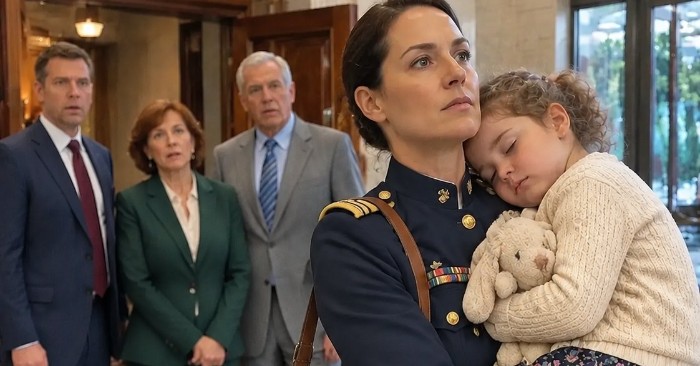
My mother-in-law couldn’t hide her amusement when I entered divorce court without an attorney. My husband sat confidently beside his wealthy family and three expensive lawyers, convinced that he had already taken everything from me. None of them knew what I had prepared. When I finally stood before the judge in my Army dress uniform, their smug expressions began to disappear. By the end of the hearing, their entire version of our marriage had fallen apart.
My mother-in-law’s laughter was the first thing I heard when I entered the courtroom.
She wasn’t trying to hide it. She noticed immediately that I had arrived without a lawyer and made sure everyone around her understood how ridiculous she thought I looked.
Across the room, my husband sat comfortably beside three attorneys dressed in expensive suits. He exchanged a satisfied glance with his mother, clearly convinced that the hearing would be nothing more than a formality.
His father sat in the front row, smiling as though the family had already completed a successful business deal.
I placed my leather briefcase on the empty table and straightened my Army dress uniform. My captain’s insignia was perfectly positioned, and my military commendation medal rested above my pocket.
I hadn’t worn the uniform to impress anyone. I needed the reminder of the discipline, confidence, and integrity that had carried me through difficult situations before.
My mother-in-law leaned toward her son and whispered loudly, “Is she attending a costume party?”
My husband smirked.
“She doesn’t even have a lawyer,” she continued. “She’s practically handing everything over.”
I ignored them and concentrated on the courtroom.
Their table was covered with legal documents, organized folders, and expensive briefcases. Mine held a single case and several carefully prepared exhibits.
They believed that having more lawyers meant having a stronger case.
They had no idea how thoroughly I had prepared.
What my husband and his relatives had never bothered to understand was that I had previously served as a United States Army captain specializing in military law.
My legal qualifications were still valid, and I remained licensed to practice in Pennsylvania.
The bailiff announced the beginning of the hearing.
Judge Lang entered, examined the documents, and looked toward both tables.
“Mrs. Kessler, are you representing yourself?”
My husband’s senior attorney watched me with an expression suggesting that I was making a serious mistake.
“Yes, Your Honor,” I answered. “I’m also a licensed attorney in Pennsylvania and have previously practiced military law.”
The courtroom immediately became quiet.
My husband’s confident expression changed, and his mother stopped smiling.
The judge nodded.
“Very well. Let’s proceed.”
I opened my briefcase and reached for the first folder.
But before presenting my evidence, I remembered the morning when everything had started to fall apart.
Three weeks earlier, my husband had entered our kitchen wearing his expensive business suit and carrying a thick envelope.
Our five-year-old daughter was upstairs playing with her toys.
I was drinking coffee when he placed the envelope beside me.
“I’ve decided we’re getting divorced,” he announced. “Everything has already been prepared. You only need to sign.”
I waited for an explanation.
Instead, he checked his phone as though the conversation were an insignificant interruption.
“After seven years together, this is how you’re telling me?” I asked.
He barely looked up.
“We’ve grown apart. There’s no reason to make things difficult.”
His voice was cold and businesslike.
I opened the settlement documents and immediately understood what he wanted.
He intended to keep our marital home, every investment account, and the technology company we had built together.
I would receive a small payment and my personal belongings.
It was an arrangement designed to erase my financial and professional contributions completely.
“Are you saying I contributed nothing to our marriage?” I asked.
“That’s not what I’m saying.”
“Then explain why this agreement treats me as though I contributed nothing.”
He dismissed my concerns.
“The business belongs to me. I built it, and my attorneys believe this is a generous offer.”
“Your attorneys prepared it,” I reminded him.
He laughed.
“You don’t even have a lawyer. Sign the papers, accept the money, and let’s move on.”
I closed the envelope.
“And if I refuse?”
His expression hardened.
“Don’t turn this into a war. Think about our daughter.”
Hearing him use our little girl as leverage made me realize how much had changed.
She was only five years old, yet he was already treating her future as another bargaining tool.
“I’ll read everything carefully,” I replied.
“There is nothing to read. Just sign.”
I refused.
He grabbed his keys and left for another meeting.
Afterward, I sat alone at the kitchen table, trying to understand how the man I had married could treat seven years of our shared life as something he could simply erase.
Our relationship had been deteriorating for months.
He frequently returned home late, avoided discussing the company, and became irritated whenever I questioned his decisions.
Still, none of that justified taking everything we had built together.
“Mommy?”
I looked toward the doorway.
Our daughter stood there wearing dinosaur pajamas and holding her favorite stuffed rabbit.
“Daddy left without saying goodbye.”
“He had somewhere to be, sweetheart.”
She climbed onto the chair beside me and asked whether she could have her favorite cereal.
I prepared breakfast, listened to her stories, and helped her get ready for the day.
I kept my expression cheerful because she deserved to enjoy her childhood without carrying the weight of our problems.
Later, I went upstairs and opened an old closet.
Behind several winter coats was a garment bag I hadn’t touched in years.
Inside was my Army dress uniform.
Seeing it brought back memories of the woman I had been before becoming a wife and mother.
I had served as a military lawyer, handling complicated cases and preparing arguments that required patience, precision, and careful attention to evidence.
Although I had left active service, I had maintained my professional qualifications and Reserve commission.
My husband had once promised that we would build a comfortable family life together. I had willingly adjusted my career to make that possible.
I never imagined he would eventually use my decision to step away from daily military service as evidence that I had accomplished nothing.
There was another important part of our history he had conveniently forgotten.
His technology company had originally started in our second bedroom.
Eight years earlier, he had approached me with an idea for a business.
I believed in him and decided to support the project financially.
When I left active duty, my separation payment and withdrawn retirement savings amounted to approximately 210,000 dollars.
I provided that money as startup financing through a formal loan agreement that my husband signed.
I also prepared the company’s founding documents.
Our original operating agreement identified me as a founding member with a 45 percent ownership interest.
I wrote the first contracts, negotiated the initial three client agreements, and spent two years working without a salary.
Much of that work happened late at night after our daughter had fallen asleep.
I remembered sitting beside my husband at our dining table, helping him prepare presentations and reviewing agreements before important meetings.
At the time, he regularly referred to the business as something we were building together.
But once the company became successful, his version of its history began changing.
He started calling it his business.
The small bedroom where we had worked became a fictional garage in his interviews and presentations.
My financial contribution was gradually described as something he had achieved entirely through his own determination.
When I confronted him, he simply shrugged.
“Everyone makes their success story sound better. It’s marketing.”
“You’ve managed to remove me from the entire story,” I replied.
He kissed my forehead and told me I knew how important I was to him.
I wanted to believe him.
His parents, however, had always treated me as though I were fortunate merely to be married into their family.
My mother-in-law frequently made insulting remarks disguised as helpful advice.
One evening, while I was preparing food for a family gathering, she commented that her son provided everything I needed.
I calmly reminded her that marriage was supposed to involve mutual support.
She smiled condescendingly and changed the subject.
At another family dinner, my father-in-law announced that plenty of women would happily marry into a family like theirs.
My husband never defended me.
Instead, I was repeatedly told that I should avoid creating unnecessary arguments.
I gradually stopped correcting their assumptions.
My attention remained focused on our daughter, our home, and the work I continued doing behind the scenes.
But now I understood that staying quiet had allowed my husband to rewrite our entire financial history.
I returned to my desk and began reviewing the divorce settlement against our original company documents.
The more records I examined, the more troubling the situation became.
For six consecutive years, my husband had presented himself to banks and investors as the company’s sole owner.
Yet the original operating agreement clearly identified me as a 45 percent owner.
He had continued benefiting from my knowledge and financial contribution while concealing my ownership rights.
Then I discovered something even more serious.
A settlement document filed with the court contained a signature that looked remarkably similar to mine.
The problem was that I had never signed it.
The final page also contained a witness signature and an official notarization.
My husband had apparently submitted paperwork suggesting that I had already agreed to surrender my rights.
I obtained a certified handwriting examination using genuine signatures from my military records, passport application, and our daughter’s birth certificate.
The specialist confirmed that the signature on the settlement was not mine.
I also investigated the notarial record.
According to the official log, the document had supposedly been signed at eleven in the morning on a day when I was attending a professional legal course in Harrisburg.
I had the attendance confirmation and parking receipt to establish where I had been.
Before the hearing, I subpoenaed the notary’s original logbook.
Everything was beginning to fit together.
I had the original loan agreement, proof of my investment, the founding operating agreement, the questionable settlement, and records contradicting the alleged signing date.
I carefully organized every document.
My husband continued behaving as though I had already surrendered.
When he asked whether I had signed the agreement, I told him the answer was no.
He simply responded that his attorney expected the hearing to be straightforward.
I didn’t argue.
The evening before court, I pressed my uniform and arranged the exhibits inside labeled folders.
Our daughter appeared beside me, holding her stuffed rabbit.
“Is that your Army jacket?”
“Yes, sweetheart.”
“Were you a soldier?”
“I was.”
She asked whether I was going somewhere important.
I knelt beside her.
“Tomorrow I need to speak with a judge. You’ll stay with someone I trust in a nearby room.”
“Is it about me?”
“It’s about our family. But none of this is your fault.”
She hugged me and returned to her toys.
The following morning, a longtime friend and retired court clerk accompanied us to the courthouse.
She offered to stay with our daughter while I attended the hearing.
After kissing my little girl goodbye, I entered the courtroom alone.
And now, standing before the judge, I was ready to present everything.
“Your Honor, I never signed that settlement agreement.”
My husband’s senior attorney immediately stood.
“Objection. The document contains Mrs. Kessler’s signature and a valid notarization.”
I remained calm.
“May I approach, Your Honor?”
The judge granted permission.
I presented my first exhibits.
The original settlement showed the signature my husband claimed belonged to me.
The certified handwriting analysis demonstrated otherwise.
I explained that the comparison had been conducted using several verified examples of my genuine signature.
Then I introduced the notary’s records.
“Exhibit C is the original logbook obtained through a subpoena. It records the supposed signing at eleven in the morning, when I was attending a legal education course in Harrisburg. The attendance documentation and parking receipt establish my location.”
Copies were handed to the opposing attorneys.
One of them stopped taking notes.
The senior attorney examined the documents repeatedly before turning toward my husband.
For the first time that morning, his confidence seemed to disappear.
After several minutes, he requested a private conversation with his client.
The judge allowed a brief recess.
When proceedings resumed, I continued.
There was another matter I needed the court to understand.
“My husband has repeatedly claimed that he alone created Kessler Digital Systems. That account is inaccurate.”
My husband immediately pushed his chair backward.
“That is ridiculous! I started that company myself!”
The judge instructed him to remain seated and allow his attorney to speak.
I continued presenting the founding records.
“When I left active military service, I provided approximately 210,000 dollars in startup financing through a written agreement signed by my husband. I also prepared the original company documents, negotiated the first three client agreements, and worked without compensation for two years.”
I handed the original loan agreement to the clerk.
Next came the operating agreement identifying my 45 percent ownership interest.
I also supplied the bank records confirming the transfer of the startup funds.
The opposing attorneys carefully examined every document.
I then explained that my husband had spent six years representing himself as the company’s only owner despite the original agreement.
These conflicting statements had appeared in annual company filings and financial records.
The judge examined the evidence without interruption.
My mother-in-law leaned toward her son and whispered urgently.
“Tell her this isn’t true!”
He remained silent.
The judge continued reviewing the documents for nearly twenty minutes.
Eventually, she removed her glasses and addressed the senior attorney.
“Mr. Pike, were you aware that the signature on this settlement might have been forged?”
He stood.
“No, Your Honor. I was not.”
Then he announced that his firm was withdrawing from the case effective immediately.
The other attorneys gathered their documents and followed him out.
My husband called after his senior lawyer, but received no response.
Suddenly, the man who had arrived with an entire legal team was sitting alone.
The judge turned toward him.
“Mr. Kessler, do you have anything to say?”
He stood nervously.
“Your Honor, this is all a misunderstanding. My wife and I—”
“Please sit down,” the judge interrupted.
She organized the exhibits and announced her findings.
The proposed settlement was declared invalid.
The signature was not mine, and the matter involving the alleged forgery and questionable notarization would be referred to the appropriate authorities.
The judge also ordered further investigation into the company’s ownership records and financial representations.
Then she addressed the marital assets.
An independent valuation of the business would be conducted, with my 45 percent ownership interest recognized.
A receiver would temporarily manage the company accounts while the valuation proceeded.
She also ruled that our daughter would remain primarily in my care, with her father’s visitation supervised until further orders.
When I heard our daughter’s name, I tightened my grip on my pen.
Everything else mattered, but protecting her was my greatest concern.
The judge looked toward me.
“Captain Ashford, or Mrs. Kessler. Which name would you prefer?”
I stood.
“Ashford, Your Honor. I’ll be returning to my previous name.”
She acknowledged my answer and made one final observation.
“In more than two decades on this bench, it is unusual to see someone arrive without representation and present such a thoroughly prepared case.”
Then she declared the hearing adjourned.
The gavel struck.
For several seconds, nobody moved.
I collected my folders and secured the briefcase.
Only after closing it did I realize that my hands were trembling.
I had prepared for aggressive objections, difficult questions, and attempts to discredit my evidence.
I hadn’t prepared for the emotional weight of finally being believed.
The court had recognized my financial contribution, my ownership interest, and the false signature.
But no judgment could restore the marriage I once thought I had.
I left the courtroom and went to the nearby family room.
My friend was sitting beside our daughter, who had fallen asleep beneath a blanket.
Her stuffed rabbit was tucked against her chest, and a few crayons were scattered across the table.
“How did everything go?” my friend whispered.
I looked at my sleeping little girl.
“The judge listened,” I answered.
I gently touched her back.
She murmured something about dinosaurs and moved closer to the rabbit.
I picked her up and carried her toward the courthouse exit.
In the corridor, I noticed my husband’s family standing together.
He no longer looked confident.
His mother was holding her handbag tightly, while his father appeared completely exhausted.
My mother-in-law watched our daughter sleeping against my shoulder.
For a moment, she seemed ready to say something.
I didn’t wait.
I had spent years hoping these people would recognize my value and treat me with respect.
I no longer needed their approval.
Outside, the afternoon sunlight fell across the courthouse steps.
The air was cold, and traffic moved steadily along the street.
I walked down the steps with my daughter in my arms, leaving behind the people who had laughed when I entered.
The legal process wasn’t finished.
The independent business valuation still had to be completed, the company accounts remained under supervision, and the authorities would continue examining the disputed documents.
There were more meetings, paperwork, and difficult decisions ahead.
But the most important battle had been won.
I could finally protect my daughter’s future without allowing anyone to intimidate me into surrendering what was rightfully mine.
Six months later, the company was valued at slightly more than 11 million dollars.
My 45 percent ownership was confirmed, providing enough money to clear the remaining debt on the house and establish long-term financial security for my daughter.
The money restored the assets my husband had tried to deny me.
It didn’t erase the betrayal.
Eventually, he pleaded guilty to fraud and forgery.
His sentence included probation, a substantial financial penalty, and permanent disqualification from holding certain corporate positions in the state.
He sold his boat, gave up his expensive club membership, and eventually sold the impressive house he had once displayed so proudly.
I didn’t celebrate his downfall.
I simply accepted that his decisions had consequences.
My mother-in-law later sent me a handwritten letter.
It was several pages long and contained apologies, explanations, and reflections about the way she had treated me.
Some passages seemed more concerned with protecting the family’s reputation than acknowledging the damage.
Others sounded genuinely remorseful.
I read the letter and placed it in a drawer.
I no longer needed to carry anger everywhere I went.
Forgiveness, if it ever happened, would not mean allowing those people to control my life again.
I eventually returned to practicing law.
After obtaining an additional professional qualification, I opened a small practice in Philadelphia, helping military families and spouses facing complicated family-law disputes.
My office was in an old converted townhouse with wooden floors, large windows, and a small waiting area.
I placed crayons and drawing paper on a children’s table because I remembered how frightening legal buildings could feel to a young child.
My clients often arrived with complicated situations and painful experiences.
Some had documents proving what happened.
Others knew they had been treated unfairly but struggled to establish the facts.
I couldn’t promise that every case would end successfully.
But I could help people understand their rights, organize their evidence, and recognize that being intimidated didn’t mean they had to surrender.
One evening, after my final appointment, I found my daughter drawing on the office floor.
She was six years old now and took her artwork very seriously.
Her stuffed rabbit was sitting beside her.
“Mommy, look what I made!”
She held up a picture.
It showed a tall woman wearing a blue military uniform, carrying a little girl down the steps of a courthouse.
The building had crooked windows, and the sun looked enormous.
I recognized the scene immediately.
“That’s you,” she explained proudly. “You’re the boss!”
I laughed and asked what exactly I was in charge of.
She climbed into my lap and thought for a moment.
“Everything,” she answered. “But nicely.”
I hugged her and looked at the picture again.
My husband and his relatives had mistaken my quiet nature for weakness.
They assumed that leaving active military service meant I had lost my professional abilities.
They believed that unpaid work didn’t count and that a woman without an attorney sitting beside her must be helpless.
They had completely misunderstood me.
I hadn’t needed a room full of lawyers to establish the truth.
I needed preparation, evidence, and the courage to stand up for myself.
Looking at my daughter’s drawing, I realized something even more important.
She hadn’t remembered the arguments, the expensive attorneys, or the people who had laughed at me.
She remembered her mother carrying her toward the sunlight.
And that was the victory that mattered most.