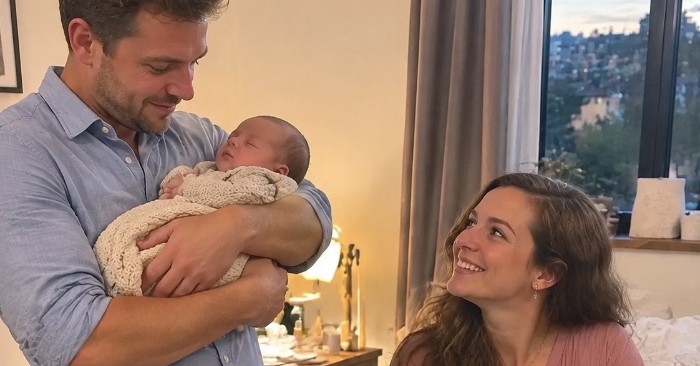
PART 1: TWO NEWBORN SONS AND A MYSTERIOUS BRASS KEY
The telephone rang thirty-seven minutes before midnight. By the time I arrived at the hospital, I was convinced my former wife had arranged one last confrontation. However, the nurse who had contacted me wasn’t interested in discussing finances, threats, or betrayal. She looked straight at me and said, “Mr. Cole, there are two reasons I needed you to come here tonight.” Suddenly, the anger that had driven me through the rainy streets of Boston began giving way to an unsettling feeling that something was terribly wrong.
Heavy rain had transformed Back Bay into a landscape of wet asphalt and shimmering streetlights. When my car stopped beneath the hospital entrance, I hurried inside. People moved aside as I approached, not because I was particularly wealthy, but because certain family names still carried considerable influence in Boston. The Cole name was one of them.
My family controlled businesses, property, labor unions, and enough influential connections to make even powerful politicians return our telephone calls. For fifteen years, I had been responsible for managing the entire operation. Competitors rarely mentioned my name loudly, preferring to refer to me as the man in charge.
Yet an unfamiliar woman had somehow obtained my private telephone number.
“Your ex-wife has been admitted to the hospital,” she had told me. “She’s in Room 418, in the maternity recovery department. Please come immediately, before your family arrives.”
Then the call ended.
Clara Bennett Cole.
We had been divorced for seven months.
Seven months of attorneys, frozen bank accounts, confidential accusations, and a silence that had gradually begun to feel like a punishment. Before everything fell apart, Clara had been the only person who could openly disagree with me without worrying about the consequences.
Then documents surfaced suggesting that she had betrayed one of my family’s most closely protected businesses.
A nurse standing behind the reception desk immediately approached me.
“Sir, visiting hours have already ended.”
“I’m looking for Room 418.”
“You cannot simply walk into the maternity department.”
“I’m not here for a social visit.”
“Mr. Cole,” she replied, “my name is Nora Harper. I was the person who called you.”
“You used a telephone number that fewer than ten people know.”
“I’m aware.”
“That number isn’t available through the hospital’s ordinary records.”
“I know that as well.”
My voice became noticeably colder.
“Then you’d better have an explanation worth hearing.”
Nora didn’t appear intimidated.
“I actually have two explanations.”
“What are they?”
“They’re both waiting in Clara’s room.”
A strange feeling settled in my chest as I looked toward the corridor leading to Room 418.
“What exactly are you telling me?”
Nora moved closer and lowered her voice.
“Before you go inside, there’s something you should understand. Clara didn’t come here looking for financial assistance, Mr. Cole. She was brought here because she had gone into labor.”
Seven months divorced.
I stared at her in disbelief.
“That cannot be right.”
Nora’s expression became serious.
“Two little boys. They were delivered prematurely, and neither cried immediately after birth.”
I struggled to find an appropriate response.
“Clara also asked me to promise something. If anything happened to her, I was supposed to place this in your hands before your mother arrived.”
She handed me a small brass key.
I examined it carefully.
“What exactly does it unlock?”
Nora glanced toward Clara’s room.
“A private trust that your family never imagined you would discover.”
PART 2: THE SECRET STORED INSIDE BOX 214
“Where is she?”
Nora indicated the room at the end of the corridor.
“She’s conscious and resting. The boys are in the special-care nursery because they arrived earlier than expected, but they’re progressing well. Their doctors are pleased with their condition.”
I hadn’t realized how badly I needed to hear that.
“And Clara?”
“She needs sleep and as little stress as possible.”
Nora paused before continuing.
“She didn’t know I was contacting you.”
“Then why did you make the call?”
“Because I’ve known Clara Bennett since before she became Clara Cole.”
Hearing her maiden name brought back memories of the woman I had married before my family became part of every decision we made.
Nora explained that she had worked alongside Clara’s mother many years earlier. They had known each other through the medical profession, and Clara had contacted her several months ago to witness some important legal documents.
“She didn’t explain every detail,” Nora said, “but she told me enough to understand that something serious was happening.”
“What kind of documents?”
“Documents she was afraid someone might make disappear.”
“Why would my mother be interested in them?”
“I never said she was.”
“You specifically warned me to arrive before my family.”
“Clara requested that nobody from your family be allowed to access her personal belongings until you had received the key.”
I looked at her.
“I am part of that family.”
Nora met my eyes without hesitation.
“Being related to the Cole family and being the Cole family are two different things, Mr. Cole.”
For fifteen years, almost everyone around me had carefully avoided speaking that way.
Clara never had.
Apparently, Nora Harper had no intention of starting either.
When I finally entered the room, Clara was awake.
Seven months had passed since I had last seen her.
Perhaps she had changed, or perhaps the separation had simply altered the way I looked at her.
Her eyes moved from me to Nora.
“You contacted him.”
Nora quietly closed the door.
“I did.”
Clara sighed.
“Nora.”
“You can be annoyed with me tomorrow.”
“I’m already considering starting tonight.”
That sounded exactly like the woman I remembered.
Nora glanced at me.
“Let’s begin with ten minutes. If Clara becomes tired, you leave.”
Clara noticed the brass key in my hand.
“So she gave it to you.”
“You expected her to?”
“I hoped she wouldn’t have to.”
I moved closer.
“What does it open?”
“Grant.”
“Please tell me what it opens.”
“You still haven’t asked about the babies.”
“I was told they’re doing well.”
“That’s not what I asked.”
I hesitated before asking the question that mattered most.
“Are those children mine?”
Clara held my gaze.
“Yes.”
“You knew about the pregnancy when we finalized the divorce?”
“Yes.”
“How long had you known?”
“I discovered it eleven days before the divorce became official.”
“You still signed the papers?”
“I did.”
“Why would you do that?”
She turned toward the hospital window.
“At that point, I believed ending our marriage was the best protection I could offer our children.”
“Protection from me?”
“Protection from the situation our marriage had become.”
“That doesn’t explain anything.”
“It’s all I can explain tonight.”
“You don’t get to decide what I’m allowed to know.”
“Grant, I spent twelve years watching your relatives decide what information other people were permitted to receive. I’m not going to let that happen again.”
“You kept my sons away from me.”
“I kept my pregnancy private.”
“They’re my children!”
“I understand that.”
“Didn’t you believe I deserved to know?”
“I believed you deserved the truth. I simply wasn’t certain you were prepared to listen to it.”
Her words brought back memories of our final evening together.
Clara had been standing in our library holding a folder.
My brother Daniel had insisted that the evidence against her was undeniable.
Clara had calmly asked me to look into her eyes and tell her whether I truly believed she had betrayed me.
I remembered choosing my family’s version of events instead.
Clara noticed the change in my expression.
“That’s why the trust exists,” she said.
“What trust?”
“The one you’ll find when you open the box.”
“Why did you hide it?”
“Because its contents aren’t money.”
“Then what are they?”
“Financial records, correspondence, agreements, copies of important documents, and information I couldn’t safely leave at our house or with the company.”
“What information?”
“The evidence I tried to show you before the divorce.”
“Our internal auditors discovered the transactions.”
“No. The documents passed through the auditors. That doesn’t mean they originated with them.”
“That’s not what the report said.”
“Your report was technically accurate about the transactions.”
I frowned.
“What does that mean?”
“The transfers happened. The signatures were present. The money moved exactly as the reports indicated.”
“Then how could the accusations be false?”
“My authorization was added after someone else had already approved those transactions.”
“That shouldn’t be possible.”
“It wasn’t supposed to be.”
“Our financial system requires two separate approvals.”
“It did.”
“Who provided the other authorization?”
Clara remained silent.
“Who was it?”
“Open the trust first.”
I asked where I could find it.
“Commonwealth Trust Company on Beacon Street. Their private storage department.”
“And the key?”
“Storage Box 214.”
“I can send someone there immediately.”
“No.”
“Clara—”
“You must go yourself.”
“I don’t have time for—”
“Alone, Grant.”
She continued speaking firmly.
“If you send someone employed by Cole Holdings, contact the family’s attorney, or inform your mother or Daniel before examining those documents, everything I’ve spent seven months arranging will become useless.”
Nora glanced at the clock.
“Your ten minutes are nearly over.”
Clara gave her a faint smile.
“You really are impossible.”
“I’ve been told I’m quite lovable.”
I turned my attention toward the nursery.
“Can I see the boys?”
Nora nodded.
“Of course.”
She led me toward two small bassinets.
“Their doctors are satisfied with their progress. They need regular feeding, rest, and continued monitoring.”
I looked down at the newborns.
Two little boys.
“Have you chosen their names?”
Nora smiled.
“Clara wanted to wait until she could tell you herself.”
“She intended to tell me?”
“That was her plan.”
“When?”
“That was something the two of you needed to decide.”
I leaned closer.
“Do they resemble her?”
“The smaller one has her mouth.”
“And the other?”
Nora examined the second baby.
“He may have inherited your eyebrows.”
For the first time that night, I smiled.
Nora noticed.
“That’s much better.”
“What is?”
“You looked like you were attending an important corporate negotiation.”
I looked at the two babies again.
“What am I supposed to do now?”
“Tonight? Nothing complicated. Stay nearby. Listen to their doctors, let Clara rest, and start learning about your sons.”
“That’s all?”
“That’s already quite a lot.”
The following morning, Boston appeared brighter beneath a pale September sky.
I had spent the night at a nearby hotel because returning to the townhouse Clara and I once shared felt impossible.
At approximately nine fifteen, I entered Commonwealth Trust Company on Beacon Street.
An elderly manager introduced himself as Mr. Bell and carefully examined my identification.
“Mrs. Cole left instructions stating that Box 214 could only be accessed by you or her.”
“My former wife.”
Mr. Bell adjusted his glasses.
“The instructions were registered while you were still married.”
“When were they filed?”
“Approximately eight months ago.”
He escorted me downstairs.
Box 214 contained no cash or valuable jewelry.
Instead, I found several carefully organized folders.
The first contained bank transfers connected to Bennett Urban Development, one of Clara’s companies.
A particular transaction had been initiated at 6:42 p.m.
Her authorization appeared at 7:18 p.m.
But I remembered that Clara had been sitting beside me at a charity dinner throughout that entire period.
She couldn’t possibly have approved the transaction.
The second authorization was connected to an executive credential belonging to my brother, Daniel Cole.
Daniel had been the person who delivered the audit report to my house and repeatedly insisted that Clara was guilty.
I continued examining the documents.
Then I discovered several letters addressed to Walter Kessler, our longtime family attorney.
They carried my mother’s signature.
The first discussed Clara’s refusal to transfer certain waterfront properties into the control of Cole Holdings.
Another mentioned that Daniel believed temporary financial discrepancies could activate a clause in the partnership agreement and force Clara away from the project.
I stopped at one particularly disturbing paragraph.
My mother had written that the situation should be handled carefully and that nothing should happen that couldn’t eventually be corrected.
There was nothing about stealing money.
Nothing about permanent damage.
Only enough uncertainty to separate Clara’s business interests from those of our family.
I leaned back in my chair.
The next folder contained correspondence between Clara and an independent financial investigator.
She had discovered the altered authorization trail three weeks before I confronted her.
There were handwritten notes documenting her questions.
Why would Eleanor want Grant to believe this?
Was the waterfront development the real reason?
Did Daniel understand the full purpose?
Who had accessed my digital signature records?
One sentence at the bottom of a page caught my attention.
Do not tell Grant until everything has been independently verified. He will defend his family first if the evidence is incomplete.
I read it twice.
It hurt because she had understood me better than I understood myself.
Then I discovered a sealed envelope bearing my name.
The letter was dated eight months earlier, before the accusations became widely known within our family.
I opened it carefully.
Clara had written that if I was reading the letter, either she had finally persuaded me to investigate the truth or something had happened that made Nora decide I needed the documents without her explanation.
She hoped it was the first possibility.
She believed Daniel hadn’t acted entirely independently.
She also suspected my mother had never expected our marriage to end.
Instead, she believed my mother had intended to apply pressure until Clara abandoned her business position.
Clara explained that my mother had spent years treating pressure as an acceptable way to manage family affairs.
That might explain her behavior, but it didn’t make it right.
She also reminded me that I loved my mother and brother, but that I was capable of caring about them without allowing them to make every important decision for me.
She asked me to remember the man she had married.
The letter continued.
Clara described our marriage honestly, including the ways both of us had contributed to its problems.
My loyalty to my family.
Her tendency to withhold concerns until she had gathered every piece of evidence.
My habit of disappearing into work.
Her frustration with always having to compete with family obligations.
We had been struggling long before the suspicious documents appeared.
Then I reached the final paragraph.
She wrote that she hadn’t left because her feelings had disappeared.
She had walked away because she could no longer distinguish loving me from being absorbed into my family’s expectations.
She needed to know whether I could ever choose an independent life rather than simply inherit the one prepared for me.
The next folder contained legal papers establishing the Cole-Bennett Independence Trust.
It included voting rights associated with the Bennett waterfront properties and several minority holdings that Clara had legally acquired through our marriage arrangements.
The agreement required both of us to approve important decisions.
Neither of us could exercise those rights while acting in an official capacity for Cole Holdings.
It was designed to make us decide something as two individuals rather than as representatives of competing family businesses.
It was an idea that sounded exactly like Clara.
Then I discovered an amendment dated six months earlier.
It established separate financial protection for the children of Clara Bennett Cole.
Our twins.
She hadn’t been trying to take anything away from me.
She had been protecting their future from the automatic influence of both families.
The next item was a small notebook.
Most pages contained legal notes, dates, and financial questions.
But toward the back, I found a handwritten heading:
Things I want the twins to know about their father.
I stopped turning the pages.
There were twelve entries.
He notices when someone is cold and quietly adjusts the heating.
He dislikes pears but buys them because I enjoy eating them.
He remembers the names of employees’ spouses after meeting them twice.
He pretends Christmas music annoys him.
He cannot prepare eggs properly.
He reads contracts far too quickly.
He isn’t very good at apologizing, but he means it when he finally does.
He loves his family with everything he has.
Sometimes that love becomes excessive.
He is a kinder man than the position he occupies allows people to see.
I closed the notebook.
My telephone rang.
Daniel’s name appeared on the screen.
I answered.
“Grant?”
“Did you use executive credential DC-03 to authorize the Bennett transfers?”
He remained silent for several seconds.
“Where did you find that information?”
“Meet me at the hospital cafeteria at noon.”
“Grant—”
“Come alone.”
I ended the call.
PART 3: THE TRUTH MY MOTHER AND BROTHER COULD NO LONGER HIDE
My mother arrived seventeen minutes before the meeting was supposed to begin.
Eleanor Cole had celebrated her seventieth birthday recently and refused to behave as though age had changed anything about her authority.
“You look awful,” she said.
“I haven’t had a particularly ordinary night.”
“Are the babies all right?”
“Two boys.”
She froze.
“Twins?”
“Yes.”
“Grant.”
“Don’t.”
“You knew Clara was pregnant?”
“She discovered it shortly before the divorce became final.”
“She should have told you.”
“And you should have told me what happened with the financial records.”
Her expression changed.
“You found the correspondence.”
“I did.”
“Then you understand that I never intended—”
“I understand exactly what you intended.”
I placed the documents on the table.
“You wanted to create enough uncertainty around Clara’s business decisions to force her away from the waterfront negotiations.”
“The development involved thousands of jobs.”
“You expected me to pressure my own wife into surrendering her position.”
“I expected you to protect the interests of this family.”
“I was supposed to protect my marriage too.”
“The project was important to thousands of employees.”
“And that somehow made manipulating her authorization records acceptable?”
“No,” she admitted.
For the first time, she didn’t attempt to avoid the question.
“I made a decision that I believed could be contained.”
“You risked my entire marriage.”
“Yes.”
She explained that she had believed the financial discrepancies could be reversed after Clara stepped away from the negotiations.
Our family attorney had assured her that the documents could eventually be corrected without causing permanent financial damage.
“What about Daniel?”
“He was told the transfer was part of a controlled internal compliance exercise.”
“Then why did he accuse Clara?”
“By the time he understood what had happened, he was frightened.”
“He could have corrected the report.”
“Yes.”
“But he didn’t.”
“No.”
“Why?”
“Because he feared what would happen if the truth became public.”
My mother looked down.
“He was afraid of disappointing me.”
“Daniel is forty-one years old.”
“Fear doesn’t disappear simply because someone becomes an adult.”
“Were you ever planning to tell me?”
“I kept telling myself I would explain everything after the waterfront vote.”
“That vote happened seven months ago.”
“I know.”
She had no further defense.
Daniel arrived at noon.
He approached the table looking nervous.
“You wanted to see me?”
“Sit down.”
He glanced at our mother.
She spoke quietly.
“Don’t try to manage this anymore. Tell him everything.”
Daniel finally admitted that he had approved the original transfer using his executive credentials.
He claimed he believed it was a temporary compliance test.
But the authorization attached to the transaction had been Clara’s archived digital signature, added afterward by the legal department.
“Did you know about that?”
“Not initially.”
“When did you discover it?”
“Three days before I came to your house.”
“You knew Clara hadn’t authorized the transaction.”
He nodded.
“And you still let me accuse her?”
“Yes.”
“Why?”
He explained that Walter had warned him that exposing the situation could trigger a major investigation involving our mother and potentially damage the entire redevelopment project.
Daniel had convinced himself that remaining silent would protect thousands of employees.
“So you chose the company instead of my marriage.”
“I know.”
“And you chose yourself instead of telling me the truth.”
He lowered his head.
“I’ve wanted to explain everything for months.”
“You had my telephone number.”
“I know.”
I informed him that an independent review would be conducted.
Walter would no longer have any involvement in the process.
Every relevant record would be provided to the investigators.
There would be no selective disclosure or attempts to protect certain family members.
Daniel agreed.
Before leaving, he asked whether he could come upstairs with me.
“No. Not yet.”
He nodded.
My mother looked toward the hospital corridor.
“Are my grandsons healthy?”
“They’re doing well.”
“Have you chosen their names?”
“Not yet.”
For the first time, I thought about the two little boys who had arrived in the middle of our family crisis without knowing anything about the history they were inheriting.
When I returned to Clara’s room, she was sitting upright.
“You hate hospital soup,” she said.
“I remember.”
“You complained about it for nine days after your appendix operation.”
“It was terrible.”
“You opened it every morning.”
“Yes.”
I told her what my mother and brother had admitted.
She listened carefully.
“Daniel confirmed the authorization was altered?”
“Yes.”
“And your mother admitted the reason?”
“Yes.”
Clara looked toward the window.
“I suspected as much.”
“You knew?”
“I suspected. I never had enough evidence to prove the entire arrangement.”
“Why didn’t you tell me?”
“I tried.”
She reminded me of the folder she had held during our final argument.
She had asked me to examine it before making any decisions.
But I had already chosen to trust the people who presented the report.
“I believed them because they were my family,” I admitted.
“And I know that now.”
“I should have listened.”
“Yes.”
“I am sorry.”
Clara remained quiet for a moment.
Then she explained why she had kept the pregnancy private.
She had been afraid our children would become another responsibility managed by my mother.
She didn’t want my relatives choosing their future before they were even born.
She also didn’t want me returning because of the pregnancy rather than because I genuinely wanted to rebuild our relationship.
“I needed to know that you could choose us without being forced into it,” she whispered.
I understood that she had made decisions out of fear, just as I had made decisions out of misplaced loyalty.
Neither of us had handled everything perfectly.
Then we discussed the trust.
Its voting rights required both of us.
I asked why.
Clara explained that she wanted one important decision in our lives to remain outside the control of either family.
The waterfront development was her idea.
Her father had once dreamed of building affordable housing on the property, but he had never possessed enough financial support to complete the project.
Clara had preserved the land and developed a plan for a residential neighborhood called Harbor House.
The remaining property included fourteen acres that weren’t part of the approved commercial development.
She wanted to create homes ordinary families could afford.
“You’ve been planning this while pregnant?”
“I had plenty of sleepless nights.”
I smiled.
Then Clara asked how long I intended to keep standing in the room.
Before I could answer, Nora entered.
“The boys are ready for a family visit.”
Clara was taken to the nursery.
She looked down at the two bassinets.
“Grant, this is Owen.”
She pointed toward the smaller baby.
“And that little one is Noah.”
“Owen and Noah,” I repeated.
“I chose their names months ago, but I didn’t put them on the paperwork.”
“Why?”
“I thought their father should hear them first.”
I looked at her.
“Can I hold one?”
Clara studied my expression.
“You look terrified.”
“I am.”
“Good.”
“Why is that good?”
“Because at least you understand how important this is.”
With the nurse’s assistance, Owen was carefully placed in my arms.
I watched his tiny face as he settled against me.
“I have no idea what I’m doing.”
“Neither do I,” Clara replied.
For several minutes, neither of us spoke.
Then I asked whether my mother knew about the children.
“She does now,” I said.
Clara looked surprised.
“What happened?”
“She admitted the truth.”
“And Daniel?”
“He did too.”
“How much did he reveal?”
“Enough to convince me that the remaining details can be established through the investigation.”
She nodded.
“And Walter?”
“I haven’t contacted him yet. I want to understand everything before making another decision.”
Clara watched me.
“That is something new.”
“I’m having an unusually difficult week.”
She smiled faintly.
Then she mentioned that Nora had placed another document inside the trust box.
“What document?”
“I don’t know exactly. Three months ago, she asked permission to place something there if certain circumstances changed.”
“What circumstances?”
“She wouldn’t explain.”
I looked toward Nora, who was speaking quietly with another nurse.
“Why does she have access to the trust?”
“She witnessed some of the original agreements.”
I adjusted Owen carefully.
“Is there another key?”
“Yes.”
“Where is it?”
Clara gave me a faint smile.
“You really don’t enjoy being kept in the dark.”
“I’m discovering that.”
“Nora has it.”
I approached her.
“Nora, what else did you place in Box 214?”
She shook her head.
“Not here.”
“What is it?”
“Something that belongs to your family.”
“What exactly?”
“Tomorrow, Grant.”
I sighed.
“You called me in the middle of the night, handed me a mysterious key, introduced me to two sons I didn’t know existed, and sent me to discover that my own mother helped create false evidence against my wife.”
Nora nearly smiled.
“What I placed in that box has nothing to do with money.”
“Then what is it about?”
“A promise.”
“Who made it?”
“Your father.”
My father, Charles Cole, had been dead for eleven years.
Nora reached into her bag and produced a second brass key.
“There is a smaller compartment behind the original storage box. Your key cannot open it.”
I stared at her.
“How did you know my father?”
Her expression became unusually thoughtful.
“He was a patient at this hospital long before Clara came here.”
“For what reason?”
Nora glanced toward the nursery.
“He wanted to make sure that if his family ever forgot what truly mattered, someone outside it would be able to remind them.”
It felt as though my father had left a door unlocked for me eleven years before I knew I would need it.
PART 4: THE RECORDING MY FATHER NEVER INTENDED ME TO HEAR
I returned to Commonwealth Trust Company the following morning.
After examining the second key, I asked Mr. Bell whether the building had any equipment capable of playing an old recording.
“Probably,” he answered.
“Probably?”
“This institution has been operating for more than a century. We have several objects nobody has been brave enough to discard.”
Approximately twenty minutes later, he returned carrying a small tape recorder.
It looked old enough to have survived several generations of employees.
My father’s name was written across the accompanying envelope.
Charles Cole.
I unfolded the paper.
Son,
If Nora Harper has given you access to this recording, something has happened that I hoped you would never experience.
That sounded exactly like him.
He never wasted words on unnecessary greetings.
I continued reading.
You grew up believing that being strong meant holding the family together.
I taught you that.
Some of that lesson was useful.
Some of it was wrong.
He explained that our family had survived difficult periods because people trusted one another.
But gradually, cooperation had become obligation, obligation had become control, and control had started presenting itself as loyalty.
He warned me not to confuse those things.
I stopped reading.
For a moment, I could almost see him sitting in his study, adjusting his glasses and explaining that responsibility should always come before privilege.
He had taught me to remember the employees who dedicated decades of their lives to our company.
He had also taught me never to embarrass our family in public.
I had inherited both principles without understanding that they could sometimes conflict.
The letter continued.
My father described my mother as stronger than he had ever been in several respects.
He believed she would keep everyone moving long after they should have stopped to question their direction.
He admitted that he hadn’t always been willing to challenge her decisions.
He wanted me to learn from that mistake.
Then he mentioned Clara’s father, Daniel Bennett.
Years earlier, the two men had discussed a plan for the waterfront properties.
They wanted to create homes that ordinary families could afford.
The project had never been completed.
Too many financial obligations had appeared.
Too much pride had become involved.
And too many people had suggested waiting for a more convenient time.
My father wrote that there was never a perfect moment to do something meaningful for the next generation.
He ended with a simple reminder.
If the opportunity returns, think carefully before trading it for another building with our family name on it.
I sat quietly with the letter.
Then I pressed play on the old recorder.
My father’s familiar voice filled the small room.
“Grant, if you’re listening to this, I assume Nora decided you needed advice from a dead man.”
He made a brief pause.
“I apologize for the unusual arrangement.”
Nora had apparently been one of his nurses during his final months.
Without his office, assistants, business meetings, and the constant activity surrounding him, my father had begun speaking more openly about his life.
He discussed my mother, my brother, and the systems he had created to protect us.
“I built those systems because I wanted my sons to be safe,” he said. “Eventually, I watched the systems begin making decisions for them.”
Nora’s voice appeared briefly in the recording.
“Perhaps you can leave them better instructions.”
My father continued speaking about Clara’s father and their unfinished waterfront plans.
He hoped our families might someday work together without turning marriage into another business arrangement.
Then he mentioned me.
“Grant needs someone who isn’t impressed by the Cole name.”
Nora laughed softly.
“And Clara?”
“She needs someone who understands that responsibility can be a form of love, even when he expresses it badly.”
I sat motionless after the recording ended.
For eleven years, I had believed my father’s most important legacy was the business he had built.
Now I understood that he had left something more valuable.
When I returned to the hospital, Clara was walking slowly down the corridor with Nora beside her.
“You’re supposed to be resting,” I said.
She stopped.
“You’ve been spending too much time with Nora.”
Nora looked pleased.
“I warned her.”
We returned to Clara’s room, where I explained what I had discovered.
Clara listened without interrupting.
“My father never told me about this.”
“Mine didn’t tell me either.”
Nora settled into a chair.
“Both men asked me to keep their plans confidential.”
“Why?” Clara asked.
“They were embarrassed.”
“About what?”
“They believed they had failed to accomplish something important.”
Nora explained that the two men had once secured preliminary investors, architectural plans, and community support.
But financial conditions changed.
Cole Holdings needed capital elsewhere, while Bennett Development faced concerns from its creditors.
Eventually, they abandoned the project.
“That’s unfortunate, but it happens,” Clara said.
Nora nodded.
“Of course. But neither man ever stopped regretting that a temporary delay became a permanent abandonment.”
Clara looked at me.
“Harbor House.”
I nodded.
“Our fathers had almost identical ideas.”
Nora gently corrected us.
“They weren’t merely similar.”
She explained that Clara’s father had preserved the original architectural plans.
“Where are they?”
“In storage.”
“You’ve seen them?”
“Yes.”
“How did you get them?”
“Your mother gave them to me after your father passed away.”
Clara stared at her.
“My mother knew?”
“Certainly.”
“Why didn’t she tell me?”
Nora smiled.
“Parents sometimes believe protecting their children from disappointment means keeping important information from them.”
Clara glanced at me.
“Apparently, that isn’t just a Cole family habit.”
Nora explained that Clara’s mother hadn’t wanted her daughter to feel obligated to finish a project simply because her father had dreamed about it.
She wanted Clara to make her own decisions.
But her father had left different instructions.
If Clara independently developed the same idea, Nora was supposed to show her the original plans.
Nora opened her bag and placed a thin archival folder on Clara’s lap.
Inside were sketches and handwritten notes dating back more than two decades.
Clara touched one page.
“That sounds exactly like my father.”
I looked at the drawings.
“It also sounds like something you would say.”
She smiled.
“Perhaps I inherited a few good things after all.”
Nora looked at both of us.
“You inherited more than you realize.”
The twins remained in the hospital for another twelve days.
Those days changed my daily life more than the previous fifteen years of running the family business.
I learned the nursery’s hygiene procedures.
I discovered that Noah usually became impatient shortly before making a sound.
I noticed that Owen settled more easily when someone rested a hand gently near his shoulder.
I learned that Clara preferred tea at two in the morning and disliked the hospital’s blueberry muffins.
We could spend an entire hour beside our sons without discussing the divorce.
Meanwhile, I placed Cole Holdings under temporary shared executive supervision.
Daniel resigned from the redevelopment committee before I formally requested it.
Walter Kessler retired three days before the independent review officially began.
The investigation eventually identified violations involving ethical responsibilities, financial authorization procedures, and corporate oversight.
No money had disappeared.
Investigators found no evidence of a criminal conspiracy.
The reality was less dramatic than I had initially imagined, but more embarrassing.
Several intelligent people had convinced themselves that temporarily manipulating the truth was acceptable because they believed their ultimate objective was important.
The real damage had been done to the trust between people.
Daniel visited the hospital on the sixth day after the twins were born.
Clara was sitting beside Noah when he approached.
“I owe you an apology,” he said.
Clara looked at him.
“Yes, you do.”
He admitted that he had known enough to understand that she hadn’t authorized the transfers.
But he had allowed her to carry the blame because correcting the situation became more frightening as time passed.
He had told himself he was protecting our mother, the company, and the employees.
In reality, he had also been protecting himself.
Clara listened carefully.
When he finished, she simply replied:
“Thank you for finally explaining it honestly.”
Daniel looked relieved.
He glanced toward the bassinets.
“Is that Noah?”
“Yes,” Clara answered.
“And Owen?”
“He’s over there.”
Daniel smiled.
“Would it be all right if I met them?”
Clara nodded.
“Wash your hands first.”
He immediately went to the sink.
A few days later, my mother sent Clara a handwritten letter.
She admitted that she had interfered with Clara’s business decisions, underestimated the consequences, and failed to correct the situation when it became personal.
She acknowledged that protecting the family had never given her the right to make decisions for everyone else.
Clara read the letter and returned it to me.
“What do you think?” I asked.
She folded the paper.
“I think your mother has never written nine sentences without giving someone instructions.”
“That might be a historic achievement.”
“It probably is.”
I asked whether she wanted my mother to visit the twins.
Clara thought about it.
“Do you want her to?”
“Yes.”
“Then invite her.”
She made it clear that forgiveness wouldn’t mean unlimited access to our lives.
We would establish boundaries together.
My mother arrived the following afternoon.
I had watched Eleanor attend funerals without shedding a tear.
But when Noah yawned, she briefly covered her mouth with her fingers.
“They’re beautiful,” she whispered.
Clara sat nearby.
“They are.”
Then my mother apologized again.
Clara acknowledged the apology but explained that believing someone was sorry didn’t automatically mean trusting them again.
My mother said she understood.
Clara established several conditions.
She wanted time.
She expected my mother to respect decisions she might disagree with.
She didn’t want family business discussions taking place around the babies.
And she certainly didn’t want anyone selecting schools for children who couldn’t even sit up yet.
My mother protested that she would never do such a thing.
Clara reminded her that she had once placed my brother’s daughter on a preschool waiting list before the child was born.
My mother insisted that situation had been different.
For once, Clara and I simply laughed.
On the twins’ final morning at the hospital, Nora found me standing in the corridor.
“You look less frightening than you did the first night.”
“I’ve been sleeping approximately four hours.”
“That might be your natural condition.”
I thanked her.
She asked whether I was referring to the coffee.
“No. I’m thanking you for calling me.”
Nora became thoughtful.
“I nearly decided not to.”
“Why?”
“Clara had asked me not to contact you unless it became necessary.”
“What changed your mind?”
She looked through the nursery window.
“The boys arrived earlier than expected. Clara was exhausted, and your mother’s office had already contacted the hospital after hearing that she had been admitted.”
I stared at her.
“Your mother hadn’t done anything improper,” Nora clarified. “Her assistant had simply heard the news through an insurance administrator.”
“So you believed my family might arrive before I knew what had happened.”
“Yes.”
“And you decided to give me a chance to arrive as their father rather than as the head of the Cole family.”
Nora smiled faintly.
“Eventually, you managed to do that.”
Then she gave me one final warning.
“Don’t turn this into a redemption project.”
“What do you mean?”
“Some people discover they’ve made mistakes and immediately become obsessed with proving that they’ve changed.”
“Is that what you think I’m doing?”
“I think you’re capable of it.”
She explained that Clara didn’t need a man making dramatic speeches about how different he had become.
She needed someone dependable.
Our sons needed the same thing.
PART 5: THE LIFE WE FINALLY CHOSE FOR OURSELVES
Clara and I didn’t immediately get back together after leaving the hospital.
She moved into the townhouse she had rented in Cambridge.
My mother offered several Cole family properties, but Clara politely declined.
Instead, we established a practical schedule for caring for the twins.
Medical appointments.
Feeding times.
Overnight visits.
During the first month, I spent more time learning how to fold baby clothes than managing Cole Holdings.
The company continued functioning perfectly well when I missed financial meetings because Noah needed a pediatric appointment.
Nobody went bankrupt because Owen required an extra hour of attention one evening.
Clara found my new priorities entertaining.
“You mean the entire company can survive without you supervising everyone?” she asked.
“Barely.”
“How tragic.”
She continued teasing me whenever I struggled with ordinary household responsibilities.
Meanwhile, we began developing Harbor House.
Clara and I established an independent nonprofit development organization that operated separately from both family companies.
The project gradually moved from an idea to an actual construction plan.
My brother eventually joined the initiative.
He discovered that community meetings involved considerable discussions about parking spaces, housing costs, and local businesses.
One afternoon, he called me after attending a particularly long meeting.
“Do you know how many people have opinions about parking?”
“Yes.”
“Very strong opinions.”
“I believe you.”
“One man spoke for eighteen minutes without stopping.”
“That sounds unusually brief for Boston.”
Daniel ended the call.
Clara laughed for several minutes.
Over time, Daniel learned to admit mistakes without immediately attaching excuses.
Clara learned to ask for help before becoming overwhelmed.
And I gradually understood that being a husband and father required much more than providing financial security or making important decisions.
Owen and Noah grew quickly.
Owen became observant and thoughtful.
Noah preferred reaching for things first and considering the consequences afterward.
Clara insisted that the second boy had inherited my personality.
At their first birthday celebration, Nora arrived carrying two small wooden boats.
“You could have chosen something less obvious,” I told her.
“I’m getting older. I’ve earned the right to be sentimental.”
The Harbor House groundbreaking ceremony took place several weeks later.
Our family names appeared among those of the other project partners.
Neither name dominated the development.
Clara stood beside me while the boys played safely on a blanket nearby with my mother and Daniel.
“Your father would have complained about the parking arrangements,” she said.
“Without question.”
“Mine would have criticized the selection of shops.”
“He probably would have.”
“I wish they could see this.”
“Perhaps this is how they get to.”
Clara gently placed her hand in mine.
It was the first time she had done that in almost two years.
Several months afterward, Clara invited me to dinner.
Most of our meals had previously happened because one of us brought food to whichever home contained the twins that evening.
This time, she arrived wearing the green dress I had always liked.
“You’re late,” I said.
“Two small children believe shoes are completely unnecessary.”
“That’s understandable.”
She sat down and placed her spoon beside her plate.
“I’ve been thinking.”
“That sentence still makes me nervous.”
“About us.”
I waited.
She explained that she didn’t want to recreate our previous marriage.
She wanted something different.
“I don’t want the old relationship back,” she said.
“Neither do I.”
“I mean it, Grant.”
“So do I.”
She wanted to know whether the changes I had made were genuine and whether I could maintain them without constantly needing someone to remind me.
I told her I understood.
Then I asked whether she still wanted a future with me.
She paused.
“I don’t know yet.”
I didn’t argue.
She seemed surprised that I hadn’t immediately presented a long explanation.
“That’s all you’re going to say?”
“What else should I say?”
“Historically, you would have prepared a twelve-point argument.”
“I’m trying a different approach.”
She smiled.
“I love you.”
I looked at her.
“I probably always will,” she continued. “But loving each other was never our only problem.”
“I understand.”
“I need to believe the changes you’re making are part of who you are becoming, not something you’re doing because of what happened.”
“They are.”
“You believe that.”
“Yes.”
“Your mother probably believed she was doing the right thing too.”
I couldn’t disagree.
I told Clara I would give her whatever time she needed.
Harbor House gradually progressed from planning into construction.
The independent organization remained separate from our family businesses.
Daniel joined the project in an administrative role and slowly began rebuilding his professional reputation.
Owen and Noah continued growing.
At their first birthday, they both received little blue jackets and spent much of the celebration trying to exchange their shoes.
Clara and I laughed as Nora watched them.
Several months later, she invited us to dinner.
It was a small gathering, with only close relatives and a few friends.
During the evening, Clara looked at me across the table.
“I’ve been thinking about something.”
“What now?”
“Us.”
I put down my fork.
She explained that she had spent considerable time considering whether we could build a new relationship without repeating the mistakes that had destroyed the previous one.
“I don’t want to return to our old marriage,” she said.
“Neither do I.”
“I want something different.”
“So do I.”
She asked what I imagined our future would look like.
I didn’t talk about business, property, or family obligations.
I described ordinary mornings with our sons.
Breakfast together.
Arguments about schools when the time eventually came.
Family vacations that would probably involve terrible planning.
Sunday dinners whenever we wanted them.
Her complaining that I worked too much.
My pretending that I could cook.
Her correcting me.
And both of us making decisions without asking our relatives for permission.
“I want a life,” I told her.
“Not another business agreement?”
“No.”
“Not a restored family arrangement?”
“No.”
“Not a perfect solution to everything?”
“Definitely not.”
She smiled.
“What happens when we disagree?”
“We probably will.”
“What happens when things become difficult?”
“They will.”
“What if your mother starts arranging school places for the boys?”
“I’ll change our names and move out of Massachusetts.”
Clara laughed.
Then she took my hand.
“I want that breakfast too.”
I smiled.
“Does that mean yes?”
“It means we’re beginning again.”
That was enough.
Eighteen months later, we married in the public garden near Harbor House.
Nora stood beside Clara.
Daniel stood beside me.
Owen and Noah wore tiny blue suits and spent much of the ceremony attempting to exchange their shoes.
When the officiant asked whether I was choosing Clara willingly, I nearly laughed at how much that word meant to me.
“I do,” I answered.
Clara looked directly into my eyes.
“I do,” she said.
Later, while our relatives enjoyed cake beneath the garden lights, my mother approached me near the harbor.
“You look happy.”
“I am.”
“So am I.”
We watched Noah attempt to convince Daniel that cake belonged on his sleeve.
After a moment, my mother mentioned that my father would have enjoyed the occasion.
“The wedding?”
She smiled.
“No. The fact that nobody requested my permission.”
I laughed.
“I am learning.”
“Slowly.”
“Very slowly.”
I told her that I had once believed keeping a family together meant making sure nobody ever walked away.
Now I understood that people stayed when they were allowed to belong without sacrificing their independence.
My mother looked toward Clara.
“You should write that down.”
“Don’t encourage me.”
Across the garden, Clara lifted Owen into her arms and looked in my direction.
Three years after Nora’s midnight telephone call, the first families moved into their new apartments at Harbor House.
A bookstore opened nearby.
Then several small shops and a community center.
The bookstore struggled financially during its first few months until Clara persuaded my mother to organize a reading group there.
That had been one of Clara’s conditions for the project.
The neighborhood was supposed to serve ordinary people, not simply display our family names.
Daniel supported the idea.
My mother approved.
Nora pretended to dislike how emotional the entire arrangement made her.
Owen and Noah were still too young to read, but they enjoyed touching the letters on the signs.
One Sunday afternoon, the four of us walked along the harbor.
Clara looked toward the water.
“Do you ever think about the night the boys were born?”
“Every day.”
“You were furious when you arrived.”
“I was convinced you had arranged another scheme.”
She laughed.
“And then you found the key.”
“Yes.”
“Did you ever imagine it would bring us back together?”
“Not for a moment.”
She admitted that she had initially hoped the documents would finally make me investigate what had happened.
She hadn’t expected them to repair our relationship.
“I hated you for a while,” she said.
“I know.”
“I missed you too.”
“I understand that now.”
She looked at the boys.
Owen had stopped to help Noah retrieve a toy that had fallen harmlessly onto the grass.
My mother and Daniel were sitting on a nearby bench discussing something that appeared to involve sandwiches.
Nora was approaching with several coffees, despite being repeatedly reminded that she was technically retired.
Clara turned toward me.
“So, what did you think when Nora handed you the key?”
“That you were trying to destroy my life.”
She raised an eyebrow.
“That isn’t particularly romantic.”
“I haven’t finished.”
I looked at her.
“You destroyed the life I thought I was supposed to want.”
“And what happened afterward?”
“We built a different one.”
Ahead of us were two little boys who would eventually inherit our family history, mistakes, property, expectations, and more advice than either of them would ever need.
That evening, Noah asked why the community center didn’t carry our family name.
Clara looked at me before answering.
“Because not everything you help create has to belong exclusively to you.”
He considered her explanation.
“Why?”
“Because sometimes something becomes more valuable when everybody can share it.”
Owen looked up from his plate.
“Like the park?”
“Exactly.”
Noah seemed satisfied and returned to eating his dinner.
I thought about everything I had learned.
From my father.
From Clara.
From Nora.
Even from my mother.
I had finally begun to understand that protecting someone didn’t mean controlling their choices.
Love didn’t mean demanding loyalty.
And family wasn’t supposed to become a place where people were afraid to disagree.
Years earlier, I had believed the Cole name could open practically every door.
It certainly had that power.
What I hadn’t realized was that a family name could also become a room people forgot they were allowed to leave.
Clara taught me to recognize the exit.
Our sons showed me why finding it mattered.
And gradually, our relatives learned to walk through that door with us.
I still keep the original brass key in my desk.
Not because Box 214 contains anything valuable anymore.
The original documents have been archived.
The trust has been updated.
The waterfront agreements have been finalized.
The little key can barely open anything now.
That is precisely why I keep it.
It reminds me that the most important thing it unlocked was never a storage compartment.
It was the moment I stopped worrying about what my relatives expected me to preserve and started thinking about the kind of family I wanted to create.
The answer was never wealth.
It was never influence.
And it certainly wasn’t maintaining a perfect public reputation.
It was something much simpler.
A kitchen where the eggs occasionally turned out badly.
Two little boys arguing over breakfast.
A woman who still tells me when I’m wrong.
A brother learning to take responsibility.
A mother discovering that loving people sometimes means giving them room.
An old nurse who appears unexpectedly and complains about the coffee.
A neighborhood beside the harbor.
A table large enough for people to return after disappointing one another.
A life we chose rather than inherited.
A home.
And, finally, trust.