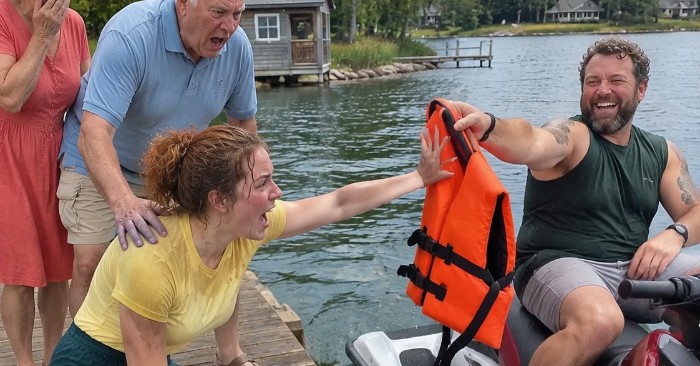
During our family’s Fourth of July celebration, my intoxicated brother took my seven-year-old daughter for a ride on his jet ski. Hundreds of yards from the shore, she fell into the water. He never turned back. When he eventually returned, he was carrying her life jacket and laughing. I screamed, demanding to know where my little girl was. Instead of helping, my father grabbed my arm and ordered me not to contact the police. My mother worried about the family holiday, and my brother seemed completely unconcerned. I ignored all of them, handed my phone to my nephew, and jumped into the lake. What I discovered in the water was something I will never forget.
My name is Claire, I’m thirty-eight, and I work as an insurance claims specialist in Springfield, Missouri.
Every Independence Day, my family celebrates together at my parents’ vacation property near the Lake of the Ozarks.
Our gatherings usually involve grilled food, swimming, fireworks, and relatives spending hours chatting outside.
However, one particular celebration turned into the most terrifying experience of my life.
My younger brother was thirty-four and had always been treated as the favorite child.
Throughout our childhood, my parents repeatedly defended his irresponsible decisions, regardless of how serious they became.
He had already received two convictions for driving under the influence.
Yet my parents continued describing his behavior as nothing more than a temporary mistake.
“He’s just having a difficult time,” my mother frequently explained.
Unfortunately, his supposedly difficult period had continued for years.
Whenever I questioned his decisions, my parents accused me of being unnecessarily critical.
That summer, I brought my seven-year-old daughter to the family gathering.
She enjoyed swimming, although she wasn’t experienced enough to manage deep water safely.
I therefore made her wear a bright orange life jacket whenever she approached the dock.
My mother frequently complained about my precautions.
“She’s seven years old, not a baby. You can’t protect her from absolutely everything,” she would say.
I never took those comments seriously.
I understood that lakes could be unpredictable and dangerous.
Before becoming a mother, I had participated in competitive distance swimming and spent several summers teaching lifeguard courses.
I knew that being comfortable in a swimming pool didn’t necessarily prepare someone for strong currents, passing boats, and unexpected waves.
I taught my daughter one important safety rule.
“If you ever find yourself in deep water, stay calm. Grab something that floats, hold on tightly, and call for help. Mommy will come looking for you.”
She repeated the instructions carefully.
“Find something floating, hold on, and Mommy will come.”
I never imagined she would need to remember those words to survive.
That afternoon, everyone was enjoying themselves near the family dock.
Music played outside, food was cooking on the grill, and relatives relaxed beneath the umbrellas.
My daughter was nearby in her pink swimsuit and orange flotation vest.
I briefly entered the house to collect some sunscreen.
I was away for approximately four minutes.
When I came back outside, something immediately seemed wrong.
The dock was unusually quiet.
I searched the nearby chairs, the wooden steps, and the surrounding water.
Then I noticed that my brother’s jet ski was missing.
“Where is my daughter?” I asked.
My mother continued holding her drink without showing much concern.
“Oh, your brother took her out for a little ride. She wanted to go.”
My stomach tightened.
“What did you just say?”
She shrugged.
“Don’t worry. She’s enjoying herself.”
I stared at her.
“Mom, he’s been drinking since lunchtime!”
My father dismissed my concerns with a wave of his hand.
“He knows these waters better than anyone. Stop making a fuss.”
I looked toward the distant part of the lake.
I could see the jet ski moving across the water at an alarming speed.
My brother was making sharp turns and jumping across waves created by passing boats.
Then something terrible happened.
The jet ski hit a particularly large wave.
Its front lifted suddenly.
A small figure wearing pink clothing flew backward into the lake.
It was my daughter.
She disappeared beneath the surface.
I waited for my brother to turn around.
But he continued moving forward.
The jet ski sped farther away.
“MY BABY!”
My scream attracted the attention of people on nearby docks.
My father immediately grabbed my shoulder.
“Calm down. Your brother will turn around and get her.”
But he didn’t.
Instead of returning to the place where my daughter had fallen, he made a wide turn and headed directly toward our dock.
When he finally arrived, he climbed off the jet ski with a ridiculous smile on his face.
He was holding my daughter’s bright orange life jacket.
My entire body went cold.
“Why are you carrying her life jacket?” I asked quietly.
He shrugged.
“She said it was bothering her. I told her she could just hold on to me.”
I couldn’t believe his response.
“She fell into the water! Where is she?”
He looked at me as though I was overreacting.
“She’s fine. She knows how to swim.”
“WHERE DID SHE FALL?”
He vaguely pointed toward the middle of the lake.
Before I could demand another answer, my father stepped directly in front of me.
“Listen to me carefully. You’re not calling the police!”
I stared at him in disbelief.
“What are you talking about?”
“Your brother already has two drunk-driving convictions. Another arrest could put him behind bars.”
For a moment, I couldn’t understand how he could say something so horrible.
My little girl was somewhere in the deep water.
Yet my father was worried about protecting his son’s criminal record.
“DAD, MY DAUGHTER IS STILL OUT THERE!”
My mother approached, visibly annoyed.
“Please don’t turn this into an even bigger disaster. Your brother has already had a difficult year.”
Something inside me suddenly changed.
I stopped arguing.
There was no time left to waste.
I grabbed the orange life jacket from my brother and handed my phone to my sixteen-year-old nephew.
“Call 911 immediately. Tell them a seven-year-old girl has fallen into the lake from a jet ski without a life jacket. Tell them the person driving was drinking.”
My father shouted after me.
“Don’t you dare bring the police into this!”
I ignored him.
I removed my sandals, ran to the edge of the dock, and jumped into the water.
The lake felt colder than I expected.
After reaching the surface, I took a deep breath and began swimming toward the area where I’d watched my daughter fall.
She was hundreds of yards away.
Every stroke felt like a desperate attempt to outrun time.
I pushed through the rough water, searching for anything that might indicate where she was.
A little hand.
A small head.
A movement between the waves.
Anything at all.
People on nearby boats were shouting, but I couldn’t allow myself to become distracted.
I had spent years training as a swimmer.
I’d competed in long-distance events and taught other people how to respond to emergencies.
But none of that experience could prepare me for searching for my own child.
When I reached the approximate location, I stopped and examined the surrounding water.
There was nothing but waves and distant boat engines.
“WHERE ARE YOU, BABY?”
I turned around, desperately searching in every direction.
“IT’S MOMMY! PLEASE ANSWER ME!”
No response came.
Then I noticed something floating nearby.
It was pink.
I reached toward the object and immediately recognized it.
It was my daughter’s hair accessory, a small elastic band decorated with a plastic strawberry.
I’d used it to tie her hair that morning.
I grabbed it.
For one terrifying moment, I thought I might already be too late.
But I forced myself to concentrate.
Panicking wouldn’t help her.
I examined the direction of the wind and the movement of the waves before searching again.
“Sweetheart! If you hear Mommy, please shout!”
I waited.
Then I heard something faint coming from my left.
“…Mommy?”
I immediately turned.
“BABY?”
Another tiny voice answered.
“Mommy!”
I swam toward the sound as quickly as I could.
And suddenly, I spotted her.
Her little head was barely visible above the water.
Both arms were wrapped around a yellow object floating on the surface.
As I approached, I realized it was a loose boat cushion.
She had managed to hook one knee around it to keep herself above the waves.
Her lips had turned bluish, and her teeth were chattering.
But my daughter was still alive.
I reached her and immediately pulled her into my arms.
“Oh, sweetheart! I’ve found you!”
She began sobbing.
“Mommy, I remembered what you told me. I found something that floats and held on.”
Tears streamed down my face.
“You did everything right, darling. I’m so proud of you.”
I carefully secured her orange life jacket around her body.
Her tiny hands tightened around my neck.
“I shouted for Uncle, but he didn’t come back,” she whispered.
My heart broke.
“I know, sweetheart. Mommy is here now.”
She pressed her face against my shoulder.
“I thought you wouldn’t find me.”
I kissed her wet hair.
“I will always come looking for you.”
A nearby pontoon boat approached us.
A man wearing a baseball cap leaned over the side.
“Don’t worry! We’re coming to help!”
He and his wife carefully pulled us aboard.
The woman immediately covered my daughter with several towels and a warm blanket.
The man told me he had already contacted emergency services.
Within minutes, a marine patrol boat arrived.
For the first time since entering the lake, I allowed myself to believe that my daughter would survive.
The man who helped rescue us was a retired firefighter named Dale.
His wife remained beside my little girl while we waited for medical assistance.
A female marine patrol officer boarded the pontoon and examined my daughter’s condition.
Then she turned toward me.
“She is frightened and very cold, but she’s conscious and responding. We’re arranging immediate medical attention.”
I nodded while holding my daughter close.
The officer then asked whether the person operating the jet ski had been drinking.
“Yes,” I answered.
“Who was driving?”
“My brother.”
“Is he still at your family’s dock?”
“I believe so.”
She immediately contacted her colleagues by radio.
Then she asked me to describe everything that had happened.
I explained how I’d gone inside briefly to collect sunscreen.
I told her how my brother had taken my daughter onto the jet ski without asking my permission.
I described watching her fall into the water while he continued driving.
I also explained how he returned carrying her life jacket instead of bringing her back.
Finally, I told her that my parents had attempted to prevent me from contacting the authorities.
The officer listened carefully and documented my account.
By the time we arrived at the hospital, I was trembling uncontrollably.
My daughter needed medical observation because of her exposure to cold water and the possibility that she had inhaled some water.
But she was alive, talking, and refusing to release my hand.
Later that evening, my nephew appeared in the hospital corridor.
He looked frightened and exhausted.
“Auntie, I’m really sorry,” he whispered.
I immediately hugged him.
“What are you apologizing for?”
“I saw Uncle drinking. I watched him take her onto the jet ski. I should have stopped him.”
I placed my hands on his shoulders.
“You did exactly what I needed you to do. You called for help.”
He began crying.
“Grandpa kept telling me to end the call. He said I was destroying our family.”
My anger returned immediately.
“Your grandfather was wrong.”
I held him until he finally calmed down.
Then I returned to my daughter’s room.
Close to midnight, she looked up at me.
“Mommy?”
“I’m right here, sweetheart.”
“Is Uncle going to get into trouble?”
I hesitated before answering.
“Yes, darling.”
Her expression changed.
“Is it because of me?”
I gently squeezed her hand.
“No. It’s because of the decisions he made.”
She remained quiet for a moment.
Then she whispered something that nearly brought me to tears again.
“I remembered our special rule. I found something that could float.”
I kissed her forehead.
“And that’s why you’re here with me.”
My brother was taken into custody that evening.
The investigation later established that his blood alcohol concentration was 0.19.
Several witnesses also provided statements describing his dangerous behavior while operating the jet ski.
He faced multiple charges, including boating under the influence, reckless operation of a watercraft, and child endangerment.
His previous convictions made the potential consequences considerably more serious.
My parents immediately began blaming me.
My mother called repeatedly.
Initially, she screamed at me.
Later, she started crying.
Eventually, she left a voicemail that made me feel physically sick.
“Your brother is family. You’ve ruined his future over one mistake.”
One mistake.
That was how she described nearly losing her granddaughter.
I didn’t respond.
Two days later, my father called.
“Claire, you need to speak with the prosecutor.”
“What about?”
“You should ask them to go easier on your brother.”
I couldn’t believe what I was hearing.
“Dad, he abandoned my daughter in deep water.”
“But she’s fine now.”
“She’s alive because she remembered what I taught her, because strangers came to our rescue, and because we were incredibly lucky.”
My father sighed.
“Your brother is still your family.”
I closed my eyes.
“And my daughter is still your granddaughter.”
He had nothing to say.
Then I reminded him of something I would never forget.
“When she was missing, you ordered me not to call the police.”
“I was trying to protect your brother.”
“I know, Dad. And that’s exactly what was wrong with your decision.”
I ended the conversation.
For the first time, I didn’t feel guilty about standing up to my parents.
The court proceedings took place in September.
My brother arrived wearing a gray suit and looked considerably thinner and quieter than before.
His attorney explained that he had been struggling with alcohol dependency and needed professional treatment.
I agreed that he required help.
However, I also believed he needed to face the consequences of what he’d done.
When I was called to testify, I described the entire incident.
I explained how briefly I’d left my daughter alone.
I described my brother taking her onto the lake, the moment she fell, and his return without her.
I also told the court how I’d eventually discovered her clinging to a floating cushion, barely able to keep herself above the water.
I explained that my own parents had tried to prevent me from requesting emergency assistance.
After listening to my testimony, the judge asked what outcome I wanted.
I took a moment before answering.
“I want my brother to receive proper treatment for his drinking problem. I want him to understand how close he came to taking my daughter’s life. Most importantly, I want safeguards that prevent another child from experiencing something similar.”
My voice began trembling.
“I’m not seeking revenge. I want him to be held responsible.”
After considering the evidence, the judge sentenced my brother to three years in prison, followed by five years of probation and compulsory treatment.
He was also prohibited from operating watercraft.
My mother began crying in the courtroom.
My father refused to look in my direction.
After the hearing, my brother requested a private conversation.
I agreed, with a court officer remaining nearby.
His eyes were red.
“I need you to understand something,” he whispered. “I don’t remember her falling into the lake.”
I watched him carefully.
“I remember taking her out. I remember riding the jet ski. But I can’t remember the moment she went into the water.”
I nodded without saying anything.
He swallowed.
“I never wanted to hurt her.”
I looked directly at him.
“But you did hurt her.”
His eyes filled with tears.
“How is she doing?”
“She’s recovering. But sometimes she still asks why you didn’t turn around and come back for her.”
He lowered his head and started crying.
Part of me wanted to comfort him.
Despite everything, he was still my younger brother.
But I could no longer protect him from the consequences of his own decisions.
“I hope you get better,” I told him. “I genuinely want you to recover.”
Then I added something I needed him to understand.
“But I’m not going to keep saving you from the consequences of your actions.”
The experience left a lasting impact on my daughter.
For several weeks, she was terrified of going near the water.
Even taking a bath became difficult.
She frequently experienced nightmares about being abandoned in the middle of the lake.
I arranged professional counseling to help her process what had happened.
We worked patiently on breathing exercises, discussed her fears, and drew pictures of the lake together.
Gradually, her anxiety began to decrease.
Several months later, we were sitting together at the kitchen table when she looked up at me.
“Mommy, I’d like to learn how to swim really well.”
I smiled.
“What made you think of that, sweetheart?”
“So that if somebody else falls into the water, I might be able to help them.”
I had to turn away briefly to hide my tears.
“Then we’ll work on becoming an even stronger swimmer,” I whispered.
She returned to swimming lessons at an indoor pool.
Initially, she was nervous and hesitant.
However, her confidence slowly returned.
By spring, she could swim the full length of the pool.
A little later, she learned to remain afloat for several minutes without assistance.
Whenever we visited a lake, she continued wearing her orange life jacket.
I never needed to remind her.
She understood its importance.
During one family gathering, my mother made another careless remark.
“Don’t you think you’re getting a little too old to wear that life jacket?”
My daughter looked directly at her grandmother.
“No, Grandma. It helps keep me safe.”
Everyone around the table became quiet.
For once, my mother didn’t argue.
She lowered her eyes and spoke softly.
“You’re right, sweetheart. I’m sorry.”
It was the first sincere apology I could remember hearing from her.
My father needed considerably more time to acknowledge his behavior.
Several months passed before he finally visited my house alone.
When I opened the front door, he was standing on the porch holding his hat.
“Claire, I owe you an apology,” he said quietly.
I waited for him to continue.
“I was completely wrong that afternoon.”
His voice began shaking.
“I cared more about protecting your brother’s future than protecting my granddaughter. I actually told you not to call for help when her life was in danger.”
His eyes filled with tears.
“I’ve thought about that moment every single night.”
I remained silent.
He continued explaining.
“For years, your mother and I kept making excuses for your brother. We convinced ourselves he was simply going through a rough period instead of making him face his behavior.”
He swallowed.
“And because of that, I nearly lost my granddaughter.”
Then he asked whether he could apologize directly to her.
I wasn’t ready to agree.
“Not yet, Dad. She needs more time.”
He nodded.
“I understand.”
However, he continued visiting.
He started coming over every Sunday.
Sometimes he brought something from the bakery.
Other times, he simply sat quietly on the porch swing.
He never demanded forgiveness or tried to pressure me into forgetting what had happened.
He just kept showing up.
Eventually, on a chilly afternoon, my daughter walked outside and sat beside him.
“Hi, Grandpa.”
His expression softened immediately.
“Hello, sweetheart.”
She studied his face.
“Mommy told me you said sorry.”
He nodded.
“I did. I made a terrible mistake.”
My daughter leaned against his arm.
“Okay.”
It wasn’t an emotional reunion filled with dramatic speeches.
But it was the beginning of something better.
Two years after that frightening Fourth of July, my daughter and I visited another lake.
It was smaller, quieter, and far less crowded.
We rented a little rowboat and spent the afternoon enjoying the sunshine.
My daughter wore her familiar bright orange life jacket.
Her hair was decorated with the same pink strawberry accessory I’d discovered floating in the water during the rescue.
I’d kept it safely stored away for two years.
After completing several months of counseling, she eventually asked whether she could wear it again.
Now she was sitting beside me, smiling as the boat gently moved across the water.
We watched the sun slowly disappear beyond the horizon.
After a while, she looked up.
“Mommy?”
“Yes, sweetheart?”
“Do you still remember our special rule?”
I smiled.
“Every single word.”
She repeated it carefully.
“Find something that floats. Hold on. Mommy will come.”
My eyes filled with tears.
“I remember, darling.”
She reached for my hand.
“You really came for me, Mommy. Even though I was so far away.”
I squeezed her little fingers.
“I’ll always do everything I can to reach you, sweetheart.”
We remained sitting together for a while, enjoying the peaceful evening.
I couldn’t help remembering the moment she disappeared beneath the waves.
The little pink hair accessory.
The yellow cushion.
And the unbearable fear that I might never hold my daughter again.
I also remembered the decision I made that afternoon.
My parents wanted me to protect my brother.
They expected me to remain silent and pretend his reckless behavior was simply another unfortunate mistake.
But I refused.
Being a loving daughter or a supportive sister should never require sacrificing a child’s safety.
My family accused me of destroying my brother’s future by contacting the authorities.
But his own reckless decisions had nearly taken my daughter’s future away.
I still hope he receives the treatment he needs.
I hope he understands the seriousness of what happened and eventually becomes a better person.
Perhaps one day, our family will find a healthier way to move forward.
But I will never regret calling for help.
I will never apologize for protecting my little girl.
And I will never forget that a seven-year-old child survived because she remembered three simple instructions.
Find something that floats. Hold on. Help will come.
My daughter showed more courage that day than any of the adults around her.
And whenever I see her happily enjoying the water in her bright orange life jacket, I’m reminded of just how close I came to losing the most precious person in my life.