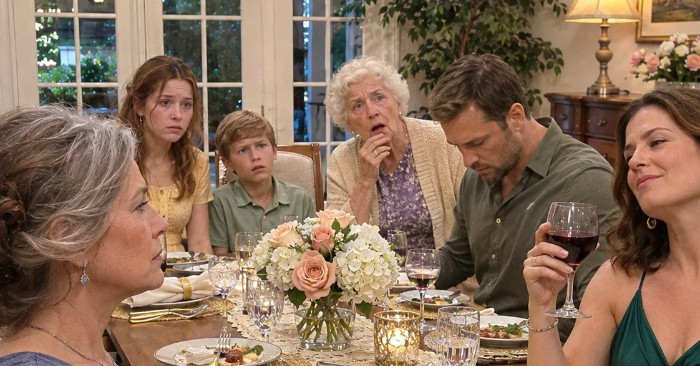
“We’ve finally purchased a house of our own. It’s about time you learned to manage without us.”
My daughter-in-law made that announcement while sitting at my dining table, smiling triumphantly as she lifted her wineglass.
For twelve years, she’d enjoyed living in my home without paying rent.
I’d helped raise her children, contributed toward their expenses, and provided shelter when their financial situation became difficult.
Yet she was addressing me as though I were an inconvenience she could finally eliminate.
My son remained silent, staring at his dinner.
My grandchildren exchanged confused looks.
I neither argued nor became emotional.
Instead, I retrieved a blue folder from beside my chair.
“Congratulations,” I replied calmly. “Interestingly enough, my lawyer submitted some rather important paperwork ninety minutes ago.”
Her expression immediately changed.
She was about to discover that the property she’d spent years treating as her own was beyond her control.
But ownership was only the beginning.
There was also a secret financing application for 420,000 dollars, arrangements to place me in a retirement community, and documents suggesting I was incapable of managing my finances.
Throughout most of my life, I’d believed that loving my family meant putting their needs before mine.
My husband and I purchased our house when our son was six years old.
Over the following decades, we transformed it into a beautiful family home.
My husband constructed the backyard deck, planted a maple tree outside the kitchen, and handled nearly every repair himself.
When I unexpectedly lost him, our mortgage had already been paid in full.
I became the property’s sole owner.
Never had I imagined needing an attorney to protect my right to remain there.
Twelve years earlier, my son lost his job while his wife was expecting their first baby.
They appeared on my doorstep with suitcases and frightened expressions.
“We only need somewhere to stay for a few months, Mom.”
Naturally, I welcomed them.
Following my husband’s passing, the house had felt unbearably empty.
Having my family nearby made life enjoyable again.
My grandson was born, followed several years later by his little sister.
Their laughter filled rooms that had once been painfully silent.
Eventually, my son found employment, and his wife resumed working.
Nevertheless, their temporary arrangement somehow continued for twelve years.
There was always another explanation.
Childcare costs.
Vehicle payments.
School expenses.
Family vacations.
Unexpected financial difficulties.
I never charged them rent.
Occasionally, they helped with groceries and utility bills, while my son performed household repairs.
I genuinely appreciated those contributions.
However, my daughter-in-law gradually started behaving like the homeowner.
She replaced curtains without consulting me.
Reorganized my kitchen.
Removed furniture that held sentimental value.
She even transformed my husband’s former study into a children’s playroom.
Little by little, my preferences stopped mattering.
Whenever I complained, my son encouraged me to avoid unnecessary disagreements.
“Please, Mom. Just let her have her way.”
And I did.
Repeatedly.
Until I barely recognized the house I’d spent decades caring for.
Six months before that extraordinary dinner, I made an unsettling discovery.
While cleaning my husband’s former study, I noticed an unfamiliar envelope inside a filing cabinet.
It was addressed to my son.
Inside was a professional appraisal estimating my property’s value at approximately 875,000 dollars.
There was also a preliminary sales proposal featuring recent photographs of my furniture, bedrooms, kitchen, and garden.
I’d never authorized an appraisal.
Then I spotted a handwritten remark.
Current owner expected to relocate before closing.
I couldn’t stop reading that sentence.
The current owner was me.
Someone was making arrangements to remove me from my house before selling it.
My hands trembled as I contacted my sister.
“Did you give anyone permission to do this?” she asked.
“Of course not.”
“Then you need legal assistance immediately.”
The following week, I visited an experienced estate attorney.
I brought my ownership documents, bank statements, property tax records, and the mysterious appraisal.
After examining everything, she asked me a straightforward question.
“What would you like to happen?”
“I want to remain in my house.”
She nodded reassuringly.
“Then we’ll concentrate on protecting that right.”
Her investigation confirmed that I was still the property’s sole legal owner.
There were no recorded mortgages or legitimate transfers of ownership.
Neither my son nor his wife possessed the authority to sell it.
However, the real estate agent disclosed something deeply disturbing.
My daughter-in-law had informed her that I intended to relocate to a smaller residence.
She’d presented the arrangement as a decision our entire family had made together.
Nobody had even mentioned it to me.
Although I desperately wanted to confront her, my attorney recommended waiting.
We began reviewing my finances, estate arrangements, and existing legal authorizations.
With her assistance, I established a living trust.
My property would be held within the trust while I retained control as trustee during my lifetime.
My sister was appointed as successor trustee should that ever become necessary.
I also included specific provisions protecting my grandchildren’s interests.
Being related to me would no longer mean someone could expect automatic control over my assets.
For the first time in months, I felt somewhat reassured.
Then another alarming notification arrived.
A financial institution contacted me regarding an inquiry connected to my home’s equity.
I’d never requested financing.
My attorney investigated and eventually obtained a document supposedly granting my daughter-in-law authority over certain financial matters.
I examined the signature in disbelief.
“This doesn’t make sense.”
“Do you remember signing it?” my lawyer asked.
“Not knowingly.”
Suddenly, I recalled an incident from two years earlier.
I’d undergone a minor surgical procedure, and my daughter-in-law had helped me during my recovery.
One afternoon, she’d presented several documents, describing them as routine paperwork for emergencies.
I’d signed them because I trusted her.
Now I wondered whether that trust had been deliberately exploited.
My attorney began examining the circumstances surrounding the authorization.
Meanwhile, I decided to reclaim my husband’s study.
I returned his drafting desk, engineering award, photographs, and favorite books to their original places.
When my daughter-in-law discovered what I’d done, she became furious.
“Where are the children supposed to play?”
“They have their bedrooms and another recreation area.”
“But we’ve been using this room for years!”
I looked at her calmly.
“And I’d like to use my own room again.”
She accused me of being unreasonable.
For once, I refused to apologize.
Three weeks later, we gathered for dinner.
My daughter-in-law proudly announced that she and my son had purchased their first house.
Everyone congratulated them.
Then she turned toward me.
“You can finally figure out how to live independently.”
Silence descended over the table.
My sister lowered her fork.
My grandchildren looked uncomfortable.
My son refused to meet my eyes.
His wife continued.
“Honestly, we’ve accommodated you long enough. We won’t be needing you anymore.”
I carefully placed my napkin beside my plate.
“I believe you’ve misunderstood your position here.”
She frowned.
I opened the blue folder.
“This property is now held in my living trust. I retain control, and my lawyer submitted additional legal documents ninety minutes ago to safeguard my interests.”
My son stared at the papers.
“You transferred ownership into a trust?”
“Yes.”
“Why didn’t you tell us?”
I looked directly at him.
“Why didn’t either of you tell me about your plans to move me elsewhere?”
He immediately fell silent.
My daughter-in-law reached for the documents.
“But he’s your only child! Everything should eventually belong to him!”
“That’s not how my estate arrangements work.”
I explained that the trust contained carefully prepared instructions, including protections for my grandchildren.
Her cheeks turned red.
Then I placed the property appraisal in front of her.
“Why did you inform a real estate agent that I intended to relocate?”
She hesitated.
“We were simply considering possibilities.”
“Possibilities involving a house you don’t own?”
“We thought you’d be more comfortable somewhere smaller.”
“Did you ever ask me what I wanted?”
She had no response.
Next, I produced the disputed financial authorization.
“Perhaps you’d also like to explain why this document grants you authority over my finances.”
My son turned toward his wife.
“What is she talking about?”
His wife shifted nervously.
“It was paperwork for emergencies.”
“What emergency required access to my assets?” I asked.
She avoided answering.
I then explained that my attorney had formally challenged the authorization and taken legal steps to protect my property.
Her confidence disappeared.
Unfortunately, I had only uncovered part of their scheme.
Later that evening, my son entered his father’s former study.
His eyes were swollen from crying.
“Mom, I’m sorry.”
I waited for an explanation.
He confessed that his wife had suggested converting my home into a rental property.
The anticipated rental income would help cover expenses associated with their new house.
“And where exactly was I supposed to live?”
He stared at the floor.
“A retirement community across town.”
My stomach tightened.
They’d already toured the facility.
Without inviting me.
His wife had also persuaded him to sign preliminary statements expressing concerns about my ability to live independently.
“You told people I couldn’t take care of myself?”
He began crying.
“She said we were only preparing for the future.”
“I’ve managed this household for decades. I handle my accounts, pay my bills, drive myself, and arrange my own appointments.”
“I know, Mom.”
“Then why would you sign something suggesting otherwise?”
His answer was barely audible.
“Because I didn’t want another argument with her.”
Those words hurt more deeply than anything his wife had said.
My own son had allowed someone to threaten my independence simply because defending me would have been uncomfortable.
The following morning, my attorney called with another discovery.
A financing application had been submitted using my property as proposed security.
The requested amount was 420,000 dollars.
The stated purpose involved purchasing another residential property.
“Were they planning to buy their new house using the value of mine?” I asked.
“The available documents suggest that possibility. We’re requesting the complete records.”
Although the application didn’t establish that any funds had actually been released, the attempt itself was deeply concerning.
Then came another shocking revelation.
My daughter-in-law had submitted an emergency petition requesting legal authority over my personal and financial affairs.
She alleged that I was forgetful, financially irresponsible, and susceptible to manipulation.
The person she’d nominated to manage my assets was herself.
I struggled to comprehend the betrayal.
I’d welcomed this woman into my home when she had nowhere else to go.
Now she was attempting to persuade a court that I shouldn’t control my own life.
According to her petition, creating a living trust demonstrated poor financial judgment.
Rejecting her relocation plans supposedly indicated emotional instability.
Even questioning her suspicious activities had been presented as evidence that I required supervision.
My attorney arranged an independent professional assessment and gathered records demonstrating my ability to manage my responsibilities.
My finances were organized.
Every bill was paid.
My legal decisions had been made with professional guidance.
There was no established reason to believe I couldn’t continue living independently.
At the hearing, my daughter-in-law sat beside her lawyer.
My son appeared miserable.
Her attorney argued that I’d recently made unexpected financial decisions and become increasingly suspicious of relatives.
My lawyer explained exactly why.
She presented the unauthorized appraisal, questionable financing application, and disputed financial authorization.
The judge examined the evidence before addressing my daughter-in-law.
“What immediate circumstances justify appointing someone to manage her affairs?”
She hesitated.
“She’s making irresponsible choices.”
“Could you provide an example?”
“She established a trust without consulting us.”
The judge looked unimpressed.
“Why would establishing a trust demonstrate an inability to manage one’s affairs?”
My daughter-in-law struggled to respond.
“She’s become a completely different person.”
The judge remained composed.
“Individuals are entitled to change their financial arrangements.”
When my son was questioned about the statements he’d signed, he admitted that he’d never witnessed me becoming disoriented, forgetting relatives, or suffering financial losses because of cognitive difficulties.
He eventually acknowledged that he’d relied entirely on his wife’s claims.
After reviewing the evidence, the judge rejected the emergency petition.
There was insufficient justification for appointing my daughter-in-law as conservator.
No finding of incapacity was made.
Relief swept through me.
My sister reached over and squeezed my hand.
However, the judge emphasized that the questionable financial activities still required proper investigation.
Outside the courtroom, my son approached me.
“I’m so sorry, Mom.”
I looked at him sadly.
“I love you. But I cannot continue suffering the consequences of your unwillingness to disagree with your wife.”
He nodded tearfully.
I hoped the worst was finally over.
It wasn’t.
Several days later, my son arrived carrying a black folder.
“There are things I haven’t told you.”
Inside were bank records, emails, transfer confirmations, and financial projections.
He began explaining what had happened to an investment account his father had established for our future grandchildren.
I’d continued contributing after both children were born.
The money was intended for their education and long-term needs.
My son had limited administrative access.
Unfortunately, he’d used that access to authorize a transfer connected to their attempted property purchase.
Approximately 180,000 dollars had been withdrawn from funds intended to benefit his own children.
I stared at him in disbelief.
“You knew that money wasn’t yours to spend however you pleased?”
He nodded.
“Then why did you take it?”
“She promised we’d put everything back.”
“How?”
“Using the rental income from your house.”
Suddenly, every piece of their plan fitted together.
They intended to use the children’s savings toward their new property.
Then relocate me to the retirement community.
Obtain authority over my assets.
Rent my house to strangers.
And gradually replenish the money they’d taken.
Their entire financial strategy depended on removing me from my own home.
My son buried his face in his hands.
“I wanted to provide a better life for my family.”
“By jeopardizing your children’s future and taking away your mother’s independence?”
He began sobbing.
“I know how terrible it sounds. I made a horrible decision.”
For once, he wasn’t hiding behind his wife’s influence.
He was accepting responsibility for his actions.
My attorney examined the records alongside his legal representative.
Fortunately, despite their earlier announcement, the purchase of the new property hadn’t been finalized.
Most of the 180,000 dollars remained in a settlement or escrow account.
A considerable portion could potentially be recovered.
However, some funds had already been spent on fees and associated expenses.
My son and his wife would have to address those losses.
The financial investigation continued.
Relevant institutions provided records through appropriate procedures, and arrangements were made to recover the children’s money.
I made one condition absolutely clear.
“My grandchildren must not lose the opportunities their grandfather wanted them to have because of decisions made by their parents.”
My son agreed.
He sold his recreational boat, arranged to dispose of a second vehicle, and eliminated unnecessary expenses.
Finally, he began dealing with his own financial responsibilities instead of expecting me to rescue him.
Meanwhile, he and his wife prepared to move out.
We established an agreed departure schedule.
There was no dramatic confrontation or shouting in the driveway.
Only cardboard boxes, moving trucks, and the realization that twelve years of living together had come to an end.
While carrying his belongings outside, my grandson approached me.
“Grandma, are you upset with us?”
I immediately bent down beside him.
“Never, sweetheart. Neither you nor your sister has done anything wrong.”
“Can we come back to visit?”
“Whenever we arrange it. You’ll always be loved here.”
My granddaughter wrapped her arms around me.
“Will we still make pancakes on Fridays?”
I laughed through my tears.
“Of course we will.”
When the final moving vehicle disappeared, I remained standing on the porch.
For twelve years, the house had rarely been quiet.
There had been children playing, televisions running, constant requests, and endless disagreements about household arrangements.
Now everything was still.
I entered the house and closed the door.
Then I walked into my kitchen.
Nobody was waiting to criticize my cooking, rearrange my belongings, or tell me how things should be done.
I prepared a cup of tea.
Sat at my table.
And began crying.
Not because I regretted protecting myself.
Because I’d almost forgotten what it felt like to be comfortable inside my own home.
An hour later, my sister arrived with homemade soup, sandwiches, and a chocolate cake.
“What’s all this for?” I asked.
She smiled.
“To celebrate your first proper day as the lady of your own house.”
I laughed before bursting into tears again.
She embraced me until I regained my composure.
During the following weeks, I rediscovered pleasures I’d gradually abandoned.
I finished restoring my husband’s study.
Placed fresh yellow roses on the dining table.
Returned to gardening.
Invited longtime friends over for coffee.
And moved furniture wherever I pleased without consulting anybody.
The legal and financial disputes gradually progressed toward resolution.
Much of my grandchildren’s money was recovered, with arrangements established to address the remaining shortfall.
The disputed authorization and related financial matters were handled through appropriate legal procedures.
My living trust remained intact.
And I continued enjoying the house my husband and I had created together.
My son visited occasionally.
Our conversations slowly became more meaningful.
He no longer arrived expecting financial assistance or solutions to his problems.
Sometimes, he simply wanted to talk.
Other times, he apologized again.
And occasionally, he came just to ask how I was feeling.
His marriage remained complicated.
He and his wife began counseling while dealing with the consequences of their choices.
I stayed out of their disagreements.
Their relationship was their responsibility.
Then, one November morning, a letter arrived from my daughter-in-law.
I left it unopened for several days.
Eventually, I carried it into my husband’s study and began reading.
She initially described the difficulties she’d experienced during the previous months.
Then I encountered a sentence I hadn’t expected.
I had absolutely no right to tell you to leave your own home.
I paused.
She admitted that she’d gradually confused my generosity with entitlement.
She acknowledged making decisions about my future without considering my wishes.
She apologized for the questionable financing arrangements, the petition seeking control over my affairs, and the distress she’d caused.
Her final words stayed with me.
I understand that you may never trust me again. But I finally recognize how badly I treated you.
I folded the letter and returned it to its envelope.
Her apology mattered.
However, forgiveness didn’t automatically restore trust.
That would require patience, honesty, and consistent behavior.
December arrived, bringing frosty mornings and early darkness.
For the first time in twelve years, I decorated my home exactly as I wanted.
I unpacked the Christmas ornaments my husband and I had collected throughout our marriage.
Wooden stars.
Delicate glass angels.
Silver bells purchased during our honeymoon.
And a slightly crooked wooden house he’d made when we were newly married.
On Christmas morning, I enjoyed my coffee beside the decorated tree.
The house was peaceful.
But I didn’t feel lonely.
Later that day, I joined my son, his wife, and my grandchildren for a family gathering.
The children greeted me with enormous hugs.
My son appeared genuinely delighted to see me.
His wife was respectful, although our relationship remained cautious.
Nobody pretended the previous months hadn’t happened.
Instead, we were gradually learning how to become a healthier family.
One where kindness didn’t mean surrendering personal freedom.
Where helping someone didn’t grant them ownership of your possessions.
And where affection could coexist with firm boundaries.
Before I left, my son approached me.
“Thank you for still being part of my life, Mom.”
I looked at the man who’d once been a little boy helping his father plant our maple tree.
Tears gathered in my eyes.
“I’ve never stopped loving you. But I cannot spend the rest of my life solving problems you’re responsible for.”
He nodded.
“I understand that now.”
When he hugged me, it didn’t feel like the beginning of another request.
It felt like the first step toward rebuilding our relationship through mutual respect.
That evening, I returned home and placed a drawing from my granddaughter beside my husband’s photograph.
She’d drawn our entire family standing outside my house.
Everyone was smiling.
I was beneath the enormous maple tree.
Across the top, she’d written:
Grandma’s House — Everyone Is Welcome.
I smiled through my tears.
My granddaughter understood something the adults had forgotten.
Being welcomed into another person’s home doesn’t make it yours.
And receiving someone’s generosity doesn’t entitle you to demand more.
Later, I watched snow gathering on the branches of my husband’s beloved tree.
I remembered the afternoon he’d planted it.
Our son had been six, proudly holding a miniature shovel.
My husband had explained that we built things worth preserving so future generations could enjoy them.
For years, I’d mistakenly believed protecting my family required me to agree to everything.
Another expense.
Another compromise.
Another sacrifice that made someone else’s life easier.
Eventually, I’d discovered a different way to love.
One that allowed me to refuse unreasonable demands.
One that respected my independence.
One that reminded me my happiness mattered just as much as everyone else’s.
I glanced toward my husband’s photograph.
“I kept our home safe, darling,” I whispered.
Then I smiled.
“And I finally remembered to take care of myself.”
My daughter-in-law had once told me it was time to learn how to live without them.
She’d expected those words to frighten me.
Instead, they helped me rediscover everything I’d gradually surrendered.
My confidence.
My independence.
My peace of mind.
And my right to decide how I wanted to spend the remaining years of my life.
In the end, my greatest victory wasn’t keeping a house worth 875,000 dollars. It was reclaiming the freedom to live inside it on my own terms.