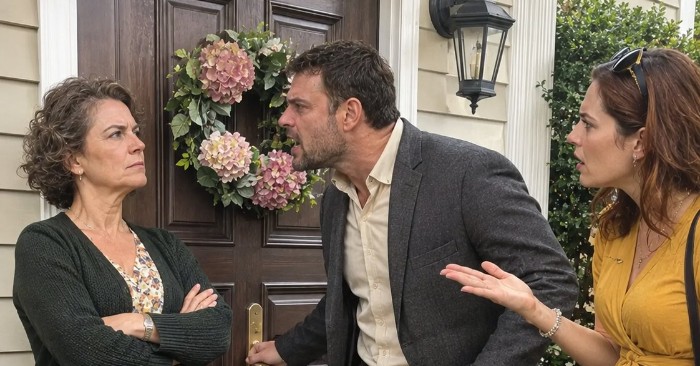
My son believed my house would eventually become his inheritance. Behind my back, he and his wife were preparing to take control of my finances and move me into a retirement community. But while they enjoyed an extravagant vacation in Europe, I sold the property, secured my money, and quietly relocated. When they returned three weeks later, their key no longer worked. What they discovered inside the house left them speechless.
My son stood on the front porch, struggling to unlock the door.
He was still wearing the jacket he’d traveled home in.
With his suitcase beside him, he tried turning the key again.
Nothing.
His wife stood behind him, wearing expensive sunglasses and carrying several designer shopping bags.
They’d returned from visiting Rome, Florence, and Paris.
Both appeared refreshed and happy.
Until they realized something was wrong.
“Why isn’t this working?” my son complained.
“Perhaps you’ve got the wrong key,” his wife suggested.
He looked at her impatiently.
“I’ve been opening this door since childhood.”
He tried once more.
From inside a rented vehicle parked across the street, I watched silently.
Just three weeks earlier, disappointing my son would have filled me with guilt.
I’d spent years believing that being a loving mother meant keeping him happy.
But that woman no longer existed.
The property had been sold.
And my son knew absolutely nothing about it.
My late husband and I had purchased our beautiful family home thirty-two years earlier.
Our son was still a little boy.
The mortgage had initially seemed overwhelming.
We worked additional hours, avoided unnecessary expenses, and completed most household repairs ourselves.
My husband installed new gutters while I repainted the bedrooms.
Together, we modernized the kitchen, replaced aging windows, and created a beautiful garden.
When we finally made our last mortgage payment, he opened an inexpensive bottle of champagne.
He embraced me and whispered, “Whatever happens, we’ll always have a place of our own.”
Then illness took him away.
Following his passing, our house became a sanctuary filled with painful memories.
His favorite armchair remained near the window.
His coffee cup stayed inside the cupboard.
For nearly a year, his winter coat hung untouched in the hallway.
Eventually, however, I adjusted to living independently.
I handled my bills, maintained the garden, attended church, and regularly met friends from my reading group.
I wasn’t incapable of caring for myself.
I was a widow learning how to enjoy life again.
Around that time, my son and his wife began visiting more often.
Initially, their concern appeared genuine.
He helped carry groceries, while she occasionally brought homemade meals.
They offered assistance with appointments and minor household tasks.
Friends frequently reminded me how lucky I was.
But their helpfulness gradually turned into interference.
“Don’t you think this property is rather large for someone living alone?” my daughter-in-law asked one afternoon.
“I’m quite comfortable here.”
“At the moment, perhaps.”
Soon, my son started expressing concerns about the staircase.
His wife began bringing brochures advertising retirement communities.
The photographs featured attractive gardens, swimming pools, and cheerful residents.
None of it interested me.
This was where I’d raised my child.
Where my husband and I had celebrated birthdays and anniversaries.
Where we’d created decades of precious memories.
For me, the house represented a lifetime of love.
For my son and his wife, it represented a substantial future inheritance.
I discovered their true intentions the day before they departed for Europe.
I was folding clothes upstairs when my telephone rang.
Before I could answer, the ringing stopped.
A voicemail notification appeared.
My son rarely recorded messages, so I immediately listened.
At first, there was background traffic and the sound of a closing car door.
Then I heard my daughter-in-law laughing.
My son’s voice followed.
“She’s becoming a burden. We’ve sacrificed enough of our own lives already.”
I froze.
His wife responded casually.
“Things will improve once we’ve dealt with the property.”
“I know,” he replied.
Then she uttered words that changed everything.
“You’re her only child. Everything she has will eventually be yours anyway.”
I slowly lowered myself onto the staircase.
“She refuses to listen,” my son complained.
His wife laughed again.
“She’s getting older. Once we persuade her to sign the paperwork, we’ll be able to handle everything ourselves.”
The message ended.
I remained sitting there, staring at my phone.
A burden.
That was how my own child described me.
Not as the mother who’d devoted years to raising him.
Not as someone learning to cope after losing her husband.
Not as the woman who’d helped build the comfortable home he’d grown up in.
Simply an obstacle preventing him from accessing his inheritance.
That evening, I walked slowly through every room.
I ran my fingers along the banister my husband had carefully restored.
I stood inside my son’s childhood bedroom.
Then I entered the laundry room, where pencil marks still recorded his height at different ages.
Six.
Eight.
Ten.
Thirteen.
Sixteen.
Underneath the highest mark, my husband had written:
Finally taller than his father.
Tears filled my eyes.
I wasn’t grieving over the possibility of losing a valuable property.
I was grieving over the little boy who’d grown into a man willing to take away his mother’s freedom.
Shortly before midnight, I entered my husband’s former office.
While examining some paperwork, I noticed a storage box my son had left behind months earlier.
He’d claimed it contained ordinary financial records.
Inside were copied bank statements, various documents, and a folder labeled with my name.
Curiosity made me open it.
What I discovered was worse than the voicemail.
There was an unsigned power of attorney.
A list of medical professionals.
Several pages questioning my ability to manage money.
Another document was titled:
Concerns About Independent Financial Decision-Making.
It described me as forgetful, unwilling to accept appropriate housing, and excessively attached to my property.
Then I recognized my son’s handwriting.
Speak with lawyer after European trip.
Secure financial power of attorney.
Estimated property value: 850,000–900,000 dollars.
Arrange sale following relocation.
I couldn’t believe what I was reading.
They weren’t planning to discuss my options with me.
They were preparing to make those choices themselves.
That was the moment my sadness turned into determination.
I stopped defending their behavior.
I stopped questioning whether I’d somehow misunderstood.
And I started making arrangements of my own.
At half past eight the following morning, I contacted the lawyer who’d managed my husband’s legal matters for more than twenty years.
During our appointment, I handed him the documents and played the voicemail.
He studied everything carefully.
“Have you signed any of these forms?”
“No.”
“Have you given your son permission to manage your assets?”
“Certainly not.”
“Has any physician determined that you’re unable to handle your own affairs?”
“Absolutely not.”
He closed the folder.
“Then our priority is ensuring your wishes and independence remain protected.”
Together, we reviewed my existing legal arrangements, updated my estate plan, strengthened financial protections, and documented my instructions.
Then he asked something my son had apparently forgotten to consider.
“What would you personally like to do with your house?”
I looked out his office window.
For years, I’d insisted that I would never leave.
But suddenly, I realized I might actually enjoy somewhere smaller and easier to maintain.
The difference was that the decision would be mine.
“I believe I’m ready to sell.”
My attorney smiled.
“Choosing to move is entirely different from being pressured into leaving.”
I contacted a trusted local real estate agent.
I requested a private sale without advertisements in the garden, public viewings, or unnecessary attention.
After examining the property, she explained that demand in the neighborhood was strong.
Within several days, she introduced me to qualified purchasers.
Their offer was 875,000 dollars.
They had secure financing, reasonable conditions, and were prepared to complete the purchase quickly.
I accepted.
That afternoon, my son sent a cheerful message from Rome.
Mom, we’ve arrived! Our hotel is incredible. Love you!
I studied the message briefly before responding.
Have a wonderful vacation.
For once, I didn’t worry about what he might think of my decisions.
While he and his wife explored European cities, I sorted through thirty-two years of belongings.
I packed my husband’s favorite chair, our photographs, treasured furniture, and albums documenting our son’s childhood.
Everything else was either donated or sold.
Then I rented a charming two-bedroom property near a quiet lake.
It had enormous windows, a lovely patio, and no staircase.
I’d always feared that leaving our family house would mean leaving my husband behind.
But as I arranged his belongings in my new home, I discovered that memories didn’t depend on an address.
Four days before my son returned, the sale was officially completed.
The purchasers were a young married couple with two children.
During their final visit, their daughter excitedly ran upstairs.
“Can I have the room with the big tree outside?”
I smiled.
“That was my son’s bedroom.”
“Did he like it?”
“Very much, sweetheart.”
After completing the paperwork, I sat inside my car and cried.
Then I headed toward my new home.
Before leaving the old property, I’d arranged for my son to collect his remaining belongings.
On the kitchen counter, with the new owners’ permission, I’d left a sealed white envelope bearing his name.
Now, three weeks after hearing that devastating recording, I watched him discover the consequences of his actions.
After unsuccessfully trying his key, he realized the door had been left unlocked for the scheduled collection.
He entered with his wife.
Both immediately stopped.
The living room was practically empty.
The photographs had vanished.
Most of the furniture was gone.
My son hurried from room to room.
“Mom?”
His voice echoed through the unfamiliar emptiness.
Then he noticed the envelope on the kitchen counter.
He ripped it open.
Inside was a letter I’d carefully written.
My dear son,
You described me as a burden and said your life would improve once my property had been dealt with.
Your wife reminded you that everything I own would eventually become yours.
Therefore, I decided to resolve the property situation myself.
The house has been sold.
The proceeds belong exclusively to me.
My financial affairs and future remain under my control.
I’ve also discovered the documents concerning power of attorney and your attempts to question my independence.
My lawyer has copies of everything.
You have no authorization to access my accounts or make decisions on my behalf.
You will always be my child, and I will always love you.
However, that love does not require me to surrender my freedom.
You wanted a life without the burden of looking after me.
Consider your wish granted.
Mom.
My son read the letter repeatedly.
His wife snatched it from his hands.
Even from across the street, I noticed the alarm spreading across her face.
My telephone began ringing.
I let the call go unanswered.
Then he called again.
And again.
Soon, seven missed calls appeared.
A message followed.
MOM! DID YOU ACTUALLY SELL THE HOUSE?
I remained silent.
Another arrived moments later.
ANSWER YOUR PHONE RIGHT NOW!
I watched him pacing through the empty living room.
When he called again, I finally answered.
“Hello, sweetheart.”
“Mom! Where are you?”
“Somewhere safe and comfortable.”
“What’s happened to the house?”
“I’ve moved.”
“Without telling us?”
“That’s correct.”
His voice became louder.
“You sold a house worth 875,000 dollars without consulting me?”
“Yes.”
For several seconds, he said nothing.
Then his true concern emerged.
“But that property was supposed to remain in our family!”
I looked toward the porch where my husband and I had once enjoyed morning coffee.
“It was my property. I was entitled to decide what happened to it.”
He began insisting that everything they’d done was motivated by concern for my welfare.
I interrupted him.
“I heard your voicemail.”
His tone changed instantly.
“You weren’t meant to hear that conversation.”
I closed my eyes.
He didn’t apologize.
He didn’t deny calling me a burden.
He simply regretted that I’d discovered the truth.
Then I mentioned the folder hidden inside the storage box.
Complete silence followed.
“Mom, those documents were just possibilities we were considering.”
“Possibilities that involved removing me from my home?”
“We were making preparations for the future.”
“Your future or mine?”
He couldn’t answer.
At that moment, the new homeowner arrived.
Through the telephone, I heard him introduce himself and explain that the property had recently changed ownership.
My son protested.
“This is my mother’s house!”
“It was,” I corrected.
The new owner politely requested that they collect their belongings and leave.
I ended the conversation.
Several minutes later, my son and his wife emerged carrying their suitcases.
They’d returned from Europe expecting to find a property that would eventually finance their dreams.
Instead, they’d discovered that it belonged to strangers.
I drove away before either noticed me.
Over the following days, my son continued calling and sending messages.
Eventually, my attorney contacted him regarding the documents I’d discovered.
His tone immediately became more cautious.
He insisted I’d misunderstood his intentions.
He repeatedly told me he loved me.
Finally, he requested a private conversation.
I agreed under two conditions.
His wife wouldn’t attend.
And my finances wouldn’t be discussed.
We met inside a quiet café.
He looked tired and uncomfortable.
“Mom, I’m sorry.”
I waited for him to continue.
“I never should’ve described you as a burden.”
“No, you shouldn’t have.”
He eventually admitted that he and his wife were experiencing considerable financial difficulties.
Credit card balances.
Costly home improvements.
Unsuccessful investments.
And an extravagant European vacation they’d already committed to.
They’d convinced themselves that my property would eventually rescue them from their debts.
“So your solution was to move me into a retirement facility?”
He lowered his eyes.
“We believed selling the house was a practical decision.”
“Practical for whom?”
He remained silent.
“If you’d approached me honestly about your problems, I might have considered helping you,” I explained. “Instead, you attempted to take control of my life.”
His eyes became watery.
“I’m really sorry, Mom.”
Perhaps he was finally recognizing the seriousness of his behavior.
But an apology couldn’t immediately restore my trust.
“I love you,” I continued. “However, you will never be given control of my money.”
He nodded.
“You will not determine where I live or make choices about my future without my permission.”
“I understand.”
“And I’ve revised my estate arrangements.”
He immediately looked concerned.
“What exactly did you change?”
I met his gaze.
“That’s private information.”
“But I’m your only child.”
“And I’m not gone yet.”
Neither of us spoke for a while.
Finally, he asked whether our relationship could ever recover.
My heart tightened.
Despite everything, he remained the child I’d raised.
The little boy whose height we’d recorded on the laundry room wall.
The teenager I’d waited awake for.
The young man whose graduation had filled us with pride.
“I can’t answer that today,” I admitted. “Your behavior from now on will determine what happens between us.”
My daughter-in-law never gave me a genuine apology.
She sent an email claiming her words had been interpreted incorrectly.
I chose not to respond.
Instead, I embraced my new surroundings.
I joined a local walking group.
I discovered a love of painting.
I filled my patio with flowers and spent evenings watching the peaceful lake.
My son began calling every week.
Initially, our conversations felt strained.
Gradually, however, his questions about my assets disappeared.
He started asking about my health, hobbies, and new friendships.
He listened when I described the flowers I’d planted.
Eventually, when I felt comfortable enough, I shared my new address.
He arrived alone for his first visit.
In his hands was a small cardboard box.
Inside, I discovered my husband’s old pocketknife, a photograph from a family vacation to Yellowstone, and a brass keychain engraved with a single word.
HOME.
My son picked up the keychain.
“Dad gave this to me before I went away to college.”
I remembered that day perfectly.
My husband had promised him that he would always be welcome home.
My son looked at me with tears in his eyes.
“I think I’ve spent years misunderstanding what Dad meant.”
I waited quietly.
“I believed he was promising me that the house would always be there for me.”
His voice trembled.
“But he wasn’t talking about the building. He was talking about you.”
For the first time since discovering his voicemail, I allowed myself to cry in front of him.
Not because his words erased everything he’d done.
But because he finally appeared to understand the difference between loving his mother and valuing her possessions.
One year after selling my former home, the real estate agent sent me a photograph.
The new owners had remodeled the kitchen.
Their children stood happily beneath the old maple tree.
Their daughter had redecorated my son’s former bedroom.
I smiled as I examined the picture.
The house was continuing to fulfill the purpose my husband and I had intended.
It was providing a loving home for a family.
It simply belonged to another family now.
That evening, I relaxed on my patio while the setting sun reflected across the lake.
My telephone rang.
It was my son.
“Hello, Mom.”
“Hello, sweetheart.”
He invited me to dinner the following Sunday.
This time, there were no financial questions or hidden expectations.
“I’d enjoy that very much,” I replied.
After ending the call, I glanced toward the little bowl beside my entrance.
Inside rested a single silver key.
The key to my new home.
The key to a future I’d chosen independently.
For decades, I’d mistakenly believed that being a devoted mother meant giving my child unrestricted access to every aspect of my life.
Now I knew better.
An inheritance is not something children are entitled to claim while their parents are still alive.
And affection never gives someone permission to take away another person’s independence.
My husband and I had spent decades building a comfortable home.
But the most valuable thing he’d left me wasn’t a property worth hundreds of thousands of dollars.
It was the courage to continue living on my own terms.
My son had called me a burden, believing I’d quietly accept whatever future he arranged for me.
Instead, while he enjoyed his luxurious European vacation, I sold the house, protected my finances, gathered my treasured memories, and started a new chapter.
When he returned, the key he’d carried for years no longer opened the front door.
And from that moment forward, nobody would enter my home—or control my life—without my permission.