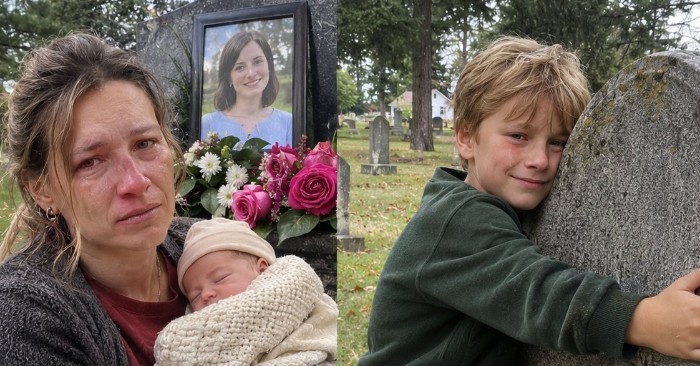
For ten years, I raised my grandson believing his father had walked away before he was born. Then a mysterious woman appeared at my daughter’s grave and revealed something that challenged everything I thought I knew about her final months.
“I promised your daughter something,” the stranger said. “And it’s time you learned the truth.”
She stood beside my daughter’s headstone, holding a sealed envelope.
My name was written across it in handwriting I hadn’t seen for a decade.
My daughter’s handwriting.
I struggled to breathe.
“Where did you get that?”
“She gave it to me.”
“When?”
“The day she gave birth.”
I tightened my grip on the flowers.
“You’ve kept a letter from my daughter for ten years?”
The woman looked down.
“Yes.”
Before I could question her further, my grandson called from the bottom of the hill.
“Grandma! I found it!”
He ran toward us, waving the birthday card he’d made for his mother.
The stranger glanced at him.
“Please don’t read this in front of him.”
“Who are you?”
“I was your daughter’s nurse.”
A terrible feeling settled in my stomach.
She placed the envelope in my hand.
“My telephone number is on the back.”
Then she walked away.
My daughter had been eighteen when she told me she was pregnant.
Throughout those months, I repeatedly asked about the baby’s father.
“Does he know?”
“Mom, please.”
“What’s his name?”
“I can manage this.”
“You shouldn’t have to do it alone.”
“Please stop making everything harder.”
Every conversation became an argument.
Eventually, we could barely discuss her pregnancy without hurting each other.
Then the day of delivery arrived.
A doctor entered the hospital waiting room and sat beside me.
His expression told me something was wrong.
“I’m sorry. We did everything we could.”
I could barely understand him.
“What about the baby?”
“He survived. He’s going to need you.”
My daughter never came home.
Instead, I brought her newborn son into the house where she’d grown up.
For the next decade, we became our own little family.
He grew into a thoughtful, curious boy who loved baseball and my Sunday pancakes.
But there was one question I could never answer.
“Grandma, who was my father?”
“I don’t know, sweetheart.”
Now, with my daughter’s envelope hidden inside my coat, I wondered whether discovering the truth might hurt more than not knowing.
When we returned home, I slipped the letter into a kitchen drawer.
My grandson dropped his backpack beside the table.
“Who was that woman?”
“Someone who knew your mother.”
His eyes brightened.
“Really? What did she say?”
“Not much.”
“Did she know my dad?”
I closed the drawer too quickly.
“I don’t know.”
He frowned.
“You always say that.”
“Because it’s the truth, sweetheart.”
He fell silent.
The expression on his face reminded me of my daughter whenever she withdrew from our difficult conversations.
That night, after he went upstairs, I returned to the kitchen.
I removed the envelope and broke its seal.
A photograph slipped onto the counter.
My daughter stood beside a teenage boy whose face looked familiar.
He’d visited our house twice during her pregnancy, although we’d barely spoken.
An old baseball glove was tucked beneath his arm.
I unfolded the letter.
“Mom,
“I know you think I’m keeping things from you because I don’t trust you.
“But that’s not why.
“He knows about the baby.”
My hands began trembling.
“He wanted to stay. But wanting something and being prepared for it aren’t the same.
“His family keeps telling him that becoming a father will destroy his future. He’s terrified of disappointing them.
“I told him not to come back until he was ready to choose us for himself.”
Then I reached the sentence that changed everything.
“You kept asking who he was, Mom. But you never asked why I was frightened.”
I lowered the letter.
A memory returned with painful clarity.
One evening, my daughter had entered the kitchen while I sat at the table.
“Mom, can I ask you something?”
Without looking up, I’d answered:
“If you’re going to avoid telling me about the father again, I can’t do this tonight.”
She stood silently for several seconds.
Then whispered, “Never mind.”
For ten years, I’d believed she’d refused to trust me.
Now I wondered whether I’d made it impossible for her to speak.
I immediately called the number written on the envelope.
The former nurse answered after four rings.
“You’ve had this letter for ten years.”
“I know.”
“Don’t say that as though it’s nothing!”
She remained silent.
“We need to meet.”
The following morning, I found her sitting in a small diner.
I placed my daughter’s photograph on the table.
“You cared for her at the hospital?”
“For part of that day.”
“Then why did she give you this?”
“She was frightened,” the woman explained. “She was eighteen and preparing to become a mother. She didn’t expect anything terrible to happen.”
Those words struck me.
My daughter hadn’t been preparing a final goodbye.
She’d simply wanted someone to help if something went wrong.
“She asked me to give you the letter if there was an emergency and the boy didn’t come.”
I pointed to the photograph.
“Is this the father?”
“I don’t know his name.”
“Then what do you know?”
The nurse hesitated.
“He came to the hospital.”
I froze.
“What?”
“After your daughter passed away, I saw a young man near the maternity ward asking about her.”
“Did you speak to him?”
“No. But he matched the description she’d given me.”
My heart began racing.
“When I realized who he might be, he noticed you.”
“Doing what?”
“Leaving with the baby.”
“And then?”
“He walked away.”
I stared at her.
“You watched him leave?”
“Yes.”
“And you still kept my daughter’s letter?”
Her eyes filled with tears.
“I convinced myself you were already suffering enough.”
“You made that decision for me.”
“Yes.”
“And for my grandson.”
She nodded.
My anger became strangely calm.
“Why tell me now?”
She looked down.
“I retired several months ago. Without my work to hide behind, I finally admitted that I wasn’t protecting your daughter anymore. I was protecting myself.”
I stood.
“Ten years is a long time to avoid facing one terrible decision.”
Then I left.
The following afternoon, I brought my daughter’s memory box out of my bedroom closet.
I hadn’t opened it in years.
Inside were school photographs, old programs, birthday cards, and the inexpensive silver bracelet she used to wear constantly.
Eventually, I found another photograph of the teenage boy.
He was holding the same baseball glove.
Beneath it was a torn page from my daughter’s notebook.
“Buy diapers.
“Finish thank-you cards.
“Ask Mom about evening classes.
“Tell Mom.
“Tell Mom.”
I stared at those final words.
She’d intended to explain everything.
She simply believed she had more time.
“Grandma?”
My grandson stood in the doorway.
When he noticed the open box, he came over and sat beside me.
“Is that Mom’s stuff?”
“Yes, sweetheart.”
I handed him one of her school photographs.
He smiled.
“I look like her.”
“You have her eyebrows and her nose.”
Then he noticed the photograph of the boy.
“Who’s that?”
“Nobody.”
The answer escaped before I could stop myself.
He frowned.
“Then why did Mom keep his picture?”
He studied my face.
“That woman told you something, didn’t she?”
“Yes.”
“About my father?”
“I’m still trying to understand everything. When I do, I’ll tell you.”
His next words caught me completely unprepared.
“You always tell me not to hide things just because I’m scared.”
“I know.”
“Are you hiding something because you’re scared?”
I swallowed.
“Yes.”
He looked back at the photograph.
“I need a little more time,” I said. “But I promise I won’t leave you wondering forever.”
He nodded reluctantly.
I knew I couldn’t postpone finding answers any longer.
An old school program helped me identify the boy.
After searching online, I eventually found his profile.
I sent a brief message.
“I’m the mother of the girl you knew ten years ago. We need to talk.”
Two hours later, he replied with a single word.
My grandson’s name.
That was enough to confirm he already knew about the child.
We arranged to meet the following morning.
When I arrived, the young man was sitting with a coffee cup, turning it nervously between his hands.
I remembered seeing him do the same thing at our kitchen table years earlier.
“You knew his name,” I said.
“His mother told me.”
“So you knew about him.”
“Yes.”
“Why didn’t you come?”
“I did.”
I stared at him.
“I went to the hospital.”
The nurse’s account immediately returned to me.
“You were there?”
He nodded.
“My parents wanted me to stay away. They believed having a baby would ruin everything I’d planned.”
“And what did you believe?”
“I was frightened. I loved her, but I let my parents make my decisions.”
“That explains being eighteen. It doesn’t explain disappearing for ten years.”
He lowered his head.
“She told me not to come back until I was ready to choose for myself. Eventually, I decided I wanted to be there.”
“But by then, she was gone.”
“I didn’t know that when I left home.”
“You found out at the hospital?”
“Yes.”
“And you saw me carrying your son?”
His eyes filled.
“I panicked.”
“What about the following day?”
He said nothing.
“The next month?”
Still nothing.
“The next year?”
He couldn’t look at me.
“You weren’t eighteen forever.”
“I know. I kept telling myself too much time had passed.”
“And every year, that excuse became easier.”
“Yes.”
I believed he regretted his choices.
But regret couldn’t erase ten years of absence.
“Does my son know about me?” he asked.
“He knows he has a father.”
“Could I meet him?”
“No.”
He looked startled.
“But I’m his father.”
“You helped bring him into this world. Whether you become a father in his life depends on what you do from now on.”
He swallowed.
“What should I do?”
“Write him a letter.”
“A letter?”
“Explain who you are, why you disappeared, and why you’re reaching out now.”
He nodded.
“And don’t blame his mother.”
“I won’t.”
I leaned forward.
“You don’t deserve praise for showing up ten years late. But you still have an opportunity to become someone your son can depend on.”
Two days later, an envelope addressed to my grandson appeared on our porch.
I disliked reading something meant for him, but at ten years old, he still needed my protection.
The letter was simple and direct.
One sentence stayed with me.
“I was scared when I was eighteen, but fear doesn’t excuse the ten years that followed.”
He didn’t demand forgiveness.
He didn’t accuse my daughter.
He accepted responsibility.
Before sharing the letter, however, I needed to speak with the nurse again.
I called her.
“Can we meet?”
She sounded surprised.
“I didn’t think you’d ever want to see me again.”
“I haven’t forgiven you.”
“I understand.”
“But there are things I still need to know.”
We met the next afternoon.
This time, I didn’t ask about my grandson’s father.
I asked about my daughter.
“Was she frightened?”
The nurse nodded.
“Yes.”
“Was she alone?”
“No. Someone stayed with her throughout.”
Relief and grief overwhelmed me together.
“Did she ask for me?”
“Yes.”
My throat tightened.
“Did she believe I’d abandoned her?”
“No. She knew you were waiting nearby.”
I closed my eyes.
“What did she say?”
The nurse thought for a moment.
“She was worried she hadn’t bought enough diapers.”
Despite my tears, I laughed.
“That sounds exactly like her.”
“She also talked about you.”
I immediately looked up.
“What did she say?”
“She told me you made your pancakes too thick and never admitted it.”
Another laugh escaped.
Even after ten years, my daughter could still make me smile.
“She wasn’t angry with you,” the nurse said gently.
“She had every reason to be. I spent so much time demanding answers about the father that I forgot to ask how frightened she was.”
“Perhaps. But that isn’t how she spoke about you.”
Finally, I asked the question that had haunted me for a decade.
“Did she know how much I loved her?”
The nurse answered immediately.
“Yes.”
For the first time since that encounter at the cemetery, I felt something other than pain.
That evening, my grandson noticed the photograph lying on the kitchen table.
“That’s him, isn’t it?”
My instinct was to hide it.
Instead, I dried my hands and sat beside him.
“Yes, sweetheart.”
He pulled out a chair.
“Did he know I existed?”
“Yes.”
“Then why wasn’t he here?”
“He was frightened when he was young. He listened to his parents instead of making his own decisions.”
My grandson listened carefully.
“But even when he got older, he stayed away.”
“Did Mom want him to come back?”
“She wanted him to choose you because he truly wanted to.”
“Did he?”
I refused to soften the truth.
“Not when he should have.”
He studied the picture.
“Do you hate him?”
“I was angry with him before I knew who he was.”
“And now?”
“I understand more about what happened. But understanding isn’t the same as forgiving.”
He thought about that.
“Do I have to meet him?”
“No.”
“Could I meet him if I wanted?”
Everything inside me wanted to say no.
For ten years, my grandson and I had built a peaceful life together.
I was terrified that allowing his father into it might destroy the security we’d created.
Then I remembered my daughter’s words.
“You never asked why I was scared.”
I couldn’t allow my own fear to decide my grandson’s future.
“Yes,” I answered. “If you want to.”
He chose a public baseball field for their first meeting.
His father arrived early, carrying an old leather glove.
My grandson recognized it immediately.
“That’s the glove from the photograph!”
The man looked down at it.
“Yeah.”
“You kept it all these years?”
“I kept a lot of things I didn’t deserve to keep.”
My grandson approached cautiously.
“I’m your son.”
The man nodded, visibly emotional.
“I know.”
Then my grandson pointed toward the baseball field.
“Are you good at baseball?”
“Not particularly.”
“But you have a glove.”
The man smiled.
“Having a glove doesn’t mean you know how to play.”
My grandson laughed.
Soon, they were throwing the ball back and forth.
Their movements were awkward at first.
One throw sailed too high, and my grandson missed it.
“Sorry,” the man called. “That was my fault.”
“I should’ve caught it.”
“No. I made a bad throw.”
I watched from a short distance away.
Eventually, my grandson asked him something I couldn’t hear.
His father crouched beside him.
Instinctively, I started walking toward them.
Then I stopped.
My grandson listened as the man answered.
I remained where I was.
That first meeting didn’t magically turn them into a family.
During the following week, his father called once.
The week after that, he called twice.
He always asked permission before visiting and never insisted that my grandson call him Dad.
One evening, my grandson didn’t feel like speaking to him.
The man accepted his decision without complaint.
I paid attention to those small moments.
My caution wasn’t intended to punish him.
Ten years of absence couldn’t be repaired by a few apologies and a baseball game.
If he wanted our trust, he’d have to earn it through consistency.
And I would have to learn to give him that chance.
Three weeks later, my grandson was sitting at our kitchen table eating his usual Sunday pancakes.
As always, I’d made them far too thick.
“He wants to come to my game on Saturday,” he announced.
I set down the syrup.
“Would you like him there?”
He nodded.
“Yeah.”
“Then he should come.”
He searched my face.
“You won’t be upset?”
“No, sweetheart.”
He hesitated.
“He’s still not really my dad-dad.”
“You don’t have to decide what to call him. Take your time.”
Satisfied, he returned to his breakfast.
I reached across the table to straighten his napkin, something I’d done automatically for years.
Then I noticed the scattered crumbs, the sticky syrup bottle, and his crooked plate.
Normally, I would have tidied everything immediately.
This time, I left it alone.
For years, I’d believed protecting my grandson meant keeping every part of his world under control.
But my daughter had wanted something different.
She’d wanted the people she loved to make their own choices.
Her son’s father had failed to do that when it mattered most.
I had failed to listen when she needed me.
Neither of us could change the past.
But we could choose what happened next.
I looked at the little boy sitting across from me.
He was growing older, asking difficult questions, and beginning to understand that the adults around him weren’t perfect.
He deserved honest answers.
He deserved the freedom to decide what kind of relationship he wanted with his father.
And most importantly, he deserved to know that none of the mistakes adults had made were his responsibility.
“Grandma?” he asked.
“Yes, sweetheart?”
“Do you think Mom would’ve liked him coming to my baseball game?”
I looked toward the photograph of my daughter on the kitchen shelf.
“I think she’d be happy to know you’re surrounded by people who want to be there for you.”
He smiled.
“Will you still come?”
I reached across the table and squeezed his hand.
“Of course.”
“Even if he comes?”
“Especially then.”
He grinned and took another enormous bite of pancake.
I laughed.
For ten years, I’d believed my daughter had left me with unanswered questions.
But the letter she’d written on the day her son was born had finally taught me something I desperately needed to understand.
Love wasn’t about having every answer.
It wasn’t about controlling every decision or protecting someone from every possible disappointment.
Sometimes love meant listening.
Sometimes it meant admitting you’d been wrong.
And sometimes it meant opening a door you were frightened to open.
I couldn’t bring my daughter back.
I couldn’t recover the conversations we’d never finished.
But I could honor her by giving her son the understanding and patience I’d struggled to offer her.
That Saturday, I sat in the bleachers at my grandson’s baseball game.
His father arrived a few minutes later and quietly took a seat several rows away.
When my grandson spotted us both, his face brightened.
He waved.
I waved back.
So did his father.
Then the boy turned toward the field, ready to play.
For the first time in ten years, I wasn’t the only person waiting to cheer him on.
And instead of feeling as though I was losing my place in his life, I realized something wonderful.
There was finally room for more love.
My daughter had been gone for a decade.
But through the little boy she’d left behind, she was still teaching me how to be a better mother.
And a better grandmother.