When I arrived at my childhood friend’s thirtieth birthday celebration, I immediately noticed that something about the private dining room felt unusual.
Only four chairs had been placed around the table.
Three were already occupied.
The fourth had been reserved for Caleb.
There were no additional guests, no elaborate birthday decorations, and not even a birthday cake.
I’d driven four hours to celebrate with him, yet the strange atmosphere made me wonder whether something serious had happened.
The last time Caleb had gathered the four of us for an important occasion, we were thirteen years old.
Our closest friend was fighting for his life.
Seventeen years earlier, Caleb Mitchell had been the quietest member of our little group.
There were four of us: Caleb, Mason, Ryan, and me.
Mason was always responsible, Ryan could make everyone laugh, Caleb was exceptionally intelligent, and I usually ended up settling their arguments.
We’d been friends since elementary school.
Most afternoons were spent riding bicycles, playing basketball, and arguing about the smallest things as though they were matters of enormous importance.
Then, quite unexpectedly, Caleb stopped showing up at school.
At first, our teacher told us he’d been diagnosed with a serious infection.
A week passed.
Then another.
His desk remained empty.
Eventually, my mother sat me down and explained that Caleb had been diagnosed with a life-threatening illness.
I was thirteen.
I understood that being seriously ill was frightening, but I couldn’t comprehend how something so terrible could happen to someone my own age.
“When will he come back to school?” I asked.
Mom gently held my hand.
“We don’t know, sweetheart.”
Her answer frightened me more than I wanted to admit.
Two weeks later, we finally received permission to visit him.
Caleb was sitting in his hospital bed beneath a blue blanket. He’d lost weight, and his tired eyes looked different from the ones I remembered.
Ryan had brought a basketball, which he accidentally bounced so hard that it hit the ceiling.
Caleb immediately started laughing.
“You idiot! My mom is going to kill you!”
For a few minutes, everything felt normal again.
Then Caleb raised his hand to scratch his head.
Several strands of hair came away between his fingers.
He looked at them briefly before trying to hide them.
None of us knew what to say.
Over the following months, his treatment caused him to lose the rest of his hair.
Eventually, he stopped wanting visitors.
We assumed he was simply too exhausted to spend time with friends.
But one evening, I overheard his mother speaking to mine.
“He hardly leaves his bedroom anymore,” Mrs. Mitchell explained tearfully. “He’s afraid the other children will laugh at him.”
She paused before adding something that stayed with me.
“He keeps telling me he looks terrible. He won’t even look at his reflection.”
That evening, I called Mason and Ryan.
Within twenty minutes, both were at my house.
“We need to do something for Caleb,” Mason said.
“But what can we actually do?” I asked.
Ryan looked down thoughtfully.
Then he ran his fingers through his hair.
“What if he wasn’t the only one at school without hair?”
We stared at him for a moment.
Then we understood his idea.
My father kept an electric hair clipper in the bathroom.
A few minutes later, all three of us were standing in front of the mirror.
Ryan volunteered to go first.
“Make sure I look incredibly attractive,” he joked.
Mason laughed.
“That’s going to be difficult, even with a professional haircut.”
I switched on the clippers.
Dark strands of hair began falling onto the bathroom tiles.
Ryan examined his reflection.
“Oh, fantastic. I look absolutely ridiculous!”
We couldn’t stop laughing.
Then Mason took his turn.
Finally, it was my turn.
I hesitated briefly.
I’d spent months growing my hair into a style I thought made me look older and more impressive.
But then I remembered Caleb hiding beneath his cap.
“Just do it,” I told Ryan.
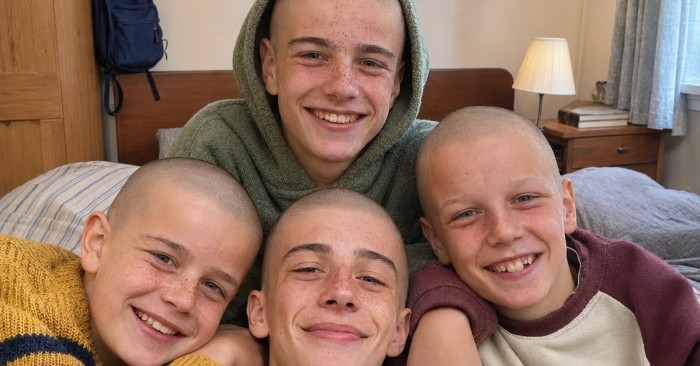
When We Finished, Three Completely Bald Thirteen-Year-Old Boys Were Standing in Front of the Mirror.
We looked ridiculous.
But for the first time since Caleb had become ill, I felt we’d found a way to show him that he wasn’t alone.
The following morning, we went to his house.
Mrs. Mitchell opened the door and immediately noticed our shaved heads.
She covered her mouth as tears filled her eyes.
“You wonderful boys…”
She pulled us into a tight embrace.
When we entered Caleb’s bedroom, he looked irritated.
“I told Mom I didn’t want visitors.”
Then he noticed our heads.
His eyes widened.
“What on earth happened to you?”
Ryan stretched out his arms.
“It’s the newest fashion trend. Apparently, you haven’t been keeping up.”
Caleb stared at us in disbelief.
“Why would you do that?”
Mason moved closer to his bed.
“Because we’re not going to let you go through this alone.”
Caleb’s expression suddenly changed.
Slowly, he removed the cap he’d been wearing.
For the first time in weeks, he stopped trying to hide his appearance from us.
Ryan grinned.
“If anybody makes fun of you, they’ll have to make fun of all four of us.”
Caleb’s eyes filled with tears.
Then he climbed out of bed and hugged us.
We stood together in his bedroom, four skinny boys with shaved heads and tears running down our faces.
That afternoon, his mother took a photograph of us.
Before leaving, Caleb extended his hand.
“No matter what happens, we’re going to stay together. Promise?”
We placed our hands over his.
“Four brothers,” Caleb whispered.
“Four brothers,” we repeated.
At thirteen, we believed that nothing could ever break a promise like that.
We couldn’t have imagined how differently life would eventually unfold.
Caleb returned to school three weeks after our visit.
We waited for him outside his house.
He appeared wearing a baseball cap.
Ryan immediately pointed at it.
“Seriously? We sacrificed our amazing hairstyles, and you’re still hiding yours?”
Caleb laughed nervously.
Then he took off his cap.
The four of us walked into school together.
Four boys with completely shaved heads.
Naturally, everyone stared.
Some students laughed, while a younger boy asked whether we’d lost a bet.
Ryan confidently explained that we’d joined a secret club and were planning to shave our eyebrows next.
The boy quickly walked away.
Caleb laughed so hard that he almost stumbled.
Of course, not every day was filled with laughter.
His treatment continued, and there were mornings when he was too weak to attend classes.
Sometimes, he became sick at school.
On one occasion, while we were playing basketball, he suddenly collapsed because he was struggling to breathe.
I remember kneeling beside him and holding his hand while Mason rushed to find help.
There was nothing we could do to make his illness disappear.
We couldn’t take away the discomfort caused by his treatment.
But we could make sure he never felt abandoned.
And we did our best to keep that promise.
After nearly two years of treatment and recovery, Caleb’s doctors finally announced that he was in remission.
We celebrated in his backyard with a huge chocolate cake.
His mother had written three simple words across the top:
YOU DID IT.
We were fifteen years old.
Old enough to understand how close we’d come to losing someone we loved.
But still young enough to believe that the worst was finally behind us.
Little by little, life returned to normal.
Caleb’s hair grew back.
We entered high school, studied for examinations, played sports, and experienced all the ordinary complications of growing up.
We also made a tradition of taking a new photograph together every year.
We always stood in the same positions.
Four friends.
Only our hairstyles and increasingly ridiculous expressions changed.
By graduation, we rarely discussed Caleb’s illness.
He didn’t want people to remember him only as the boy who had survived a serious disease.
He wanted to be treated like everyone else.
He wanted to be Caleb.
Our friend.
Our brother.
However, As We Became Adults, Our Lives Slowly Started Moving in Different Directions.
Mason became an engineer.
Ryan moved to Chicago and started working in sales.
Caleb studied biology before accepting a position with a charitable organization supporting children undergoing difficult medical treatments.
I relocated, got married, and became increasingly occupied with my career.
Initially, the four of us spoke almost every day.
Eventually, our conversations became weekly.
Then months started passing between telephone calls.
We regularly discussed organizing another reunion.
But something always seemed to get in the way.
Work deadlines.
Family responsibilities.
Travel plans.
All the familiar excuses people make when they assume there will always be another chance.
The last time I’d seen Caleb in person, we were twenty-four.
We met for dinner while he was visiting my city for work.
He told me about children who were frightened to return to school after losing their hair during treatment.
“Some of them remind me of what I was like at that age,” he admitted.
“Doesn’t it make your job emotionally difficult?”
“Sometimes,” he answered.
Then he smiled.
“But I had three idiots who made everything easier. I want those children to have someone like that in their lives too.”
Before we separated, he hugged me.
“Don’t disappear on me, all right?”
I promised I wouldn’t.
But over the following years, I gradually did exactly that.
Six years later, a message from Caleb appeared on my phone.
Hey, brother. I’m turning thirty next Saturday. I’m planning a small birthday dinner, and it would mean a lot if you came.
A second message followed.
Mason and Ryan will be there too.
Then another one arrived.
I really need all three of you to come.
Something about the way he’d written that final message made me uneasy.
I asked whether everything was okay.
Caleb replied:
There’s something important I’d rather explain in person.
I immediately tried calling him.
He didn’t answer.
Instead, another message appeared.
Please don’t worry about me. Just make sure you come.
I rearranged my schedule.
After everything we’d experienced together, driving four hours seemed like a very small price to pay.
When I arrived at Bellamy’s restaurant, a hostess directed me to a private dining room.
Mason and Ryan were already there.
But one chair was still empty.
“Where is everybody else?” I asked.
Ryan shrugged.
“Apparently, we’ve been invited to the entire birthday celebration.”
We greeted one another and spent some time catching up on everything that had happened since our last meeting.
Then Mason mentioned something that immediately caught my attention.
“Caleb’s mother called me a few months ago. She said he’d been experiencing some health problems.”
My stomach tightened.
“What kind of problems?”
Before Mason could answer, the door opened.
Caleb walked into the room.
He looked thinner than I remembered.
His face appeared tired, and his hair was cut much shorter than usual.
But he still had the familiar crooked smile we’d known since childhood.
“Well, look at you three,” he said quietly.
We immediately stood and embraced him.
He held each of us a little longer than expected.
Then he took his place at the table.
I noticed that his hands were trembling.
“I didn’t bring you here just to celebrate my birthday,” he finally admitted.
Everyone became quiet.
He looked around at the three of us.
“Seventeen years ago, you saved my life.”
Ryan tried to lighten the atmosphere.
“I think the doctors deserve most of that credit. All we did was give ourselves the worst haircuts in history.”
Caleb smiled briefly.
But his expression soon changed.
He lowered his eyes toward the table.
“I remember something very different from that afternoon.”
His voice became softer.
“I remember being terrified. I thought everyone would laugh at me. I hated the way I looked. And honestly, I was convinced I wasn’t going to survive.”
Nobody interrupted him.
“I had stopped wanting to eat. I wouldn’t leave my bedroom, and I couldn’t even stand looking in the mirror.”
His voice began trembling.
“Then three idiots showed up at my house without a single hair on their heads.”
Ryan wiped his eyes.
Caleb continued.
“That was the first time in months that I remembered how to laugh.”
He paused.
“And it was the first time I felt that perhaps I still had something worth fighting for.”
Mason reached across the table.
“You’ve never owed us anything, Caleb.”
“I know,” he whispered.
“But there’s something else I need to tell you.”
He took a deep breath.
“About six months ago, I visited my doctor for what I thought was just a routine examination.”
I immediately felt uneasy.
Caleb explained that he’d been unusually exhausted for some time.
Initially, he’d blamed his demanding job and assumed he needed more rest.
But his doctors decided to perform further tests.
Then they asked him to return for another appointment.
Caleb lowered his head.
“The illness has returned.”
For several seconds, nobody moved.
It felt as though seventeen years had disappeared.
We were suddenly those frightened thirteen-year-old boys again.
Ryan whispered, “No…”
Caleb nodded.
“They caught it early. I’ve already begun treatment, and the doctors are cautiously optimistic.”
Mason leaned closer.
“Why didn’t you tell us earlier?”
Caleb stared at his hands.
“Because I remembered how frightened everyone was the first time. I didn’t want to put you through all of that again.”
Tears began filling my eyes.
“Caleb, you don’t get to decide whether we care about you.”
He looked up.
“We promised we’d always be brothers,” I continued. “Brothers don’t walk away when things become difficult.”
Ryan nodded firmly.
“Exactly.”
Mason placed his hand on Caleb’s shoulder.
“Whatever happens from here, we’re staying.”
Caleb closed his eyes.
When he opened them, I noticed a sense of relief in his expression.
“That’s one reason I wanted all of us together tonight.”
Then he reached for his phone and showed us a photograph.
A little girl was lying in a hospital bed beneath a pink blanket.
She had beautiful brown eyes and a stuffed rabbit beside her pillow.
Her head was completely bald.
“Her name is Lily,” Caleb explained. “She’s seven years old.”
She was receiving medical treatment and had become terrified of going back to school.
She worried that other children would laugh at her appearance.
She refused to have photographs taken and avoided looking at herself in the mirror.
Her situation reminded Caleb of exactly how he’d felt seventeen years earlier.
“I told her mother about the three of you,” he continued.
“I explained how you all shaved your heads because you didn’t want me to feel different.”
Ryan smiled.
“Well, obviously. We’ve always been trendsetters.”
Caleb laughed.
“Apparently, Lily thought our story was hilarious.”
Then his expression became serious again.
“Yesterday, she asked her mother something.”
“What did she ask?” Mason wondered.
Caleb looked directly at us.
“She wanted to know whether those three boys would be brave enough to shave their heads again.”
For a moment, the entire room was silent.
Then Ryan slowly pushed his chair backward.
“Where can we find some clippers?”
Caleb looked confused.
“What?”
“The electric hair clippers, you idiot.”
Mason started laughing through his tears.
I stood up.
“I’m ready.”
Caleb covered his face with both hands.
His shoulders began shaking as he cried.
We gathered around him.
Four friends.
One promise.
The same friendship that had helped us survive some of the most difficult moments of our childhood.
Then Caleb revealed something else.
“Lily and her mother are actually here tonight.”
He glanced toward the entrance.
“And I invited someone else too.”
Before we could ask who he meant, someone knocked on the door.
A woman entered holding a little girl’s hand.
Lily wore a yellow cardigan and a knitted hat. Her stuffed rabbit was tucked beneath her arm.
Her mother introduced herself as Hannah.
Lily looked directly at Ryan.
“Are you one of the boys who shaved his head?”
Ryan grinned.
“I used to be. These days, I’m incredibly handsome.”
She giggled.
Then another person appeared behind them.
An elderly man with silver hair was standing in the doorway, leaning on a walking cane.
Initially, I barely noticed him.
But Caleb did.
The color suddenly disappeared from his face.
He grabbed the back of his chair.
Then he whispered something that made all of us turn toward him.
“That’s impossible.”
The elderly man stopped.
Tears immediately appeared in Caleb’s eyes.
“They told me you died seventeen years ago.”
Nobody spoke.
Then I recognized the man’s features.
I’d seen them before in an old photograph that once stood on Caleb’s bedroom dresser.
His narrow nose.
His familiar eyes.
The shape of his jaw.
It was Caleb’s father.
The man we’d all believed had died in a terrible highway accident while Caleb was receiving treatment.
We’d been thirteen at the time.
We’d been told that Mr. Mitchell had been involved in a collision with several vehicles while traveling for work.
There had been a funeral.
The coffin had remained closed.
And nobody had ever questioned the explanation.
Yet there he was.
Standing in front of us.
Alive.
Caleb took an uncertain step toward him.
“Dad?”
The elderly man’s expression crumbled.
“Hello, son.”
Caleb stumbled backward.
Mason reached out and steadied his arm.
“No,” Caleb whispered. “This can’t be happening.”
His father remained near the doorway.
“I understand how difficult this must be to believe.”
Caleb stared at him.
“Mom told me you were dead!”
“I know.”
“Then where have you been all these years?”
His father explained that a serious mistake had occurred during the identification process following the original accident.
Another person involved in the collision had mistakenly been identified as him.
Meanwhile, he’d been transported to a different hospital without any identification documents.
He’d suffered a severe head injury.
For years, his memory remained badly affected.
He couldn’t remember his name or recognize where he’d lived.
He spent a long time receiving medical treatment before eventually moving into an assisted-living facility.
Occasionally, fragments of memories returned.
A familiar kitchen.
A bicycle.
A woman singing.
A little boy laughing.
But he couldn’t connect those memories to his own identity.
Only recently had a detailed review of old medical documents helped establish who he really was.
Hannah, Lily’s mother, worked with a community assistance program connected to his care facility.
She’d helped him investigate his forgotten past.
Eventually, they discovered information about the Mitchell family.
But Caleb’s mother had passed away two years earlier.
His father had only recently learned that his son had survived his childhood illness and grown into a thirty-year-old man.
He’d also discovered that Caleb was facing another difficult medical battle.
Caleb listened without moving.
“Seventeen years,” he whispered.
His father nodded.
“I know.”
“I waited for you, Dad.”
Tears streamed down his face.
“I was thirteen. I was so scared. I thought I might die, and I kept waiting for you to come home.”
His father began crying.
“I wish I’d known where you were. I wish somebody had found you sooner.”
Caleb turned away.
His expression showed both anger and overwhelming sadness.
Then Lily quietly approached him.
She gently tugged on his sleeve.
“Are you crying because you missed your dad?”
Caleb looked down at her.
After a moment, he nodded.
Lily glanced toward the elderly man.
“My mommy says missing someone means you love them very much.”
She paused thoughtfully.
“Maybe you can sit together now.”
Nobody knew what to say.
Caleb looked toward his father.
The elderly man was waiting quietly.
He didn’t demand forgiveness.
He didn’t insist that Caleb embrace him.
He simply stood there, looking at the son he’d lost so many years earlier.
I gently placed my hand on Caleb’s shoulder.
“You don’t have to understand everything tonight,” I whispered.
He nodded.
Then he approached his father.
“Dad, did you ever stop looking for me?”
The old man shook his head.
“Never. Even when I couldn’t remember your name, I always felt that somebody important was missing from my life.”
Caleb’s face crumpled.
He moved closer.
His father attempted to stand upright.
Caleb lowered himself to his knees and wrapped his arms around him.
His Father Dropped His Cane as He Pulled His Son Into an Embrace.
“I needed you,” Caleb sobbed.
“I know, sweetheart.”
“I needed you so much.”
His father rested his cheek against Caleb’s head.
“I’m sorry. I’m so terribly sorry.”
Nobody in the room could hold back their tears.
We watched our thirty-year-old friend become a frightened thirteen-year-old boy again as he finally embraced the father he’d spent seventeen years believing was gone.
After a long time, Caleb pulled away.
His father gently touched his cheek.
“You look so much like your mother.”
Caleb nodded.
“She missed you every single day.”
The elderly man closed his eyes.
“I wish I’d had the chance to tell her I was still alive.”
They sat together without speaking.
Seventeen birthdays had passed.
Seventeen Christmas celebrations.
Graduation.
College.
Countless important moments they’d never been able to share.
Nothing could bring those lost years back.
But they finally had an opportunity to make new memories.
Then Lily raised her hand.
Everyone turned toward her.
“Are you really going to shave your heads?”
Ryan grinned.
“Sweetheart, I drove three hours to get this haircut.”
Mason laughed.
“I drove five.”
Then Caleb’s father slowly ran his fingers through his gray hair.
“If you don’t mind,” he said, “I’d like to join you.”
Caleb looked at him in surprise.
“Dad, you don’t have to do that.”
“I know.”
The elderly man smiled at Lily.
“But sometimes giving up a little hair can help someone find a lot of courage.”
Lily’s mother smiled through her tears.
The restaurant manager looked completely bewildered when Ryan asked whether they had electric clippers.
“Here? Inside the restaurant?”
“Preferably somewhere away from the food,” Mason replied.
Caleb started laughing.
It was the first genuinely carefree laugh we’d heard from him all evening.
After hearing Lily’s story, the manager contacted his brother, who owned a nearby barbershop.
About fifteen minutes later, he returned with a professional set of clippers.
He also offered us an unused service room with several chairs and a large mirror.
Lily climbed onto one of the chairs, holding her stuffed rabbit tightly.
Her mother stood beside her.
Ryan picked up the clippers.
“Who’s volunteering first?”
I raised my hand.
“Me.”
Seventeen years earlier, Ryan had volunteered to go first.
This time, I wanted that honor.
Caleb placed a towel around my shoulders.
For a few seconds, we looked at one another.
Behind his tired expression, I could still recognize the frightened thirteen-year-old boy I’d known for most of my life.
“Ready?” he asked.
I smiled.
“Just make sure I look good.”
He laughed.
Then the clippers started buzzing.
The first strands of hair fell onto my shoulders.
I closed my eyes.
Suddenly, I remembered standing in my parents’ bathroom all those years ago.
Thirteen years old.
Frightened that my best friend might not survive.
Trying to help him in the only way I knew.
When Caleb finished, I examined myself in the mirror.
I looked completely ridiculous.
Lily studied my reflection.
Then she giggled.
“You look like an egg!”
Everyone burst into laughter.
“A handsome egg?” I asked.
She nodded seriously.
“A very nice egg.”
Mason volunteered next.
Then Ryan took his turn.
He spent the entire time complaining dramatically about losing his expensive hairstyle.
Finally, Caleb sat down.
Much of his hair had already fallen out because of his treatment, but he wanted to take part too.
Mason carefully removed the remaining strands.
When Caleb looked at himself in the mirror, his expression softened.
“Just like when we were little,” he whispered.
Then his father took the chair.
Caleb hesitated.
“Dad, are you completely sure?”
His father nodded.
“Absolutely.”
As Caleb carefully shaved away his father’s gray hair, the elderly man looked toward Lily.
“I’ve missed so many important moments in my son’s life,” he said.
He paused.
“But I’m grateful I can share this moment with him.”
Tears gathered in Caleb’s eyes.
His father gently squeezed his hand.
“I wish I could have been there for you all those years ago. But if you’ll allow me, I want to be beside you from now on.”
Caleb nodded.
“I’d really like that, Dad.”
When the final gray strands fell, his father examined himself in the mirror.
Then he turned toward Lily.
“Well, what do you think?”
She grinned.
“Now you all look like eggs!”
The entire room erupted with laughter.
When we returned to the private dining room, the restaurant manager had arranged another surprise.
Two birthday cakes were waiting on the table.
One was chocolate, with a message written across the top.
HAPPY 30TH BIRTHDAY, CALEB.
The second was smaller and decorated with pink frosting.
Its message read:
YOU ARE NEVER ALONE.
Lily stared at the little cake.
“Is that one for me?”
The manager smiled.
“Of course it is.”
Her face immediately lit up.
We gathered together for a photograph.
Five bald men.
One little girl who had finally taken off her knitted hat.
And a mother smiling through her tears.
Caleb’s father rested his hand on his son’s shoulder.
Ryan put his arm around Mason.
I stood beside Caleb.
The restaurant manager raised the camera.
“Everyone ready?”
Ryan shouted, “Say egg!”
Lily burst into laughter.
The camera flashed.
For a moment, I remembered another photograph.
Four bald thirteen-year-old boys standing together in a sunny backyard.
Seventeen years separated those two pictures.
But the promise connecting them had never changed.
Later that evening, Caleb asked us to read the letters he’d prepared for each of us.
I carefully unfolded mine.
To my brother,
You probably remember the day we shaved our heads as a funny adventure from childhood.
For me, it was the day I stopped feeling completely alone.
You never demanded that I act brave or pretend I wasn’t frightened. You simply stayed beside me until I found the strength to face the world again.
I don’t know what the coming months will bring.
But whatever happens, I want you to understand how much your friendship has meant to me.
Thank you for never allowing me to face my darkest moments alone.
I couldn’t finish reading the letter aloud.
Mason and Ryan were equally emotional.
We embraced Caleb once again.
Before leaving the restaurant, we discussed his upcoming medical appointments.
Mason offered to arrange transportation whenever Caleb needed it.
Ryan promised to visit regularly.
I told him I’d organize time away from work whenever he needed company or support.
Caleb immediately tried to protest.
We ignored him.
Some traditions were too important to abandon.
His father then asked whether he could accompany Caleb to his next hospital appointment.
Caleb smiled.
“I’d love that.”
As the evening came to an end, Lily approached me with her stuffed rabbit tucked beneath one arm.
“Do you think Caleb will get better?”
I crouched beside her.
I wanted desperately to promise that everything would be fine.
But I understood that nobody could guarantee such a thing.
“I really hope so,” I answered gently.
She looked worried.
“Me too.”
I smiled.
“The doctors are doing everything they can to help him. And all of us will stay beside him.”
She thought about that for a moment.
“Even when he’s frightened?”
“Especially when he’s frightened.”
Lily glanced toward Caleb and the other men.
Then she smiled.
“Good. Nobody should have to be scared all alone.”
I couldn’t have agreed more.
In the weeks that followed, the four of us made a real effort to become part of one another’s lives again.
There were regular phone calls.
Visits.
Medical appointments.
And more ridiculous jokes than any of us could remember.
Caleb still had an uncertain road ahead.
His treatment was difficult.
Some days he felt exhausted or frightened about what the future might bring.
But this time, he didn’t have to face those feelings by himself.
His father also gradually became part of his everyday routine.
They couldn’t recover the seventeen years they’d lost.
But they could begin building a relationship with whatever time they had now.
One afternoon, after a hospital appointment, Caleb handed me another envelope.
I laughed.
“Have you started writing letters to everyone again?”
He shook his head.
“Just open it.”
Inside Was a Copy of the Photograph We’d Taken Together the Night of His Birthday.
On the back, Caleb had written:
Seventeen years later, we’re still on the same team.
I stared at the words for a long moment.
Then I wrapped my arms around him.
“Four brothers,” I whispered.
Caleb smiled.
“Four brothers.”
When we were thirteen, we thought forever meant that we’d never be separated.
Now, at thirty, I understood that it meant something much more important.
Forever didn’t mean life would always be simple.
It didn’t guarantee that nobody would become seriously ill.
And it certainly didn’t mean that distance, grief, or unexpected events would never interfere with our plans.
It meant that whenever one of us needed the others, we’d find a way to come back.
Even after seventeen years.
Even when hundreds of miles separated us.
Even when nobody could predict what tomorrow might bring.
Because sometimes, the greatest thing you can offer another person isn’t a cure or a promise that everything will turn out perfectly.
Sometimes, it’s simply being there.
Staying beside them.
Holding their hand when they’re frightened.
And reminding them that whatever happens next, they will never have to face it alone.