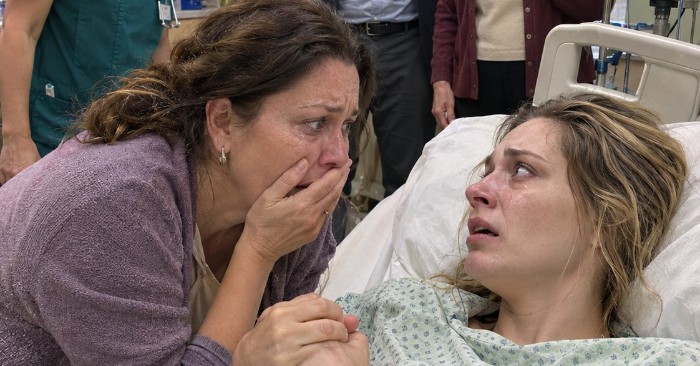
After Spending Four Months Unconscious, My Daughter Finally Opened Her Eyes. But Her First Words Weren’t About the Hospital or Her Injuries. Instead, She Whispered a Warning That Sent a Chill Through Me.
“Mom, he knows what I uncovered.”
I moved closer, gently holding her unsteady hand.
“Sophie, darling, what are you trying to tell me?”
She struggled to keep her eyes focused on mine.
“The hidden safe… behind the picture. Don’t let Christopher know.”
Then she managed to whisper something even more frightening.
“He never intended to save me.”
Before I could ask another question, the monitor beside her bed began sounding urgently. Medical staff rushed into the room, and I was instructed to step into the corridor.
Standing near the far end of the hallway was my daughter’s husband, Christopher Langford.
He wore an immaculate dark-blue designer suit, an expensive wristwatch, and the same carefully rehearsed expression of concern he’d displayed throughout the previous four months.
“What’s going on?” he demanded.
“Sophie regained consciousness,” I told him.
His face changed instantly.
But instead of seeing happiness or relief, I noticed an expression that looked alarmingly like terror.
His mother, Diane, stepped into the hallway behind him.
“That’s impossible,” she said sharply. “The doctors told us she might never wake up.”
Christopher immediately pulled out his phone.
And in that instant, I understood that my daughter’s words hadn’t been the confused ramblings of someone recovering from a coma.
She’d been desperately trying to warn me.
Four months earlier, Sophie had been discovered unconscious at the foot of the grand marble staircase inside the mansion she shared with Christopher.
Her husband claimed she’d consumed too much wine, stumbled on the stairs, and suffered a catastrophic head injury.
But something about his explanation had never seemed right to me.
Sophie was thirty-five years old, worked successfully as a financial consultant, and hardly ever drank alcohol.
Even more troubling was the telephone conversation we’d had the afternoon before she was injured.
“Mom, there’s something I have to tell you about Christopher,” she’d whispered. “Something terrible.”
Before she could explain further, I heard a door opening somewhere near her.
Her voice suddenly became tense.
“I’ll call you tomorrow.”
But she never made that call.
Instead, the following evening, I learned that my daughter had been taken to the hospital with a severe head injury.
Throughout the next four months, I visited her almost every single day.
I remained beside her hospital bed, held her hand, read her favorite books aloud, and repeatedly promised that I’d be waiting whenever she was ready to come home.
Christopher and Diane made little effort to hide how much my presence annoyed them.
One afternoon, Diane stood near the end of Sophie’s bed and gave a contemptuous laugh.
“She can’t even hear a word you’re saying. Why do you insist on putting on this ridiculous display?”
Christopher chuckled.
“Honestly, Helen, you’re making the entire situation uncomfortable for everyone.”
I looked down and continued gently holding my daughter’s hand.
They assumed I was nothing more than a heartbroken mother who refused to acknowledge the seriousness of her daughter’s condition.
What they didn’t realize was that, before retiring, I’d spent twenty-seven years investigating complicated cases of corporate financial wrongdoing.
My work had involved analyzing intricate accounting records, tracing suspicious money transfers, and dealing with powerful individuals who believed their wealth placed them beyond the reach of the law.
I knew the many ways people attempted to conceal incriminating evidence.
And I understood that individuals often made serious mistakes when they assumed nobody was watching closely.
That evening, after Sophie briefly regained consciousness, I stepped into the hospital stairwell and called someone from my professional past.
My former colleague, Laura Mitchell, had worked as a federal investigator specializing in financial crimes.
She answered after the third ring.
“Helen? Is something wrong?”
“I believe Christopher may have intentionally harmed Sophie.”
Her tone immediately became serious.
“Why do you suspect that?”
I told her about my daughter’s warning, the concealed safe, and Christopher’s disturbing reaction when he discovered Sophie had awakened.
Laura listened without interrupting.
Then she asked what I wanted her to do.
Through the stairwell window, I could see Christopher walking anxiously back and forth outside Sophie’s room.
“First,” I whispered, “I need you to help me discover what’s hidden inside that safe.”
The following morning, Christopher telephoned me.
He announced that he was planning to transfer Sophie to an exclusive private rehabilitation center.
I reminded him that she’d only just regained consciousness and still required close medical supervision at the hospital.
He insisted that the doctors would decide when a transfer was medically appropriate, but claimed that as her husband, he would be responsible for arranging everything.
In the background, I heard Diane remark cruelly that it was about time I went home and found something more useful to do with my days.
I forced myself not to respond.
Instead, I calmly acknowledged what he’d said and ended the conversation.
Later that afternoon, while Christopher attended a business appointment and Diane was elsewhere, Laura and I went to the Langford mansion accompanied by an attorney.
We had written authorization signed by Sophie permitting us to collect certain personal documents belonging to her.
The mansion was just as extravagant as I remembered.
Glossy floors, luxurious furniture, and enormous works of art filled the spacious rooms.
A large oil painting depicting the estate hung above the living room fireplace.
I walked toward it cautiously.
Concealed behind the frame, exactly where Sophie had described, was a steel safe built into the wall.
Years earlier, my daughter had given me the combination in case of an emergency.
I entered the numbers carefully.
The mechanism clicked, and the safe opened.
Inside were three USB drives, a leather-bound notebook, and a large sealed envelope.
Across the front of the envelope, Sophie had written:
IF SOMETHING HAPPENS TO ME, THIS MUST GO TO MOM.
My fingers trembled as I broke the seal.
The first documents detailed questionable financial transfers amounting to nearly eleven million dollars.
The funds appeared to have been redirected from accounts associated with Sophie’s consulting clients into businesses controlled by Christopher.
Additional records contained suspicious electronic approvals and paperwork associated with a property investment company.
Then I discovered an unfinished life insurance application.
Sophie was identified as the person to be insured.
Christopher appeared as the designated beneficiary.
The proposed policy was worth eight million dollars, although the application apparently hadn’t been finalized.
Laura began carefully examining the leather notebook.
Her expression grew increasingly serious.
“Helen, your daughter was conducting an investigation into her own husband.”
Sophie’s handwritten notes revealed that she’d spent months tracking unexplained withdrawals and complicated financial transfers.
She appeared to have discovered that Christopher and Diane were using their real estate business to divert clients’ money while presenting the transactions as ordinary consulting costs.
One entry, written shortly before her injury, was especially alarming.
Sophie had recorded that Christopher was aware of her investigation and that Diane had warned her to stop asking questions.
She’d also written that she was becoming increasingly afraid for her safety.
Then I noticed a brief sentence that made my hands begin shaking.
“He threatened me near the staircase.”
Laura immediately advised that we preserve everything properly and notify the relevant law enforcement authorities.
We carefully documented the location where each item had been discovered and arranged for the original materials to be delivered to investigators with written confirmation of receipt.
When I returned to the hospital, Sophie was awake.
She looked extremely weak, but she recognized me the moment I approached.
“Mom,” she whispered. “Were you able to find it?”
I wrapped my fingers gently around hers.
“Yes, sweetheart. We found all of it.”
Tears began sliding down her cheeks.
Then she slowly started describing what had happened on the evening she was injured.
She explained that she’d confronted Christopher about the suspicious transfers and told him she intended to report the financial activity to the authorities.
Their argument had taken place upstairs.
According to Sophie, Christopher seized her arm when she attempted to walk away.
Then he shoved her toward the staircase.
I felt as though I couldn’t draw a full breath.
“Sophie… are you absolutely certain?”
She gave a weak nod.
“Diane was standing there. She watched him do it.”
I tightened my grip on her hand.
My daughter began to cry.
“He said nobody would ever believe what I told them.”
I leaned forward and gently kissed her forehead.
“I believe you, darling. And we’re going to make certain the investigators hear your account.”
Later that evening, Christopher appeared at the hospital carrying a bouquet of flowers.
He approached Sophie’s bed with a tender smile that now seemed horribly artificial.
“My beautiful wife,” he murmured. “You’re finally recovering.”
He leaned down, apparently intending to kiss her forehead.
Sophie immediately stiffened.
I noticed her reaction.
The nurse standing nearby noticed it as well.
Christopher carefully straightened the blanket covering her.
“There’s nothing to worry about, sweetheart. I’ll handle everything.”
I looked at him and managed a small smile.
“I’m certain you will.”
He had no idea that Sophie had already given investigators a recorded account of what happened, after her physician confirmed that she was medically capable of participating.
Meanwhile, Laura had discovered another disturbing piece of information.
The questionable financial transactions were continuing.
Records suggested Christopher was arranging to move another two million dollars into overseas accounts within the next forty-eight hours.
He appeared completely convinced that nobody had the ability to stop him.
And his certainty was causing him to make increasingly reckless decisions.
Three days afterward, Christopher asked me to meet him at his office in downtown Chicago.
His workplace occupied one of the upper floors of a prestigious commercial tower, with enormous windows offering panoramic views of the city.
When I arrived, Diane was already seated near his desk.
A document had been placed in front of the chair reserved for me.
Christopher pushed it closer.
“We need you to cooperate with us, Helen.”
I picked up the paper and began reading.
It was a prepared statement claiming that Sophie had displayed confusion, emotional instability, and poor judgment before her accident.
Christopher expected me to confirm those claims with my signature.
“Why on earth would I agree to sign this?” I asked.
Diane released an irritated sigh.
“Because Sophie is making completely absurd allegations. It’s obvious she’s confused.”
Christopher leaned across his desk.
“And certain individuals are encouraging her to believe things that simply never occurred.”
I met his gaze.
“Are you referring to me?”
He gave a thin smile.
“Precisely.”
I placed the document neatly back on the desk.
“Christopher, there’s something I’ve been wanting to ask you.”
His smile disappeared.
“What is it?”
“Did Sophie really lose her footing on those stairs?”
Diane immediately interrupted.
“How dare you imply anything else?”
Christopher rose from his chair.
“This meeting is finished. Get out of my office.”
I didn’t move.
Instead, I quietly spoke two words.
“Eleven million.”
Christopher stopped abruptly.
Diane’s expression shifted.
I continued speaking.
“Three separate companies. Suspicious electronic approvals. Money belonging to clients moved through transactions disguised as legitimate business expenses.”
Christopher stared at me in disbelief.
“Where did you get that information?”
“Because Sophie kept detailed records.”
He stepped toward me.
“You’ve been searching through my confidential documents?”
“Only the materials my daughter legally authorized me to retrieve.”
His face became hard.
“You have absolutely no understanding of what you’re getting yourself into.”
I slowly stood.
“Actually, Christopher, I investigated complex financial misconduct for twenty-seven years. I understand far more about this than you realize.”
For the first time since I’d known him, genuine fear appeared in his eyes.
Then someone knocked at the office door.
Laura entered, accompanied by two investigators carrying a search warrant authorized by the court.
Christopher instinctively moved backward.
“What is going on here?”
Laura introduced herself and explained that the investigators were conducting an authorized search connected to suspected financial fraud.
Diane immediately reached for her mobile phone, but one of the investigators warned her not to interfere with the search.
I turned toward Christopher.
“There’s one more thing you need to understand.”
He stared at me without speaking.
“Sophie remembers what happened on the stairs.”
The color disappeared from his face.
“She remembers your argument. She remembers you pushing her. And she remembers that your mother stood there watching.”
Diane immediately shook her head.
“She’s confused! She has no idea what she’s talking about!”
I answered calmly.
“Then you’ll have an opportunity to explain your version of events to the detectives.”
Suddenly, Christopher’s luxurious office seemed much smaller than it had when I’d entered.
Over the following months, investigators analyzed the financial records, interviewed witnesses, and examined the documents recovered from the mansion.
The evidence supported allegations of a substantial financial fraud operation involving Christopher and Diane.
Investigators also recovered footage from a security camera on a neighboring property showing Christopher aggressively following Sophie upstairs shortly before emergency responders were called.
Although the camera hadn’t recorded the fall itself, the footage became one element of a larger investigation that included Sophie’s testimony, threatening communications, and other supporting evidence.
Christopher and Diane were eventually charged in connection with the suspicious financial transactions.
Christopher also faced a serious criminal charge relating to the assault on Sophie.
Their legal representatives disputed the allegations, but investigators continued gathering evidence.
Fourteen months later, Christopher pleaded guilty to fraud and aggravated assault as part of an agreement that included a lengthy prison sentence and restitution.
Diane also entered a guilty plea to conspiracy-related offenses after investigators established her involvement in the fraudulent financial activity.
She received a prison sentence of her own.
Their financial accounts were subjected to legal restrictions, their business collapsed, and the mansion was eventually sold to help compensate those who’d lost money through the scheme.
I attended Christopher’s sentencing hearing.
He looked noticeably older and thinner than the arrogant man who’d once laughed at me while I sat beside my unconscious daughter’s hospital bed.
As officers prepared to escort him away, he turned toward me.
Bitterness filled his voice.
“You destroyed everything I had.”
I looked directly at him.
“No, Christopher. I made sure my daughter had the chance to live.”
He couldn’t find a response.
Six months later, Sophie and I were sitting together on the porch of a peaceful little house overlooking a lake.
She’d purchased the property after gradually returning to her career and beginning the difficult process of rebuilding her independence.
Her recovery had required enormous patience.
Some days were particularly challenging, with continuing medical appointments, physical limitations, and painful memories of everything she’d endured.
But she was finally able to walk without assistance again.
She was smiling and laughing.
And most importantly, she no longer had to live in fear.
That evening, she leaned her head against my shoulder while we watched the setting sun scatter golden reflections across the water.
“Mom,” she said softly, “can I ask you something?”
“Anything, sweetheart.”
“Why did you keep visiting me at the hospital when everyone insisted I couldn’t hear a word you said?”
I turned toward her.
“Because you’re my daughter. Nothing could ever change that, whether you were able to answer me or not.”
A gentle smile appeared on her face.
“Sometimes I could hear you.”
My eyes immediately filled with tears.
“You really could?”
She nodded.
“Not every word. But there were moments when I recognized your voice. It helped me feel that someone was still there with me.”
I slipped my arm around her shoulders and held her close.
For four long months, Christopher and Diane had ridiculed me for sitting beside Sophie’s hospital bed and speaking to someone who couldn’t respond.
They’d interpreted my love and dedication as foolishness.
They’d mistaken my quietness for weakness.
And they’d convinced themselves that money, social status, and powerful connections would protect them from being held responsible for their actions.
But they’d failed to understand two important things.
How determined a mother can become when her child is in danger.
And how powerful the truth can be when someone refuses to let it remain hidden.
I hadn’t fought because I wanted revenge or because I hoped to destroy another person’s future.
I’d fought because my daughter deserved the opportunity to reclaim her own.
As the final sunlight disappeared beyond the lake, Sophie gently squeezed my hand.
“Thank you for never giving up on me.”
I smiled, even as tears slipped down my cheeks.
“I never could, darling.”
For the first time in years, I could look at my daughter without feeling terrified about what might happen next.
She had survived something unimaginable.
She was recovering, one day at a time.
And she’d been given another opportunity to create a future filled with freedom, hope, and happiness.
That was the only victory I’d ever wanted.