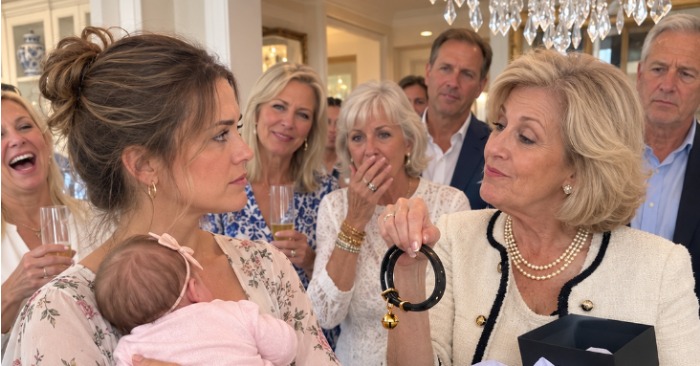
The Pembroke family was already waiting when we arrived.
No one spoke.
Margaret sat stiffly in her usual chair, still convinced she had done nothing wrong.
My father walked in wearing a simple navy blazer.
No medals.
No uniform.
Just quiet confidence.
Behind him came two retired officers who had served with him for years.
They weren’t there to intimidate anyone.
They were there because my father believed witnesses mattered.
Wesley’s father, Richard, stood first.
“I’ve watched the recording.”
He turned toward his wife.
“Margaret…”
“Did you really place a dog collar in front of my granddaughter?”
She crossed her arms.
“It was a joke.”
Richard didn’t even blink.
“No.”
“It was cruelty.”
She looked around the room, expecting someone to defend her.
No one did.
Then my father spoke.
“When Nora was six years old, she rescued an injured bird from a storm drain.”
“When she was twelve, she stood up to classmates bullying another child.”
“When she joined the Army, she swore an oath to protect those who couldn’t protect themselves.”
He looked directly at Margaret.
“Yesterday…”
“The person she protected was her daughter.”
Silence filled the room.
Then Richard slowly walked to a cabinet and removed a framed family portrait.
Without a word, he took it off the wall.
“I’m replacing this.”
Margaret frowned.
“With what?”
“With a new family portrait.”
“One that includes every member of this family.”
He turned to me.
“I should have stopped this years ago.”
“I watched you be humiliated over and over because confronting my wife seemed harder than disappointing you.”
“I was wrong.”
Then he faced Wesley.
“You have one decision to make.”
“Either you become the husband and father your family deserves…”
“Or you leave this house without them.”
Wesley broke down.
For the first time since I’d known him, he didn’t defend his mother.
He walked over to me.
Dropped to one knee.
And whispered,
“I’m sorry I failed both of you.”
I didn’t answer immediately.
Trust wasn’t something an apology could repair overnight.
Over the following months, Margaret repeatedly asked to see June.
The answer remained the same.
“No.”
Until one afternoon she arrived without jewelry.
Without makeup.
Without excuses.
She handed me a handwritten letter.
Inside was a sincere apology—not only to me, but to my daughter.
It ended with one sentence:
“The day I placed that collar in front of your child, I showed everyone the ugliness inside me. Thank you for refusing to let your daughter inherit my silence.”
I eventually allowed supervised visits.
Not because Margaret deserved forgiveness.
But because June deserved the chance to grow up surrounded by people who had learned that respect is never inherited…
It is earned.