Nobody moved.
Even the violinists lowered their bows.
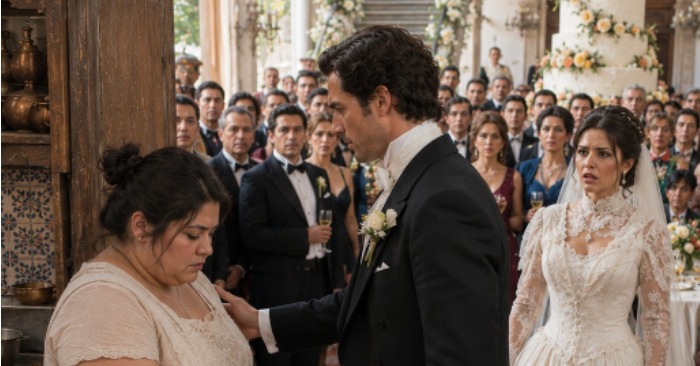
Mateo looked around the ballroom before speaking.
“For six weeks,” he said calmly, “every person here has praised this banquet.”
He pointed toward the long tables.
“The bread.”
The roasted hams.
The honey vegetables.
The fruit cakes.
“And this cake that everyone has admired since they arrived.”
His hand rested lightly on the sugar roses.
“None of it came from my family’s wealth.”
“It came from her hands.”
Every eye turned toward Beatriz.
She wanted to disappear.
Carlota stepped forward.
“This is ridiculous. She’s only the cook.”
Mateo slowly faced her.
“Only?”
He picked up a small knife and cut a slice from the cake.
Then he carried it himself to the oldest guest in the room.
Don Ernesto Salcedo, ninety years old and nearly blind.
The old man tasted it.
Closed his eyes.
And smiled.
“I know this recipe.”
The room became silent again.
He slowly stood with the help of his cane.
“My wife used to make this.”
He turned toward Beatriz.
“Who taught you?”
Beatriz swallowed.
“My grandmother.”
“What was her name?”
“Isabel Morales.”
The old man’s cane slipped from his hand.
“My sister.”
Gasps spread across the ballroom.
Don Ernesto stared at Beatriz for a long time.
“She disappeared after marrying a farmer forty years ago.”
“My grandmother always said her family abandoned her.”
“No,” the old man whispered.
“She left because she married for love.”
Tears filled his eyes.
“You carry her smile.”
Carlota tried to interrupt.
“This changes nothing.”
But nobody was listening anymore.
Servants stepped closer.
Guests stood from their chairs.
The musicians remained silent.
Mateo smiled gently.
“My mother loved Isabel’s cooking.”
He looked at Beatriz.
“When she became ill, she told me something I never forgot.”
He reached into his pocket.
Carefully unfolding an old letter worn by years.
“She wrote…”
“If you ever meet a woman whose food reminds you that kindness exists, never allow anyone to make her feel invisible.”
His voice grew quiet.
“I didn’t understand those words until six weeks ago.”
Beatriz lowered her eyes.
“You owe me nothing, Señor Salcedo.”
He nodded.
“I know.”
Then he turned toward the entire ballroom.
“My marriage cannot begin with humiliation.”
Carlota’s face hardened.
“You’re choosing a cook over me?”
“No.”
He looked directly at her.
“I’m choosing respect over pride.”
The silence that followed seemed endless.
Carlota’s father stood.
“So this wedding is canceled?”
Mateo answered without hesitation.
“Yes.”
Carlota tore off her gloves and stormed out while whispers followed her through the great doors.
No one stopped her.
Minutes later, one by one, the guests approached the kitchen.
Not to stare.
To thank Beatriz.
An elderly woman kissed her flour-covered hands.
Children asked for another slice of cake.
Even the servants smiled openly for the first time.
Late that evening, after the last carriage disappeared into the darkness, Beatriz packed her old iron skillet.
Mateo found her beside the kitchen door.
“You’re leaving?”
“My forty pesos are enough to save my farm.”
He handed her another envelope.
“I paid for the banquet.”
She tried to refuse.
He shook his head.
“Open it after you get home.”
The next morning, sitting at her worn wooden table while rain tapped against the roof, Beatriz unfolded the papers.
Inside was the promised payment.
And something else.
The mortgage to her farm.
Stamped in red.
PAID IN FULL.
There was no letter.
No declaration.
No promise.
Only one handwritten line.
Some people feed a room. Others feed a lifetime. Thank you for reminding me of the difference.
For the first time since Julián died, Beatriz cried.
Not because someone had rescued her.
But because someone had finally seen her.
And years later, when people in Durango spoke about the grand wedding that never happened, almost no one remembered the bride’s dress.
Everyone remembered the cook whose flour-covered hands taught an entire ballroom that dignity is worth more than status.