The concrete burned with cold.
I could feel it through my hospital pants.
Through my skin.
Through the pain medication that had already started to fade.
For a moment, all I could do was breathe.
In.
Out.
Again.
Every breath hurt.
Every movement sent fire through my leg.
But the steel door behind me was locked.
My phone was gone.
My medication was inside the house.
And the people who were supposed to protect me were laughing on the other side of the wall.
So I moved.
One inch.
Then another.
My elbows scraped against the concrete.
My injured leg dragged uselessly behind me.
I bit down on my sleeve to keep from screaming.
The rubber mat was less than ten feet away.
It felt like ten miles.
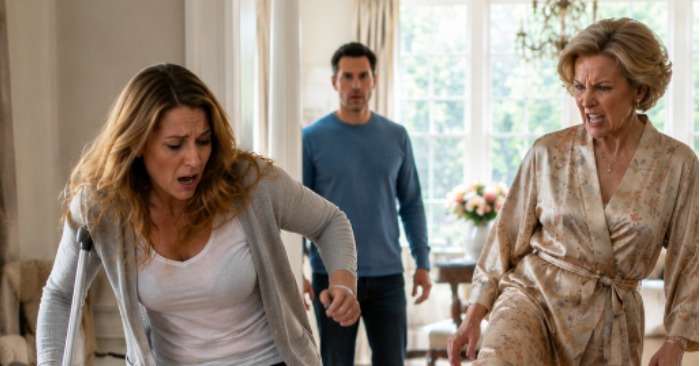
From inside the house, I heard Audrey’s voice.
“Can you imagine her face? She really thought she could order us around.”
Caleb muttered something I couldn’t hear.
Audrey laughed again.
“Don’t start feeling guilty now. Once the company transfer is complete, she won’t matter.”
I froze.
Company transfer?
My heart began pounding harder.
I already knew about the fraud.
Fake vendors.
Offshore accounts.
Payroll ghosts.
Forged invoices.
But a transfer?
That was new.
And dangerous.
I forced myself forward again.
By the time I reached the rubber mat, my hands were shaking so violently I could barely lift the corner.
Underneath was the loose concrete panel.
Still there.
Caleb had forgotten.
Of course he had.
Men like Caleb always remember what benefits them and forget what can bury them.
I dug my nails beneath the edge.
Pulled.
Pain exploded through my body.
I nearly blacked out.
But the panel shifted.
Inside the floor safe waited.
Small.
Steel.
Dusty.
Perfect.
My fingers found the keypad.
I entered the code with shaking hands.
Our wedding date.
The cruelest joke of all.
The safe clicked open.
Inside was the encrypted flash drive.
Beside it were three things Caleb had also forgotten.
A prepaid phone.
A tiny backup battery.
And my old police contact card from the first time I considered reporting him.
I almost laughed.
Then I almost cried.
Instead, I turned on the phone.
One bar.
Enough.
The first call was to my attorney.
When Marcus answered, his voice was sleepy.
“Vivian?”
“Marcus.”
The sound of my own voice scared me.
Weak.
Hoarse.
Shaking.
“I need you to listen carefully.”
Within thirty seconds, he was fully awake.
Within two minutes, he had contacted the police.
Within five minutes, he had forwarded the emergency evidence package to federal investigators.
Within seven minutes, he said the words I needed most.
“Stay alive. Help is coming.”
I ended the call.
Then I did one more thing.
I opened the garage recording app connected to the small security camera I had installed months earlier.
Caleb thought I used it to watch for package thieves.
He never knew it recorded audio from the garage.
Audrey’s voice came through clearly.
“Once the documents are signed, the freight company belongs to us.”
Caleb sounded nervous.
“She still owns thirty percent.”
“Not after the medical incapacity petition.”
My stomach turned.
“What?”
I whispered it into the cold.
Audrey continued.
“We tell the court she’s unstable after the accident. Overmedicated. Delusional. You take control as her husband.”
Caleb was silent.
Then he said softly,
“And if she talks?”
Audrey laughed.
“Who will believe her after tonight?”
That was when I stopped feeling afraid.
Completely.
Not because the situation was less dangerous.
Because now I understood the whole shape of the monster.
They didn’t just want the bedroom.
They didn’t just want the house.
They wanted my company stake.
My records.
My silence.
My life reduced to a medical file and a locked garage.
I pressed record.
Then I waited.
The sirens arrived eighteen minutes later.
At first they were faint.
Then louder.
Then close enough to make Audrey stop talking.
“What is that?”
Caleb’s chair scraped.
Then came footsteps.
Fast.
The garage door burst open.
Audrey stood there first, fury twisting her face.
“What did you do?”
I lay on the concrete with the flash drive in one hand and the phone in the other.
I smiled.
“I remembered what you forgot.”
Police lights filled the driveway behind her.
Caleb appeared over her shoulder.
His face collapsed.
“Vivian…”
A paramedic pushed past him.
“Ma’am, don’t move.”
I laughed weakly.
“Wasn’t planning to.”
Audrey immediately started performing.
“She fell. She gets confused after medication. We were trying to help her rest.”
One officer looked at the locked garage door.
Then at me.
Then at the phone recording still running in my hand.
“Is that so?”
Marcus arrived minutes later, wearing a coat over pajamas and carrying a laptop bag.
He looked at Audrey.
Then at Caleb.
Then at me.
His face hardened.
“We have everything.”
Caleb whispered,
“Everything?”
Marcus held up the encrypted flash drive.
“Everything.”
Audrey lunged for it.
An officer caught her wrist before she touched it.
That was the first time I saw real fear in her eyes.
Not annoyance.
Not cruelty.
Fear.
The kind people feel when consequences finally enter the room.
At the hospital, doctors confirmed what I already knew.
My injuries had worsened.
The fall had shifted part of the fracture alignment.
The bruising around my throat was documented.
The marks on my arms were photographed.
Every word went into the report.
By morning, Caleb was in custody.
Audrey followed shortly after.
By the end of the week, federal investigators had opened a full case into Whitaker Freight Solutions.
The flash drive did exactly what Caleb feared it would do.
It spoke.
Clearly.
Coldly.
Without emotion.
It showed every fake vendor.
Every stolen tax payment.
Every forged invoice.
Every offshore account.
Every company asset Audrey planned to move before anyone noticed.
The beautiful Whitaker name became front-page poison.
Reporters camped outside the courthouse.
Audrey tried to blame Caleb.
Caleb tried to blame Audrey.
Both tried to blame me.
None of it worked.
Documents don’t cry.
Files don’t exaggerate.
Numbers don’t need sympathy.
They simply tell the truth.
Six months later, I walked into court with a cane.
Not crutches.
A cane.
My leg still hurt.
Some days more than others.
But I walked.
Caleb saw me and lowered his eyes.
Audrey stared straight ahead, pale and stiff, her pearls gone, her designer confidence replaced by prison-gray fear.
The judge reviewed the evidence.
The abuse.
The fraud.
The attempted coercion.
The medical incapacity scheme.
The locked garage.
The stolen phone.
The worsened injury.
When the sentences were read, I didn’t smile.
I thought I would.
I imagined satisfaction.
Victory.
Maybe even relief.
But all I felt was quiet.
A deep quiet.
The kind that comes when the danger is finally outside your life instead of living inside your walls.
Afterward, Marcus helped me down the courthouse steps.
Reporters shouted questions.
I ignored them.
One asked,
“Do you feel vindicated?”
I stopped.
For some reason, that word bothered me.
Vindicated.
As if survival were a debate I had won.
I looked at the cameras.
“No.”
They went silent.
“I feel free.”
Then I got into the car.
A year later, the house was sold.
I kept nothing from it except one thing.
The old oil-stained rubber mat.
People thought that was strange.
Maybe it was.
But I framed a small piece of it and hung it in my new office.
Not because I wanted to remember the pain.
But because I wanted to remember the moment I refused to stay powerless.
My new company had a simple policy.
Every employee had access to emergency legal support.
No questions.
No shame.
No waiting until things became impossible.
On the first anniversary of that night, my father visited me.
He stood in my office staring at the framed rubber mat.
Finally he said,
“That’s an ugly thing to hang on a wall.”
I laughed.
“It is.”
“Then why keep it?”
I looked at the dark square behind glass.
“Because it reminds me that even when someone thinks they’ve locked you away, they may have forgotten what you hid for yourself.”
He didn’t answer.
He just hugged me.
Carefully.
Because my leg still hurt.
Because healing takes longer than justice.
Because surviving doesn’t mean you leave the room unchanged.
That night, before I went home, I turned off the office lights and stood alone in the quiet.
No locked doors.
No stolen phone.
No cold concrete.
Only peace.
And the steady knowledge that the woman they dragged into the garage was not the woman who came out.
They thought they had trapped an injured wife.
They forgot they were dealing with the woman who had already found the truth.
And truth, once opened, does not go quietly back into the dark.