“Noah, you really don’t have to carry this,” I said as we walked out of the grocery store with bags heavier than they should’ve been for a single trip.
But my eight-year-old only shook his head and quietly took one of them from my hands.
“You shouldn’t have to do everything by yourself, Mom.”
A couple nearby smiled at that. An older man by the cart return let out a soft chuckle. Noah didn’t notice any of it. He was already walking ahead like the bag in his hand was something fragile he had been trusted to protect.
On the drive home, he started asking practical questions instead of childish ones.
“Do we need milk again soon?”
“Did the electricity bill come yet?”
“Should I help Miss Bonnie with her yard again? She gives better tips when she’s happy.”
I glanced at him at a red light, half amused, half aching.
“Most kids your age ask for snacks on the way home.”
He shrugged like it was obvious.
“Snacks don’t keep the lights on, Mom.”
That should’ve sounded funny. It didn’t. Not after everything we’d been through since his dad passed away the year before. Noah had learned how to live inside responsibility far too early.
He did odd jobs for neighbors—carrying groceries, pulling weeds, sorting yarn. Nothing big. Just enough to bring home folded bills people handed him like he was already an adult.
Those earnings went into an old blue tin above the fridge. Every Sunday, he brought it down and placed it on the table like he was reviewing accounts.
“House money,” he’d say proudly.
And every time, I’d try to push it back toward him.
“You don’t need to do this, sweetheart.”
“I know,” he’d reply calmly. “I just want to help the team.”
It was impossible to argue with that kind of love.
—
A few days later, I found him at the kitchen table drawing something with intense focus while I wrestled with a washing machine that had clearly given up on life.
When I finally looked over, I saw it: a bright little stand labeled in uneven letters, lemons scribbled across a sign, and me drawn beside a machine that looked like it belonged in a scrapyard.
“I’ve got an idea,” he announced, eyes shining. “I’m going to sell lemonade and buy you a new washer.”
I almost laughed. Almost.
“Where did this come from?”
“They had stands at school,” he said seriously. “And I noticed our washer makes you tired.”
“It doesn’t make me tired,” I lied.
He gave me a look that felt too old for his face.
“You stare at it like it hurt your feelings.”
That made me laugh despite myself.
He stood up straight like he was presenting a business plan.
“This is going to be professional.”
“It’s going to be adorable,” I corrected.
“Professional,” he repeated firmly.
And just like that, I said yes.
Because sometimes saying no to hope feels worse than anything else.
—
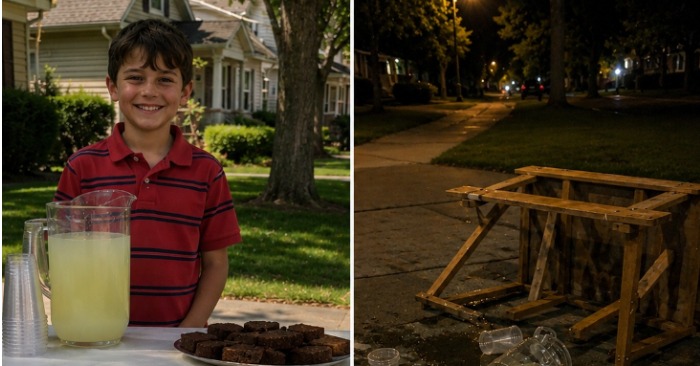
Saturday came with markers, cardboard, and a slightly crooked banner that read “LEMONADE” like it was sliding downhill.
Noah stood back, hands on his hips, proud beyond reason.
“It looks official.”
“It looks perfect,” I said.
He squinted at me.
“Official,” he corrected again.
People did come. Of course they did. Neighbors stopped by. Mrs. Campbell bought cups and praised his manners. Mr. Lee called him “young businessman,” which Noah repeated like it was a title he’d earned in gold.
For a while, he looked lighter. Not just happy—free.
And I hadn’t realized how long it had been since I’d seen that.
—
I went inside for less than two minutes to grab more lemonade.
Less than two.
When I stepped back out, everything had changed.
Mr. Peterson was standing there.
He lived across the street in the gray house with the tired yard and the permanent look of irritation carved into his face. A retired veteran, the kind of man everyone kept a respectful distance from because his complaints came often and loudly.
Leaves. Noise. Kids. Life, apparently.
That day, though, he didn’t look angry.
Just worn down.
“This is blocking the sidewalk,” he said flatly.
Noah blinked. “I can move it, sir. I’m sorry.”
Before I could react, Mr. Peterson grabbed the table and shoved.
Everything went at once.
Cups toppled. Lemonade spilled across the pavement. Coins scattered into the street. Noah’s carefully drawn sign snapped in half like it meant nothing.
My son just stood there.
Frozen.
People on the sidewalk stopped. Watched. Did nothing.
“Learn some respect,” Mr. Peterson muttered, already turning away.
That was it.
Something inside me broke.
“He is eight years old!” I shouted.
He didn’t even look back.
Then the front door of his house closed.
And my son made a sound I will never forget—small, shaking, like he was trying not to fall apart in front of the world.
—
We cleaned it up together.
Neighbors eventually helped. But the damage wasn’t just spilled lemonade or broken cardboard.
That night, Noah stood in front of his father’s photo for a long time.
Then he whispered, “Please help him be kind, Dad. I think he’s hurting.”
I didn’t know what to say to that.
Later, I called the police. They came, spoke to Mr. Peterson, and left with polite sympathy and no real solution.
“Not much we can do,” they said.
That night, Noah sat quietly at the kitchen table.
“I’ll fix it,” he said suddenly.
“What do you mean?”
“He’s not bad,” Noah said. “He’s just stuck.”
I shook my head immediately.
“You’re a child. You don’t fix grown men.”
But he only smiled a little.
“I know. I just want to help him remember.”
And somehow, I let it go.
—
The next morning, the neighborhood children showed up like they had been briefed for something important. Noah gathered them in a tight circle, whispering plans like a commander.
Then he came to me.
“It’s okay, Mom. We’ve got a mission.”
Forty minutes later, someone knocked hard on my door.
When I opened it, Mr. Peterson was standing there.
Crying.
“Please,” he said hoarsely. “Tell him to stop.”
“Stop what?”
“Your son.”
I stepped outside.
And froze.
Across the street, Noah and the kids had transformed the broken stand into something new. They stood beside Mr. Peterson’s old flagpole, freshly cleaned and repainted. A new flag moved gently in the wind.
On his porch railing hung a hand-painted banner:
THANK YOU FOR YOUR SERVICE, MR. PETERSON. HEROES DESERVE KINDNESS.
I crossed the street slowly.
Noah looked up like everything was perfectly normal.
“His flag was faded,” he said. “And the yard looked lonely.”
Then he added, matter-of-factly:
“So I used my lemonade money to replace it.”
Mr. Peterson made a sound behind me. Something like he couldn’t breathe properly.
He lowered himself onto the steps.
“My wife used to raise that flag every morning,” he said quietly. “After she passed… I stopped looking at it.”
Noah stepped closer.
“You didn’t need to stop,” he said simply.
And that was it.
The man who had broken my son’s stand the day before sat there crying while my child stood in front of him offering something none of us expected—understanding.
“I didn’t think anyone still saw me,” Mr. Peterson whispered.
Noah just nodded.
“I do.”
—
By the next afternoon, Mr. Peterson showed up at our house carrying wood, tools, and two pies.
“A business partnership,” he said gruffly.
By noon, they had rebuilt the stand into something sturdier, brighter, and unmistakably proud. He even added a little shelf for baked goods.
Noah looked at it like it was a dream made real.
The whole neighborhood came back.
And for the first time in a long time, my son laughed without hesitation.
Later, Mr. Peterson leaned toward him and said, “We keep this up, kid, and we’ll get your mom that new washer before summer ends.”
Noah grinned.
“We’re partners?”
The old man nodded once.
“Looks like it.”
And standing there with a paper cup in my hand, I realized something simple and true.
The washer didn’t matter.
What mattered was that my son had somehow turned pain into kindness—and pulled the rest of us along with him.
I thought I was raising him.
But some days, he’s the one quietly teaching all of us how to stay human.