I knew the moment Brian said, “Laura, the kids don’t need another adult war on the porch,” that letting him stay in our garage was going to be a mistake.
Alan meant well when he suggested it. He always did.
Brian stood under the porch light with a worn duffel bag, rubbing the back of his neck like he could smooth over the past if he just tried hard enough.
“Laura,” he said, “Angela and I had a fight. I just need a place to crash for a night or two. I figured the garage would be easiest. I can still see the kids.”
I should’ve said no.
Upstairs, Tyra was probably curled up with a book. Micah would’ve been in his dinosaur pajamas, talking to himself like the world was a friendly place.
Brian always had a way of stepping into stable things and making them shift.
“A fight?” I asked.
He didn’t meet my eyes. “Please. I wouldn’t ask if I had anywhere else.”
That was always his strongest trick—sounding stranded.
And I had two children who still called him “Dad.”
Alan rested a hand lightly on my shoulder. “The garage is separate. It used to be his space anyway.”
It had. Back when we were married, it had been more like a second living room—old couch, small TV, mini fridge, a bathroom off the laundry.
“One or two nights,” I said firmly. “That’s it.”
Brian nodded too fast. “Of course.”
“No coming in and out like you live here.”
“I understand.”
“And you don’t say anything that confuses the kids.”
His brows tightened. “Confuses them how?”
“It means you don’t make them feel like they’re choosing between adults. And you don’t act like you’re being punished.”
A pause. Then: “Got it.”
I stepped aside.
That was my first mistake.
—
For the first few days, he stayed in the garage like a ghost trying to prove it deserved space.
Too quiet. Too careful. Always just out of sight.
On the second night, Tyra asked from the kitchen, “Is Dad moving back?”
My hand froze mid-rinse. “No, sweetheart. Why?”
She hesitated. “He told Micah he’d sleep anywhere to be close to us.”
Ten minutes later, I found him in the garage with Micah.
“I’d do anything to be with you guys,” Brian was saying softly. “I miss you. I always will.”
I knocked once on the open door. “Micah. Go pick out your clothes for tomorrow.”
Brian leaned back. “Seriously? What’s going on?”
I kept my voice low. “Don’t do that.”
“Do what?”
“Turn missing them into something heavy for them to carry.”
His mouth tightened. “So I’m not even allowed to miss my kids now?”
“You can miss them. Just don’t turn it into a performance they have to live inside.”
He gave a short laugh. “Still controlling everything, huh.”
I held his gaze. “You’re here because I didn’t want you stranded. Don’t make me regret that.”
“Fine,” he said.
But with Brian, “fine” never meant anything finished.
—
He left five days later without drama, thanking Alan in the driveway like everything had been reasonable.
I didn’t say much when he went.
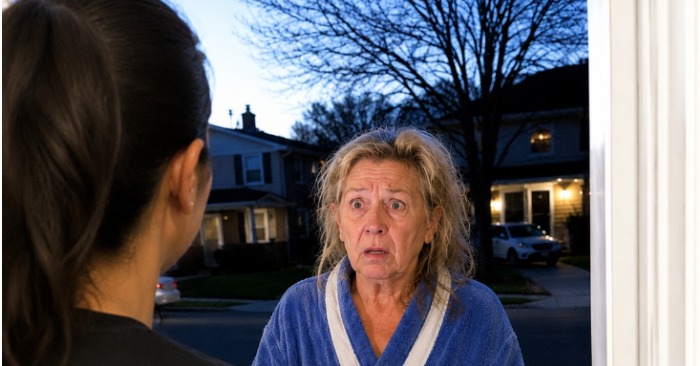
Two days after that, Mrs. Donnelly knocked on my door.
She had lived next to us for years—the kind of neighbor who notices everything even when she pretends not to.
“Laura,” she said quietly, “I think you need to see something.”
“What is it?”
“My security camera catches part of your garage.”
My stomach tightened. “And?”
“I didn’t want to get involved. But what I saw at 4:17 in the morning… I can’t ignore it.”
She handed me her phone.
—
The footage was dim, blue with early dawn light.
At first, nothing.
Then Brian stepped out of the garage holding Micah’s red sneakers.
“Why does he have those?” I whispered.
“Watch,” Mrs. Donnelly said.
He set the shoes neatly beside the door, went back inside, then returned with Tyra’s purple backpack.
My throat went dry. “That was missing.”
He arranged it carefully. Adjusted it. Stepped back.
Then he sat on the step with his head in his hands.
A moment later, he checked his phone—reviewing the angle.
And then he smiled.
Not a tired smile.
A deliberate one.
“There’s more,” Mrs. Donnelly said.
Clip after clip.
Same hour. Different mornings.
A blanket draped like someone had slept outside. Lunch bags placed like offerings. A hoodie positioned just so.
But the kids were inside the house. Asleep.
Alan’s voice came quietly from behind me. “Look at the timestamps.”
My stomach turned. “He used their things… because he couldn’t use their presence.”
Mrs. Donnelly nodded. “And he was taking photos.”
The screen showed him crouched low, adjusting items like a display. Changing his expression each time.
Grief. Loneliness. Devotion.
All staged.
Alan exhaled sharply. “Laura…”
“Don’t,” I said. “Don’t try to soften it.”
I stood up. “I’m going to the garage.”
—
I didn’t have to search long.
Micah’s sneaker was behind the fridge. Tyra’s backpack under cushions. The blanket folded in a storage bin like it had never been touched.
My hands stayed steady as I held the shoe.
That scared me more than shaking would have.
Alan stood in the doorway. “He planned it.”
I nodded slowly. “He didn’t need shelter. He needed an audience.”
—
That evening, I asked Brian to come back—with Angela and his mother.
He agreed too quickly.
Of course he did.
—
Evelyn arrived first, all composure and judgment. Angela followed, uneasy. Brian came last, confident in a way that already felt rehearsed.
Mrs. Donnelly sat quietly at the table. Alan stood by the counter.
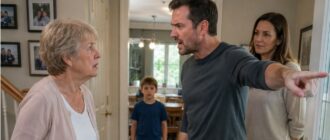
Evelyn didn’t sit down. “Laura, I’ve seen the pictures. I never thought you’d be that kind of woman.”
“What kind is that?” I asked evenly.
“The kind who lets a father sleep in a garage while his children cry for him.”
Angela shifted uncomfortably.
Brian lowered his eyes, playing the part.
I stood, walked to the laundry room, and returned with Tyra’s backpack, Micah’s sneaker, and the blanket.
I placed them on the table.
“Before anyone judges me,” I said, “you should see what he’s been doing.”
Brian stiffened. “Laura, don’t.”
“Sit down,” I said.
Silence fell.
Then I played the video.
Nobody spoke.
Not at first.
Then Angela’s hands went to her mouth.
Evelyn slowly sat down.
By the third clip, Brian’s voice broke through. “That’s not what it looks like.”
But it was exactly what it looked like.
Angela turned on him. “You told me they brought you those things.”
“I didn’t say that,” he tried.
“You did,” she said sharply. “You said they woke up early. You said they wanted to be with you. You said Laura was keeping you away.”
I looked at her. “They were asleep. He staged it.”
Evelyn’s voice was quieter now. “Brian…”
He exhaled. “You don’t understand. I lost my place in this family.”
“You weren’t erased,” I said. “You were trusted. And you turned that trust into a story about rejection.”
His eyes flicked up at me. “You replaced me.”
I didn’t flinch. “No. I rebuilt a home after you left it broken.”
That landed harder than I expected.
Angela stood slowly. “You lied to me.”
Brian reached for her. “Angie—”
She pulled away. “Don’t.”
And I knew that word. I had used it too late once in my life.
Evelyn looked at him differently now. “You used your children’s things to sell a version of yourself.”
Silence stretched.
Then Brian whispered, “I just wanted to be seen as a good father.”
I answered quietly. “Then be one. Not a performance of one.”
—
After they left, Alan removed the old garage key from the hook and dropped it into a drawer.
“I should’ve done that sooner,” he said.
“We all wanted peace,” I replied.
He shook his head. “That wasn’t peace. That was avoidance.”
Yes.
It had only been quiet.
—
The next morning, I told the kids the truth they could carry.
“Dad made choices that hurt trust,” I said gently. “You’re not in trouble. You’re safe. The rules are changing.”
Micah asked for syrup. Tyra held my hand under the table.
That weekend, we painted over the garage walls.
When Alan locked the door, I didn’t hesitate.
Brian had wanted a stage.
This time, there was no audience.