The wind that night cut straight through my jacket.
By the time I pulled up to the address with a hot pepperoni pizza balanced on my passenger seat, I already had the uneasy feeling that something about the order was wrong.
The house sat at the end of a quiet street, dark except for a faint glow coming from somewhere inside. The grass was overgrown, and the porch sagged slightly beneath my feet as I climbed the steps.
I checked the order again on my phone.
Correct address.
Delivery note: PLEASE KNOCK HARD.
I frowned.
“This better not be some weird setup,” I muttered before knocking loudly against the old wooden door.
For a few seconds, nothing happened.
Then a weak voice drifted from inside.
“It’s open. Come in.”
Every instinct I had told me not to step into a stranger’s dark house at nearly ten o’clock at night.
But I was already behind on deliveries, and the voice sounded exhausted more than dangerous.
So I pushed the door open.
The first thing I noticed was the cold.
Not normal cold — the kind of cold that settles into your bones. Somehow it felt even colder inside the house than it did outside.
The kitchen was nearly black except for the pale light coming from an open refrigerator door.
“Back here,” the voice called again.
I followed the sound into a small living room.
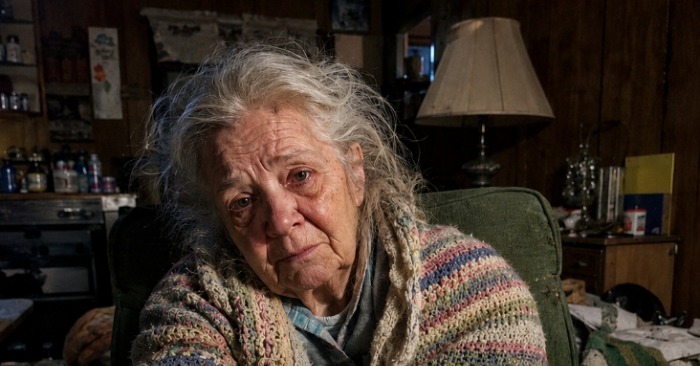
An elderly woman sat curled up in an old recliner beneath layers of blankets. A single candle flickered beside her, throwing soft shadows across the room.
But the second she saw the pizza box in my hands, her face brightened.
“Evening,” I said carefully. “Are you okay in here? It’s freezing.”
She gave a small shrug.
“Heat costs money. Medication costs money too. One of those things matters more.”
Then she slowly reached toward the side table and pushed a clear plastic sandwich bag toward me.
It was stuffed with loose change.
Pennies. Nickels. Dimes. Quarters.
Carefully saved coins.
“I counted it three times,” she said quietly. “It should be enough.”
For a second, I couldn’t say anything.
I glanced back toward the kitchen and finally noticed what was inside the refrigerator.
Almost nothing.
A few water bottles.
A medicine bag.
That was it.
That was the moment I understood.
This pizza wasn’t comfort food.
It wasn’t someone treating themselves after a long day.
It was probably the only hot meal she’d had in days.
I slowly pushed the bag of coins back toward her.
“It’s already paid for,” I said.
Her forehead wrinkled immediately.
“I don’t want anybody getting in trouble because of me.”
I should’ve told the truth.
Instead, the lie came out automatically.
“It’s fine,” I said. “I own the pizza place.”
She studied me for a moment before finally relaxing.
Then she looked down at my name tag.
“Well,” she said softly, “thank you, Kyle.”
I handed her the pizza.
The second she opened the box, steam rose into the cold room, and she actually closed her eyes for a second just to feel the warmth.
That hit me harder than anything else.
Not the darkness.
Not the empty fridge.
The fact that the warmth from a pizza box clearly meant something to her.
I stood there awkwardly, suddenly unsure what else to say.
Then I wished her goodnight and walked back outside.
But once I got into my car, I couldn’t leave.
I sat there with my hands gripping the steering wheel, staring at the dark little house across the street.
No heat.
No food.
No one checking on her.
And all I could hear was her insisting she was “perfectly fine.”
Finally I grabbed my phone and texted dispatch.
Flat tire. Be back in 45.
It was the first excuse I could think of.
Then I started the engine and drove straight to the small police station a couple blocks away.
At the time, I honestly believed I was helping.
I had no idea how badly things were about to spiral.
—
The officer at the front desk looked bored until I explained why I was there.
I told him about the freezing house, the empty refrigerator, and the woman choosing medicine over heat.
When I finished, he folded his arms.
“You think she’s in danger?”
“I think somebody should check on her before something happens,” I answered.
That seemed to be enough.
He called in a welfare check immediately.
Then he slid a clipboard toward me.
“Write down your information in case responders need to follow up.”
I filled it out feeling strangely relieved.
Like I had finally done the responsible thing.
That feeling lasted maybe twenty minutes.
Because when I drove back past her neighborhood on my way to work, an ambulance sat outside her house with flashing lights reflecting across the snow.
Several neighbors stood gathered near the sidewalk.
My stomach dropped instantly.
Two paramedics emerged from the house helping the older woman carefully down the porch steps.
She looked scared.
Then she saw me sitting in my car.
Her entire expression changed.
“You!” she shouted, pointing directly at me. “This is because of you!”
I got out of the car immediately.
“I was worried about you,” I said.
“I told you I was managing!” she snapped.
“You were freezing in there.”
“I was FINE!”
One of the neighbors stepped closer, glaring at me.
“What exactly did you do?”
“I asked someone to check on her,” I replied. “That’s all.”
One of the paramedics looked toward the crowd.
“She’s showing signs of hypothermia,” he explained calmly. “We need to evaluate her properly.”
The woman suddenly looked smaller than before.
Not angry anymore.
Just frightened.
“They’re making it sound worse than it is,” she whispered.
I shook my head gently.
“You couldn’t even answer the door.”
When they finally helped her into the ambulance, she looked at me one last time.
“This is your fault,” she said again.
Then the doors closed.
As the ambulance pulled away, several neighbors turned their frustration toward me instead.
One woman crossed her arms tightly.
“She’s lived here thirty years,” she snapped. “Now they’ll probably force her out because you couldn’t mind your own business.”
I felt my face burning.
“She had no heat,” I shot back. “Her fridge was empty.”
A man muttered quietly, “She’s always been stubborn.”
Another neighbor sighed.
“She refuses help from everyone.”
I stared at all of them in disbelief.
“Then why didn’t any of you do something?”
Nobody answered.
I got back into my car and drove away shaking.
But after that night, I couldn’t stop thinking about her.
Every elderly customer I delivered to after that made me wonder what their house looked like inside.
Every dark window made me uneasy.
And over and over again, I heard her voice in my head.
This is your fault.
I kept trying to convince myself I’d done the right thing.
But guilt has a way of making even good intentions feel ugly.
Then a week later, something happened that I never expected.
—
I was stacking pizza boxes in the kitchen when my manager yelled toward the back.
“Kyle! Delivery’s up. Customer requested you specifically.”
I grabbed the receipt.
And froze.
It was her address.
The entire drive there, my stomach twisted harder and harder.
When I pulled up this time, the porch light was glowing warmly.
I walked to the door and knocked.
Almost immediately, a woman in her forties opened it.
She smiled politely.
“Come in,” she said. “She’s been waiting for you.”
The difference inside the house shocked me instantly.
It was warm.
Bright.
Alive.
People filled the kitchen and living room.
One man unpacked grocery bags on the counter. A younger woman adjusted a brand-new space heater near the wall.
I recognized several faces immediately.
The same neighbors who had glared at me the night of the ambulance.
And there she was.
The older woman sat in the same recliner, but now she wore normal clothes instead of hiding beneath piles of blankets.
Two small children sat cross-legged on the rug beside her while she showed them how to knit.
“Slow down,” she laughed gently as one of them tangled the yarn. “You’re rushing again.”
For a moment I just stood there silently holding the pizza.
Then one of the men walked over.
“Hey,” he said awkwardly. “I owe you an apology.”
I blinked.
He rubbed the back of his neck.
“We didn’t realize how bad things had gotten. Truth is… we should’ve stepped in a long time ago.”
From the kitchen, someone added quietly:
“We all should have.”
No one argued.
No one defended themselves.
Then the older woman looked up and spotted me.
And smiled.
“There’s my pizza man,” she said warmly. “Come here.”
One of the neighbors took the pizza from my hands while another pressed cash toward me.
I walked closer to her chair.
Up close, she still looked tired.
But better.
Safer.
“I need to apologize too,” she told me softly. “I was angry that night. Mostly because I was scared.”
“You don’t have to apologize.”
“Yes, I do.” She squeezed my hand gently. “The doctors told me things could’ve gone very badly if nobody had checked on me.”
A woman near the kitchen nodded.
“We made a schedule now. Someone stops by every day.”
“And county services come twice a week,” another person added.
“We’re making sure she eats properly too,” said the man unpacking groceries.
The woman by the door gave a small sigh.
“We should’ve been doing all this before.”
Nobody disagreed with her.
And standing there in that warm little house filled with food, voices, and people finally paying attention to each other, something inside me finally quieted.
That’s when I understood something important.
Doing the right thing doesn’t always feel good at first.
Sometimes people hate you for it.
Sometimes they accuse you of ruining their lives.
Sometimes helping means forcing someone to face a reality they desperately wanted to hide.
But sometimes the thing you interrupt isn’t their peace.
Sometimes it’s the lie slowly destroying them.