“I don’t need to go to prom,” Wren said.
We were in the school hallway after a parent information night. She had walked a step ahead of me, then stopped at a poster advertising prom.
“A Night Under the Stars,” it said in glittery lettering.
She gave it a quick look, then shrugged. “It’s all fake anyway.”
And she kept walking.
But later that night, long after the house was quiet, I found her in front of the storage closet in the garage.
She wasn’t moving.
Her father’s police uniform hung inside a garment bag.
She didn’t notice me at first. She was just staring at it, like she was afraid to touch it.
Then she whispered, barely audible, “What if he could still take me?”
My throat tightened. “Wren…”
She jumped, turning fast.
“I wasn’t doing anything,” she said quickly.
“It’s okay,” I told her.
Her eyes drifted back to the uniform. “I had this idea… I know I don’t really want prom, but… if I did go, I’d want him there. And I thought maybe… I could use his uniform…”
She had spent years pretending not to want things other girls wanted. Parties. School dances. Father-daughter nights she always skipped without complaint.
But I knew what that really was.
Not indifference. Protection.
“Open it,” I said softly. “Let’s see it.”
She hesitated. “Are you sure?”
I nodded.
She unzipped the bag.
The uniform was still carefully pressed, preserved like it had been waiting.
Wren’s fingers brushed the fabric. “Do you think it could work?”
“It’s worth trying,” I said.
Her late father’s mother had taught her how to sew. That old sewing machine still sat in her room, half-used but never forgotten.
“I can turn this into a dress,” Wren said slowly. Then she looked up at me. “Is that really okay?”
Part of me wanted to say no. That uniform wasn’t just fabric—it was everything he had been.
But it was also the only way she still knew how to feel close to him.
“Yes,” I said. “If this helps you carry him with you… then yes.”
—
For weeks, our home turned into a quiet workshop.
Fabric covered the dining table. Pins disappeared into couch cushions. The sewing machine clicked late into the night.
And on the mantle sat a small velvet box.
Inside was a badge.
Not his official one—that had stayed with the department.
This one was something else.
A memory.
I still remember the day he gave it to her.
She was three years old, sitting cross-legged on the floor while he crouched beside her.
“I’ve got something for you,” he said.
He handed her a small badge.
Not real. But carefully made. Polished. His number written across the front.
“I want you to be my partner,” he told her.
Wren held it like it was the most important thing in the world. “Am I a police officer?”
He smiled. “You’re my brave girl.”
—
The night before prom, she took the badge from the box.
“I want to wear it,” she said, pressing it gently over her chest.
I looked at her for a long moment.
People would misunderstand. They always do.
But she already knew that.
And she still chose it.
“Then wear it,” I said.
—
When she came downstairs on prom night, I had to sit down.
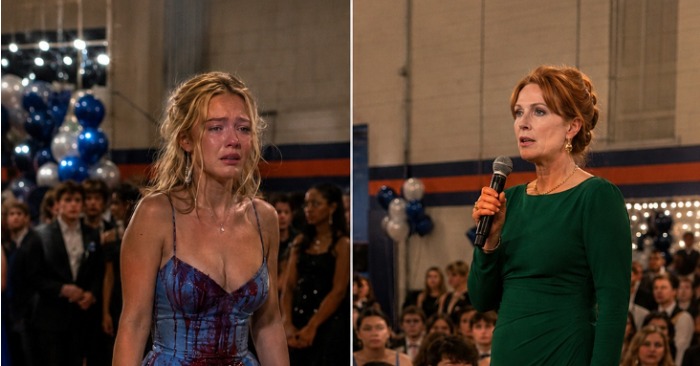
The uniform had been transformed. Softer now. Tailored into something beautiful and respectful. But the badge remained exactly where she placed it—over her heart.
When we walked into the gym, conversations slowed.
Some people stared. Some just nodded quietly, recognizing something unspoken.
A few understood immediately.
Then came the ones who didn’t.
A girl stepped forward with her friends behind her, laughing before she even reached us.
“Okay… what is this?” she said loudly.
Her eyes flicked over Wren. “This is actually kind of depressing.”
The circle around us went quiet.
“You’re really doing the dead cop thing as your whole personality?” she added with a smirk.
Wren didn’t answer.
The girl leaned closer. “I bet he’d be embarrassed of you right now.”
I moved forward—but I wasn’t fast enough.
The girl raised her cup.
And poured it.
Punch spilled across the uniform. Across the careful stitching. Across the badge.
Red liquid ran down like a stain that didn’t belong there.
For a moment, nobody reacted.
Then phones lifted.
Wren didn’t move. She just looked down and started wiping the badge with shaking hands, like she could undo it by force alone.
My body tensed—but before I could step in, feedback screeched through the speakers.
Everyone turned.
At the DJ table stood a woman I recognized from the crowd earlier. One of the mothers. Pale. Hands trembling as she held the microphone.
“Do you even know who that officer is?” she asked, voice breaking.
The girl blinked. “Mom, what are you doing?”
The woman swallowed hard. “You were a child. You don’t remember. But I do.”
The room went still.
“There was an accident,” she said. “You were in the back seat. The door was crushed. I couldn’t reach you.”
Her voice shook harder.
“The car started smoking. They told me later it could have gone up in flames any second.”
She pointed toward Wren.
“That man didn’t hesitate. He broke the window with his bare hands and pulled you out.”
Silence swallowed the gym.
“You were screaming,” she whispered. “And he just kept saying, ‘You’re safe now.’”
She looked at her daughter. “That badge number on her chest? That’s him.”
The girl froze.
“No,” she whispered.
“Yes,” her mother said.
And then, quieter: “The person you just mocked is the reason you’re alive.”
The room shifted.
Phones lowered.
Even the air felt different.
Wren had stopped wiping the badge. Her hand rested over it now, stained and trembling.
The girl’s voice cracked. “I didn’t know…”
Wren finally looked up.
“You don’t have to know someone to respect what they gave you,” she said.
No anger. Just truth.
Her shoulders sank.
“I’m sorry,” the girl whispered.
Wren nodded once. “Then remember it.”
The girl stepped back, tears forming, and disappeared into the crowd with her mother.
For a moment, nobody spoke.
Then someone clapped.
Then another.
Until the entire gym filled with it.
Wren turned toward me, overwhelmed.
“Go,” I whispered.
A girl from her class handed her napkins. “It’s still beautiful,” she said softly.
And somehow… it was.
The stain didn’t disappear completely. But the badge shone again when she pressed it flat.
The music started back up, uncertain at first, then stronger.
Wren looked at the dance floor.
“You don’t have to,” I told her.
She shook her head slightly. “I want to.”
And she walked forward.
Not as someone defined by loss.
Not as someone carrying a story people whispered about.
But as herself.
And in that moment, I could almost hear him say it again.
My brave girl.