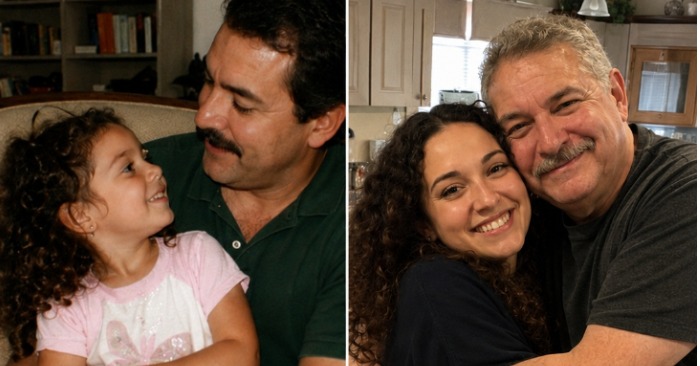
For years, my stepdaughter’s silence wasn’t just distance — it was something I learned to live inside. A quiet that filled every corner of my house until it became normal.
Then, one morning, a delivery truck pulled into my driveway.
And everything changed.
It had been five years, three months, and twelve days since Grace walked out of my life.
I knew the number exactly.
Not because anyone asked. Not because it mattered to anyone else.
But because I counted.
Every morning, I stood in my kitchen — the same kitchen where everything fell apart — and marked another square off a calendar taped beside the refrigerator.
The calendar still hung crooked. I never fixed it.
It had shifted the day Grace slammed the door so hard the magnets fell.
Part of me always told myself I left it that way out of neglect.
But the truth was simpler and heavier:
Fixing it would mean admitting she wasn’t coming back.
That kitchen used to be alive.
My wife, Jean, would hum while cooking — always slightly off-key. Grace would sit on the counter stealing bacon when she thought no one was looking.
Jean would laugh and scold her lightly.
And I’d pretend I didn’t notice.
That was our rhythm. Our noise. Our family.
Grace was four when I met her — missing teeth, sharp-witted, and immediately suspicious of me.
Jean warned me early on.
“If you’re not serious, don’t stay,” she told me over dinner once.
I remember answering without hesitation.
“I’m not going anywhere.”
And I meant it.
For years, I wasn’t just “around.” I was there for scraped knees, school projects, midnight fevers, and learning how to braid hair badly but proudly.
I taught her how to fix things. She taught me patience.
We never made it official legally. We talked about adoption once, but life delayed it.
Then Jean died.
No warning. No preparation. Just gone.
Grace was eighteen.
And everything after that broke in slow motion.
At first, neither of us knew how to survive the silence Jean left behind.
Grace stopped talking much. When she did, it was sharp — like every sentence was meant to cut something open.
And I… I tried to hold things together.
Meals. Routines. Normal conversations that no longer fit the house we were living in.
But I didn’t realize something important then:
She wasn’t just grieving.
She needed somewhere to put her anger.
And I became the only place it could go.
The breaking point came months later.
I went into Jean’s closet.
Her clothes still hung there untouched, holding the faint trace of her perfume like a memory refusing to leave.
I stood there longer than I should have.
Eventually, I decided someone should use them. A family from church had lost everything in a fire.
So I donated them.
I thought I was doing something decent.
That night, Grace came home.
She saw the empty closet and froze.
“You gave them away,” she said quietly.
“I donated them,” I replied. “Someone needed them.”
Her face changed instantly.
“You had no right.”
“I thought your mother would’ve wanted—”
She laughed once. Cold. Empty.
“There is no ‘we,’ Vincent. You’re not my father. You were just… there.”
The words hit harder than I expected.
“I raised you,” I said, barely recognizing my own voice.
She didn’t hesitate.
“And now she’s gone. So you don’t matter.”
She walked into her room, packed a bag, and left.
The door closed behind her with a sound I still hear sometimes when the house is too quiet.
After that, there was nothing.
Calls went unanswered. Messages never read. Letters returned.
Eventually, silence became the only thing she ever gave me again.
Until five years later.
That morning started like every other.
Coffee. Calendar. Another mark crossed off.
Then a truck pulled into my driveway.
I hadn’t ordered anything.
The driver struggled to unload a massive package onto my porch.
“Whatever’s in here, it’s heavy,” he muttered before leaving.
I signed without thinking.
And stared at the box long after he drove away.
No company name.
No explanation.
Just a return address I didn’t recognize… and a single letter:
G.
My hands started shaking before I even touched it.
Because I knew that handwriting.
Grace.
I carried it inside like it might fall apart in my arms.
For a long time, I just walked around it.
Arguing with myself.
What if it’s hate?
What if it’s nothing but a reminder that she still doesn’t want me in her life?
Eventually, I opened it.
Inside, there was no padding. No careful packaging.
Just something heavy, wrapped in a worn workshop blanket.
The smell hit me first.
Oil. Metal. Degreaser.
And suddenly I wasn’t standing in my living room anymore.
I was back years earlier.
Grace beside me in a garage. Grease on her cheek. Laughing when I messed something up.
“Again,” she’d say. “You missed a spot.”
My hands moved faster.
I pulled the blanket away.
And froze.
An engine block.
Not just any engine.
The V8 from the ’67 Mustang we had dragged home together when she was fourteen.
The project that used to be ours.
The one we never finished.
My knees almost gave out.
Because this wasn’t the broken, rusted piece we had abandoned.
This one was restored.
Perfect. Clean. Polished.
Better than I ever imagined it could be.
Even the weld mark I once ruined was still there — preserved like a signature.
My breath broke in my throat.
“No…” I whispered.
But I already knew.
She hadn’t thrown it away.
She hadn’t forgotten.
She had finished it.
I dropped to the floor, one hand on the metal, feeling the cold of it anchor me as everything else inside me cracked open.
And then I saw it.
A letter tucked inside the engine.
My name on the front.
My hands shook so badly I could barely open it.
“Dear Dad,” it began.
And I stopped breathing right there.
She wrote about everything I never knew she carried.
The anger.
The guilt.
The way she took the engine with her when she left because she didn’t know how to let go of me completely.
How she learned machining. How she rebuilt it alone. How every hour in a workshop felt like trying to speak to me without words.
Then a second item fell out.
A photograph.
Grace, older now. Tired eyes. Softer face.
Holding a baby.
And beneath it, a plane ticket.
A note.
Come meet your grandson. He needs someone to teach him how to use a wrench.
I sat on the floor for a long time, unable to move.
Through the window, I saw a real estate sign in my yard.
I had put the house up for sale weeks earlier. I thought there was nothing left here worth keeping.
I was wrong.
I picked up my phone and called the realtor.
“I’m keeping the house,” I said.
A pause.
“I’m sorry?”
“I’m keeping it. Take the listing down.”
More silence.
Then a soft laugh. “Alright… I’ll handle the paperwork.”
When I hung up, the house didn’t feel empty anymore.
It felt like it was waiting.
Waiting for something that was finally coming back.
I looked at the engine one last time.
At everything we had broken…
and everything she rebuilt.
“I’m coming,” I said quietly.
And for the first time in years, I wasn’t speaking into silence.