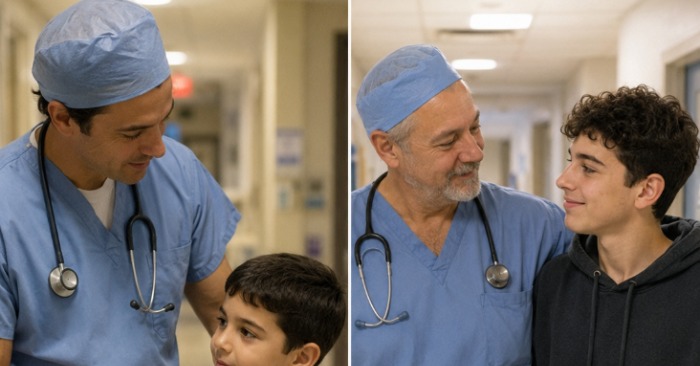
I was 33 when I performed my first solo cardiac surgery as an attending.
Five-year-old patient. Trauma case. Car accident.
The kind of case where hesitation kills faster than anything else.
I still remember walking through those hospital corridors that night, trying to look like I belonged there… while quietly feeling like I didn’t.
Then my pager went off.
**Trauma bay. Pediatric. Suspected cardiac injury.**
That was all it said.
My stomach dropped before I even started running.
When I reached the room, chaos was already in motion. Monitors were screaming, nurses were calling out vitals, and in the center of it all was a child so small he looked swallowed by the equipment around him.
Five years old.
Barely conscious.
Blood in his hair. A deep facial laceration. Rapid, shallow breathing that made the monitor numbers jump in all the wrong ways.
One of the ER doctors looked up at me.
“Hypotensive. Distended neck veins. Muffled heart sounds.”
I didn’t need the rest.
**Cardiac tamponade.**
Blood was filling the sac around his heart, slowly suffocating him from the inside.
We confirmed it in seconds.
There was no time for debate.
“OR. Now,” I said.
And just like that, I became the only surgeon in the room responsible for whether this child lived or died.
No supervisor. No backup. Just me.
In the operating room, everything narrowed down to breath, rhythm, and steel.
I remember absurd details I shouldn’t remember — his eyelashes resting against pale skin, the way his chest was so small under my hands.
When we opened him, the problem was worse than expected.
A tear in the right ventricle. Damage to the aorta.
The kind of injury that doesn’t forgive mistakes.
My hands moved on instinct.
Clamp. Suture. Bypass. Repair.
There were moments his vitals collapsed so sharply I thought I’d lost him right there on the table.
But he kept fighting.
So I kept going.
Hours later, his heart began to beat on its own again.
Weak. Uneven. But alive.
“Stable,” anesthesia finally said.
I had never heard a more beautiful word in my life.
He was moved to the ICU shortly after.
That’s when I met the family.
A young woman and a man pacing the hallway outside the unit, both pale with fear.
And when I looked at her face… something in my chest stopped.
Emily.
My past. My first love. Someone I hadn’t seen in years.
“Mark?” she said, barely believing it.
Her husband looked between us, confused, until I cleared my throat and forced myself into doctor mode.
“I was your son’s surgeon,” I said.
Her knees nearly gave out.
“Is he going to live?”
I explained everything clinically — injury, repair, risk, recovery.
But all she really heard was one thing:
He was alive.
She broke down right there in her husband’s arms.
And I stood there, quietly realizing I had just saved the child of someone I once loved.
That night, I told myself that was the end of the story.
I was wrong.
Twenty years passed.
I built a career. Became the surgeon people requested when cases turned impossible. I learned how to carry pressure like it was part of my uniform.
Life moved forward in all the expected ways — work, relationships that didn’t last, nights that got quieter as time went on.
And then, one morning after a brutal shift, I walked into the hospital parking lot half-asleep.
That’s when someone screamed.
“You!”
A young man was storming toward me, face twisted with rage.
“You ruined my life!”
I froze.
And then I saw it.
A thin scar running across his face — from brow to cheek.
A scar I recognized instantly.
Five-year-old trauma patient.
Now grown.
Ethan.
Before I could speak, he pointed past me.
“I can’t even get my mom to the hospital because of your car!”
That’s when I noticed the woman in the passenger seat of a nearby car — slumped, barely responsive.
Chest pain. Pale skin. Labored breathing.
Something was very wrong.
“All right,” I said immediately, shifting focus. “Move your car. I’m taking over.”
Within seconds, we had her inside the ER.
And just like that, I was back where I started — standing over a patient whose life was slipping away.
Aortic dissection.
Same kind of urgency. Same kind of fight.
“OR ready?” I asked.
“Cardiac is tied up,” someone answered.
“Then I’ll take it,” I said.
Ethan stared at me like I was insane.
But I wasn’t thinking about him anymore.
I was thinking about survival.
In surgery, I only realized who the patient was when I finally looked at her face.
Emily.
Again.
Time hadn’t erased her completely, but it had softened her edges — streaks of gray in her hair, deeper lines around her eyes.
And yet it was her.
Lying on my table.
Dying.
For a second, the room felt unreal.
“Don’t stop,” I said quietly. “We start now.”
We opened her chest. Found the tear. Replaced the damaged section of her aorta. Held her together with everything we had.
There was a moment when her pressure crashed hard enough that the entire OR went silent except for alarms.
Then slowly… it came back.
“Stable,” anesthesia said again.
That same word. Twice in one lifetime.
After surgery, I found Ethan in the hallway.
He was shaking.
“How is she?” he asked.
“She’s alive,” I told him. “Critical, but stable.”
He collapsed into a chair like his legs stopped working.
“I thought I was going to lose her,” he whispered.
“You didn’t,” I said.
Then, after a pause, he looked up at me differently.
Like something was trying to connect in his mind.
“Do I know you?” he asked.
I exhaled.
“You might,” I said. “From when you were five.”
His expression shifted instantly.
“…wait.”
And I told him.
The night of the crash. The OR. The repair. The scar that never left his face.
His mouth slowly opened.
“You’re the surgeon?”
“I was.”
He shook his head like he couldn’t process it.
“My whole life,” he said quietly, “I thought that scar ruined everything. My parents split. My mom struggled. I blamed it for years.”
Then he swallowed hard.
“But today… when I thought I was going to lose her? I would’ve taken every bit of it again just to keep her alive.”
That hit harder than anything else.
Because that’s what I had learned too.
Love doesn’t erase pain.
It just changes what you’re willing to survive.
A few days later, Emily woke up.
First thing she said was:
“If I’m dead, this is a very elaborate hallucination.”
I laughed before I could stop myself.
“You’re very much alive.”
She smiled weakly. “Ethan told me. Both times… you were there.”
And for the first time in a long time, I didn’t feel like the story was something I survived alone.
A few weeks later, she left the hospital.
The first text she sent me from home read:
“Cardiologist says no coffee. I think he enjoys suffering.”
I replied:
“I’ll risk it when you’re cleared.”
And I did.
Now, sometimes we sit in a small café downtown — me, Emily, and Ethan when he’s not busy trying to figure out his own life.
And occasionally someone asks about scars, or accidents, or luck.
And I just think:
If saving someone means “ruining” their life…
then I guess I’ve been guilty of that twice.