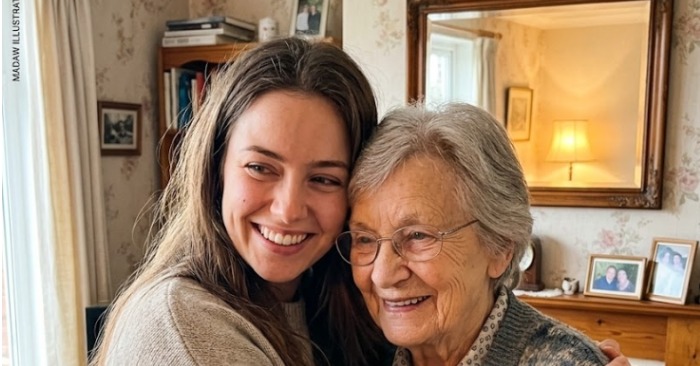
At my grandmother’s funeral, I noticed my mother quietly slipping a strange bundle into the casket. Later, unable to ignore my curiosity, I secretly retrieved it — never imagining it would expose devastating truths that would change the way I saw my family forever.
Grief doesn’t arrive gently for me. It crashes without warning, like stepping into darkness and missing the ground beneath your feet. My grandmother, Catherine, wasn’t simply a relative — she was my safe place, my closest companion, the person who made the world feel warm no matter how difficult life became. At her funeral last week, standing beside her coffin felt unreal, as though half of me had been buried with her.
The dim glow inside the funeral chapel softened the lines of Grandma’s peaceful face. Her silver hair had been styled exactly the way she always liked it, and around her neck rested the pearl necklace she wore on every special occasion.
As I ran my fingertips along the polished wood of the casket, memories overwhelmed me. Only a few weeks earlier, we had been sitting together in her kitchen drinking tea while she laughed and showed me the secret ingredient in her sugar cookies.
“Emerald, sweetheart, she’s still with you,” our neighbor Mrs. Anderson said softly, resting her weathered hand on my shoulder. Her eyes were swollen from crying behind her glasses. “Your grandmother adored you more than anything.”
I forced a weak smile through my tears. “Remember her apple pies? Every Sunday the whole street smelled like cinnamon and butter.”
Mrs. Anderson chuckled sadly. “Of course. And she’d always send you over carrying slices for everyone. She loved telling people you helped bake them. Said nobody handled cinnamon better than you.”
“I tried making one last week,” I confessed quietly. “It tasted wrong. I almost called her to ask what I’d messed up… and then I remembered she was gone. The ambulance… the heart attack…” My voice broke.
“Oh, dear.” Mrs. Anderson wrapped me in a hug. “She knew how deeply you loved her. That’s what mattered most.”
The chapel was crowded with mourners sharing quiet stories about Grandma. Through the gathering, I spotted my mother, Victoria, standing apart from everyone else, distracted by her phone. She hadn’t cried once the entire day.
Then something strange happened.
As Mrs. Anderson spoke to another guest, I noticed Mom approach the coffin. She quickly glanced around to make sure nobody was paying attention before leaning over and slipping a small wrapped package inside near Grandma’s body.
The moment she straightened up, her eyes darted nervously around the room before she hurried away, her heels tapping sharply against the floor.
My pulse quickened.
“Did you notice that?” I whispered.
“Notice what?” Mrs. Anderson asked.
“My mother just…” I stopped myself, watching Mom disappear into the restroom hallway. “Never mind. Maybe I’m imagining things.”
But I wasn’t.
A heavy feeling settled deep in my stomach. Mom and Grandma had barely spoken for years. There was no reason for her to secretly hide something inside the coffin.
Something felt terribly wrong.
Hours later, evening shadows stretched across the funeral home as the final guests slowly left. The scent of roses and lilies lingered heavily in the air.
Mom had already gone home, claiming she had a migraine, but I couldn’t stop thinking about what I’d seen.
“Ms. Emerald,” the funeral director, Mr. Peters, said kindly as he approached me. “Take as much time as you need. I’ll be in my office.”
“Thank you.”
Once his footsteps faded, I slowly walked back toward Grandma’s casket. The silence in the room felt suffocating now, thick with secrets waiting to be uncovered.
My heartbeat thundered in my ears as I leaned closer.
Then I saw it.
Partially hidden beneath the folds of Grandma’s blue dress — the same dress she’d worn to my college graduation — was the edge of a small cloth-wrapped bundle.
For a moment, guilt tore through me. Taking it felt wrong. But leaving it there felt even worse.
Grandma had always taught me to trust my instincts.
With trembling hands, I carefully reached inside the coffin, removed the package, and slipped it into my purse.
“I’m sorry, Grandma,” I whispered, gently touching her cold hand. Her wedding ring caught the light one final time. “But I know something isn’t right.”
Back at my apartment, I sat in Grandma’s old reading chair — the one she insisted I keep when she moved into a smaller place last year.
The package rested in my lap.
It was wrapped in a blue handkerchief embroidered with the letter “C.” I instantly recognized it. I remembered watching Grandma sew that tiny letter years ago while telling me stories about her childhood.
“What were you hiding, Mom?” I muttered as I slowly untied the string around the bundle.
The moment I opened it, my stomach dropped.
Inside were dozens of letters.
Every single one had my mother’s name written on it in Grandma’s unmistakable handwriting.
The oldest letter was dated three years earlier.
“Victoria,
I know what you’ve been doing.
Did you truly believe I wouldn’t notice money disappearing from my accounts? At first I convinced myself there had to be another explanation. I refused to believe my own daughter would steal from me.
But the truth became impossible to ignore.
Your gambling addiction is destroying you. I’ve tried helping you again and again, but you continue lying while taking more money. Last Christmas, you swore you had changed. One week later, another five thousand dollars vanished.
I’m not writing this to humiliate you. I’m writing because watching you destroy yourself breaks my heart.
Please let me help you.
Mom.”
My hands shook as I continued reading.
Letter after letter exposed years of betrayal I had never known existed. The tone shifted over time — concern becoming frustration, frustration turning into heartbreak.
One letter described a family dinner where Mom tearfully promised she had stopped gambling.
I remembered that night perfectly. She seemed so sincere while hugging Grandma and crying at the table.
Now I wondered if any of it had been real.
Then I unfolded the final letter Grandma had written.
“Victoria,
You made your decisions. I’ve made mine.
Everything I own will be left to Emerald — the only person who loved me without expecting something in return.
You once accused me of loving her more than you. That was never true. I loved both of you equally. The difference is that Emerald never treated me like a source of money.
I will always love you.
But I can no longer trust you.
Mom.”
Tears blurred my vision as I reached for the last envelope in the pile.
This one wasn’t from Grandma.
It was from my mother.
The date on it was only two days earlier — written after Grandma’s death.
“Mom,
Fine. You win.
Yes, I took the money. I needed it. You never understood what that feeling is like.
But your plan won’t matter anyway. Emerald loves me. She’ll give me whatever I ask for — including the inheritance.
So in the end, I still come out ahead.
Stop trying to control us from the grave.
Victoria.”
I barely slept that night.
Everything suddenly made sense.
The expensive gifts Mom somehow always managed to buy. The times she borrowed my credit card for “emergencies.” Her constant questions about Grandma’s savings and legal documents.
One memory replayed over and over in my head.
“Have you talked to Grandma about giving someone power of attorney?” Mom had casually asked me once. “She’s getting forgetful.”
“She seems perfectly fine to me,” I’d replied.
“I’m just thinking ahead,” she’d said sweetly. “We need to protect her finances.”
Now I finally understood the truth.
By morning, my heartbreak had hardened into clarity.
I called her.
“Mom, can we meet for coffee? Grandma left something for you. She wanted me to give it to you at the right time.”
Her voice instantly brightened. “Of course, sweetheart. Where should we meet?”
“The café on Mill Street.”
“You’re such a good daughter, Emerald,” she said warmly. “Far better than I ever was with my own mother.”
Her words felt like a knife twisting in my chest.
The next afternoon, she arrived at the café wearing her favorite red blazer, her eyes immediately landing on the package beside my purse.
She sat down and reached for my hand. “You look exhausted, honey. I know this has been hard for you. You and your grandmother were inseparable.”
Without answering, I slid the wrapped bundle toward her.
Inside were blank sheets of paper… except for two letters.
The first was Grandma’s “I know what you did” letter.
The second was from me.
Mom opened the envelopes confidently at first — but within seconds, the color drained completely from her face.
Her hands trembled as she read my note.
“Mom,
I have every letter.
If you ever try to manipulate me or take what Grandma left behind, I will expose everything.
Everyone will know the truth.
Emerald.”
“Emerald, please, I can explain—”
I stood before she could continue.
“I love you,” I said quietly. “But love doesn’t mean allowing someone to use me.”
Tears filled her eyes as years of lies finally caught up with her.
“You lost my trust,” I whispered. “And you’ll never get it back.”
Then I turned and walked away, leaving her alone with the consequences of everything she had done.
That day, I realized the truth has a way of resurfacing — no matter how deeply someone tries to bury it.