My mom had been gone for barely a month when my stepfather told me he was marrying her best friend.
At first, I thought I misunderstood him.
Grief does that—it makes words feel unreal, like they belong to someone else’s life.
But he repeated it, calmly, as if it were a normal update instead of something that should have shattered the room.
My name is Lena, and I was still learning how to exist in a world where my mother didn’t answer her phone anymore.
Cancer didn’t take her all at once. It took her in layers. First her energy, then her appetite, then her laughter, and finally her ability to pretend she was fine when she clearly wasn’t. The last weeks were the hardest because she kept apologizing for things she didn’t need to apologize for—being tired, needing help, being alive in a body that was giving up on her.
Paul, my stepfather, stayed through all of it. So did Linda, her best friend. They were always there—driving her to appointments, sitting in hospital rooms, bringing food we didn’t have the energy to cook. I trusted them because she trusted them.
That’s what made everything afterward feel so disorienting.
Four weeks after the funeral, Paul came to my apartment.
He didn’t sit down.
He didn’t even take off his coat.
He just stood in my kitchen like he was about to deliver news that didn’t belong in a home.
“I need to tell you something,” he said.
Then he said it.
“Linda and I are getting married.”
I remember blinking at him, waiting for the second sentence that would make it make sense.
It never came.
“Married?” I repeated.
“Yes.”
“To each other?”
He nodded.
And something inside me didn’t just break—it rearranged itself into something colder.
“Mom died less than a month ago,” I said slowly, like maybe saying it correctly would make him hear it differently.
“I know this is hard—”
“This isn’t hard,” I interrupted. “This is wrong.”
His expression tightened, not with guilt, but impatience.
“We’ve all been through a lot,” he said. “Life moves on.”
That sentence stayed with me longer than anything else he said.
Life moves on.
As if my mother was just a chapter they had all agreed to close faster than I was ready for.
The wedding happened anyway.
I didn’t go at first.
I told myself I wouldn’t.
But then I saw the photos.
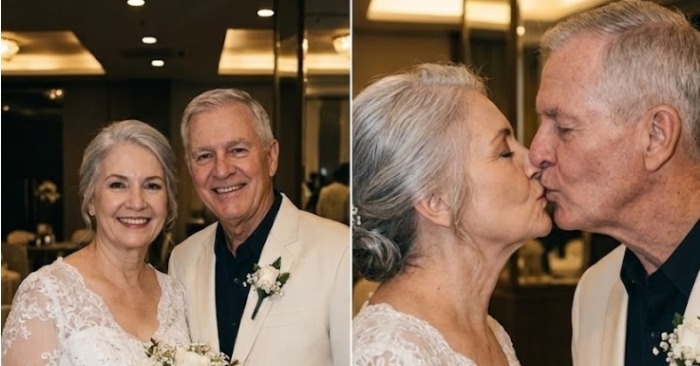
Soft lighting. Smiling faces. Carefully written captions about “new beginnings” and “healing.” Linda in a pale dress that looked almost performative in its innocence. Paul standing beside her like nothing in his life had just ended.
And then I saw something that made my stomach drop.
My mother’s necklace.
The one she had worn for years. The one she told me would one day be mine.
I called Paul immediately.
No answer.
Again.
Nothing.
When I finally reached him, I didn’t bother pretending I was okay.
“Where is it?” I asked.
Silence.
“The necklace,” I said again. “Where is it?”
A pause.
Then: “We had to make decisions after the wedding.”
My grip tightened.
“Did you sell it?”
Another pause.
That was all I needed.
Two days later, I saw Linda outside a shop downtown. She looked perfectly put together—hair done, bags in hand, like nothing in her life had shifted at all.
I didn’t plan what I said.
It just came out.
“You sold it.”
She turned slowly, like she was mildly inconvenienced.
“Oh,” she said. “That old thing?”
Old thing.
As if it had no history. No meaning. No weight.
“We needed money for the honeymoon,” she added casually. “It was just sitting there.”
“It belonged to my mother.”
She shrugged. “Sentiment doesn’t pay for trips.”
That sentence landed harder than anything else.
Sentiment doesn’t pay for trips.
That night, I couldn’t sleep.
Not because I was grieving.
Because something about the way they were behaving didn’t match the story I had been told my entire life about them being “family.”
So I started asking questions.
Carefully.
Quietly.
A friend of my mother’s—someone who had worked at the hospital—called me after the funeral. She hesitated at first, like she wasn’t sure she should speak at all.
Then she told me things she had never said out loud before.
Not accusations.
Not theories.
Observations.
Mom had believed Linda and Paul were her support system. She talked about them constantly during treatment—how devoted they were, how grateful she felt, how lucky she was not to go through it alone.
But there were moments that didn’t fit that picture.
Conversations that stopped when someone entered the room.
Private remarks about “after things settle.”
Plans made with a strange timing that now felt too precise to ignore.
I sat there listening, feeling like the ground had quietly shifted under everything I thought I knew.
When the call ended, I didn’t cry right away.
Instead, I became still.
Not numb.
Focused.
Because suddenly, this wasn’t just grief anymore.
It was something structured.
Something deliberate.
I didn’t confront them immediately.
That was the surprising part.
I didn’t explode.
I didn’t show up screaming.
I did something much more dangerous.
I waited.
And I collected everything.
Messages. Dates. Receipts. Records. Conversations. Anything that could be verified instead of argued with.
Then I called Paul.
“I’ve been thinking,” I said calmly. “I was unfair. I think I reacted emotionally.”
The shift in his tone was immediate.
“I’m glad you understand,” he said.
“I think Mom would want peace,” I added. “I’d like to see you both when you’re back.”
He agreed too quickly.
They thought I had moved on.
I hadn’t.
When they returned from their trip, I arrived at their house with a gift bag.
Linda opened the door smiling, warm and practiced.
Paul looked relieved, like tension had finally left his body.
“Come in,” Linda said brightly. “We were just talking about you.”
We sat in the living room like a normal family gathering was about to happen.
Then I handed them the bag.
At first, they smiled.
Then they opened it.
And everything stopped.
Inside wasn’t a gift.
It was evidence—carefully organized, printed, dated, undeniable. Messages between them. Financial records. Details that didn’t match the story they had been telling anyone who asked.
Page after page.
The room changed temperature.
Paul flipped through them, his hands shaking slightly now.
Linda’s expression collapsed first.
“This is private,” Paul said.
I shook my head.
“No,” I said quietly. “This is real.”
The silence that followed wasn’t dramatic.
It was heavy.
Because there was nothing left to reinterpret.
No excuses that fit cleanly anymore.
Just the truth sitting in the middle of the room where they had assumed no one was looking closely enough.
I didn’t shout.
I didn’t need to.
“I’m not going to argue about what my mother meant to you,” I said finally. “But I’m done accepting stories that don’t match reality.”
I stood up.
And for the first time since she died, I left a room without feeling like I was still being pulled back into someone else’s version of events.
Not because everything was healed.
But because I had finally stopped pretending I didn’t see it.