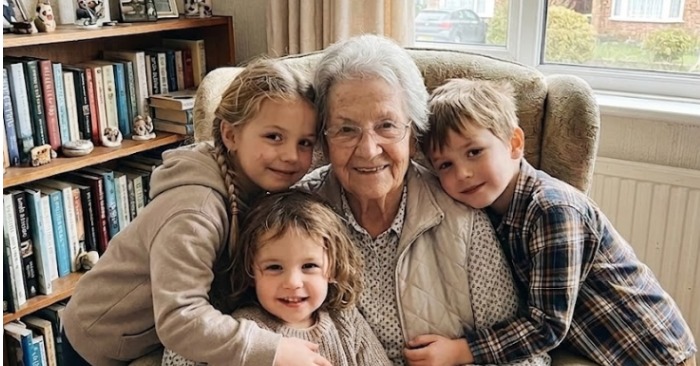
Six months ago, my world collapsed in a way I still don’t know how to explain without my voice breaking.
My daughter Darla and her husband were on a routine flight. Work trip. Nothing unusual. They left their four children with me for the weekend.
They never came back.
The plane went down. No survivors.
Just like that, I became everything at once—mother again, grandmother, guardian, referee, and the only stable thing left in four small lives that didn’t understand why the front door stayed closed when it should have opened.
Lily was nine. Ben seven. Molly five. Rosie only four.
Rosie kept asking when “Mommy’s trip” would end.
So I lied.
Not because I wanted to—but because I needed her to keep breathing.
“She’s just away for a while,” I told her. “Grandma’s here.”
And I meant it. Every word.
We were barely surviving the first weeks. The house felt too big, then too small, then too loud even when nobody spoke.
I went back to work at a diner because grief doesn’t pay bills. I washed dishes until my hands cracked. I knit at night until my fingers went numb. I learned how to live in survival mode at seventy-one.
We found a rhythm eventually. Not peace—just motion.
Then, six months later, something arrived that stopped all of it.
A delivery truck pulled into my driveway.
The package they unloaded looked wrong immediately—too large, too heavy, too intentional. Like it didn’t belong in a normal life.
The driver asked, “Are you Carolyn?”
I nodded.
“This is for you.”
There was only one line on the label:
“To my mom.”
Darla’s handwriting.
My chest tightened before I even touched it.
It took three men to bring it inside. They set it in my living room like a piece of furniture no one knew how to classify, then left without another word.
I stood there for a long time before I opened it.
Inside was a sealed envelope on top.
My name.
And her handwriting again.
My hands weren’t steady when I broke it open.
“Mom,” it began, “if you’re reading this, I’m gone.”
The room tilted slightly.
She wasn’t saying goodbye. She was explaining something I hadn’t known existed.
“I didn’t tell you everything while I was alive,” the letter continued. “Not because I didn’t trust you—but because I couldn’t let you carry it with me.”
My daughter had been preparing for something. Not emotionally. Practically.
The box wasn’t random. It was organized. Deliberate.
Smaller packages inside, each labeled in her handwriting.
“For Lily’s 10th birthday.”
“For Ben’s first school award.”
“For Molly’s first dance recital.”
“For Rosie’s 5th birthday.”
And then more.
Every milestone I could imagine. Every future moment she would never see.
A life already mapped out without her in it.
At the bottom, another envelope waited.
Inside: a second message.
“Please go to this address. He will explain what I couldn’t.”
No name. Just coordinates to a house two hours away.
I didn’t think.
I just moved.
When I arrived, it was a quiet suburban home that looked ordinary enough to hide anything.
A man opened the door before I could knock again.
He looked like he had been waiting for me.
“Mrs. Carolyn?” he asked softly.
“Yes.”
“I’m William,” he said. “I was your daughter’s physician.”
The word “was” hit harder than anything else.
Inside, he didn’t waste time.
“Your daughter was sick,” he said.
My body went cold.
“Sick how?”
He hesitated, like the truth had weight.
“Cancer. Advanced. Diagnosed over a year ago.”
I couldn’t speak. I couldn’t even breathe properly.
He continued anyway, gently but relentlessly, as if he knew stopping would make it worse.
“She didn’t tell you because she knew you were already holding too much. She didn’t want you to watch her disappear.”
The room blurred at the edges.
“She spent her remaining time preparing for her children. Not for herself. For them.”
I looked down at the folder in my lap.
At the bottom, he handed me something smaller.
A locket.
Inside was a photo of all five of us at the lake. Darla smiling behind the camera. Me in the center. The kids laughing like nothing bad had ever existed in the world.
“She wanted you to have that,” he said quietly.
I broke right there.
Not quietly. Not gently. Completely.
When I finally got home, the house felt different. Like it had absorbed a truth I wasn’t ready to live with yet.
But something still didn’t sit right.
One line in the letter kept echoing in my head:
“It’s better if some truths stay buried.”
That wasn’t closure.
That was protection.
From something else.
That night, I found a drawing in Molly’s notebook.
A family.
Two adults. Four children.
And beside “Daddy,” another figure labeled:
“Mommy 2.”
My stomach dropped.
I asked her gently the next morning.
“Who is Mommy 2?”
She didn’t even look up from her cereal.
“The lady Daddy used to hug.”
The room went silent in a way that didn’t feel natural.
“Mommy didn’t like her,” she added. “Then she stopped coming.”
Everything shifted after that.
The story wasn’t finished.
It was split.
I started asking questions I hadn’t dared ask before. Quiet ones. Careful ones.
A neighbor mentioned a nanny. Then stopped talking mid-sentence.
A name surfaced eventually.
Then another truth behind it.
The husband. The secrecy. The timing.
And suddenly Darla’s letter made a different kind of sense—not emotional, but strategic.
She hadn’t just been preparing gifts.
She had been protecting something.
Or someone.
When I finally understood the shape of it, I stopped digging further.
Because some truths don’t just break people.
They scatter what’s left.
Instead, I made a decision.
The children didn’t need every answer.
They needed a future.
So I sealed the past where it belonged and focused only on what could still be saved.
That weekend, I opened the box labeled for Lily’s birthday.
Inside was a journal.
On the first page, Darla’s handwriting:
“Write your dreams here. I will always be with you in them.”
Lily cried when she saw it.
So did I.
Because I finally understood what my daughter had really left behind.
Not just letters.
Not just secrets.
But a choice.
To carry love forward… without letting it become destruction behind you.