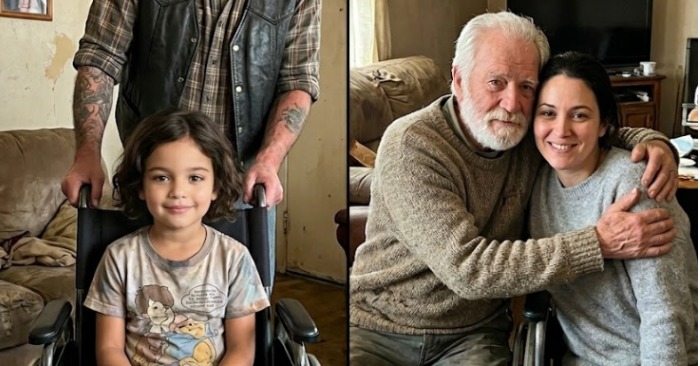
I was 26 when I learned the man who raised me had been lying to me since the day I was injured — and the truth didn’t come from him… it came from a letter he left behind.
I’ve used a wheelchair since I was four.
That’s the version everyone knows.
The simple version.
What people don’t see is the “before.”
I don’t remember the crash itself.
I just know I had parents once — Lena and Mark — and a life that felt loud and warm and ordinary.
My mom sang while cooking. My dad always smelled like engine oil and peppermint gum. I had light-up shoes and a purple cup I refused to let anyone touch.
Then everything stopped.
The official story was always the same: accident, sudden, unavoidable. Parents gone. Spine damaged. Life divided into “before” and “after.”
After that, everything became paperwork and decisions made by strangers.
Until my uncle stepped in.
Ray.
He wasn’t soft. He wasn’t polished. He was the kind of man who looked permanently tired of the world but still showed up anyway.
“No institutions,” he said when they discussed placing me elsewhere. “She’s coming with me.”
And just like that, I did.
He didn’t have experience. Or stability. Or even a plan.
What he had was stubbornness.
And me.
The early years were survival disguised as routine.
He learned everything by watching nurses and failing forward. How to lift me safely. How to prevent pressure sores. How to cook something edible while answering insurance calls on speakerphone.
He built a ramp out of scrap wood so I could leave the house. It was crooked. It was perfect.
At night, I’d wake up and hear him moving around the house, checking on me like the world might steal me back if he blinked too long.
When I got older, he stopped being just my guardian.
He became my entire world.
He learned how to do my hair badly but proudly. He sat through awkward puberty conversations he clearly wished the universe would spare him from. He worked overtime until his body started folding under it.
Still, he never complained where I could hear it.
By the time I was in my twenties, I thought I understood everything about my life.
Simple story. Sad beginning. Stable middle.
I was wrong.
It started with exhaustion.
Ray slowed down. Then forgot things. Then stopped pretending he wasn’t hurting.
Eventually came the diagnosis.
Stage four.
That word changed the air in our house.
He tried to stay the same. Tried to keep making breakfast, keep pretending he wasn’t slipping away.
But some nights I’d hear him in the bathroom, trying not to make noise while the world broke him quietly.
Hospice came eventually. Machines. Medication. Quiet footsteps in the living room.
And then the night before he died, he sent everyone out.
Even the nurse.
Then he came to me.
He sat beside my bed like he always had.
And he looked smaller than I’d ever seen him.
“I need you to hear me,” he said.
I was already crying.
He held my hand. “You are the best thing I ever did.”
“That’s a low bar,” I tried to joke.
He almost smiled.
Then he got serious again.
“You’re going to live,” he said. “Promise me you won’t stop there.”
“I don’t know how without you.”
“I know,” he said softly. “Me too.”
And then he added something I didn’t understand yet.
“There are things I should have told you.”
He kissed my forehead like I was still four years old.
And he left.
He died the next morning.
The house after that didn’t feel empty. It felt paused.
His boots by the door. His mug still in the sink. The life he built still standing in place like it didn’t know it had ended.
Then a letter arrived.
Mrs. Patel brought it to me, shaking.
“He asked me to wait,” she said. “And to tell you… he’s sorry.”
My name was on the envelope in his handwriting.
I opened it expecting grief.
I got truth instead.
The first line shattered everything:
“I’ve been lying to you your whole life.”
He wrote about the crash.
Not the version I knew.
He said my parents hadn’t simply “lost control.”
They had argued that night. Drunk. Angry. Already deciding to leave town.
And I was supposed to go with them.
But they changed their minds.
They decided I should stay with Ray instead.
“Your father shouldn’t have been driving,” he wrote. “I saw it. I should’ve stopped him. I didn’t.”
He admitted he could have called someone. Could have taken the keys. Could have prevented them from leaving.
But he didn’t.
Minutes later, they crashed.
And I survived.
He wrote about what that made him feel.
Not immediately grief.
Something worse.
Responsibility.
“I saw you in that hospital bed and I couldn’t separate love from guilt,” he wrote. “I stayed because I had no right not to.”
For years, I thought I had been rescued.
But in his words, I saw something heavier.
A man trying to balance a debt no one asked him to carry.
He also wrote about the money.
The insurance.
The accounts.
The trust he quietly built for me over years of overtime shifts and sleepless nights.
“I told myself it was protection,” he wrote. “But it was also punishment. I didn’t want you to ever need anything I couldn’t give you.”
The letter ended simply:
“Don’t live inside what I did. Live past it. And if you can’t forgive me, I still understand. I always loved you anyway.”
I read it until the words blurred.
I didn’t know whether to grieve him or argue with him.
Maybe both.
Mrs. Patel said something later that stuck with me:
“He didn’t fix the past. He just refused to abandon you inside it.”
Weeks later, I started therapy again.
Not because I had answers.
Because I didn’t.
Rehab became part of my routine again too.
Small progress. Unsteady steps. A body learning to trust gravity in a new way.
Some days I hated it.
Some days I didn’t.
But I kept going.
Because somewhere between anger and understanding, I realized something uncomfortable:
My life wasn’t just what happened to me.
It was also what he built around what happened.
And now I had to decide what to do with that.
I don’t have a clean ending.
No perfect forgiveness. No dramatic closure.
Just a quieter truth.
He didn’t get to undo the night everything changed.
But he spent the rest of his life trying to make sure I still had one worth living.
And now, for the first time, I’m not only surviving inside that story.
I’m learning how to continue it myself.