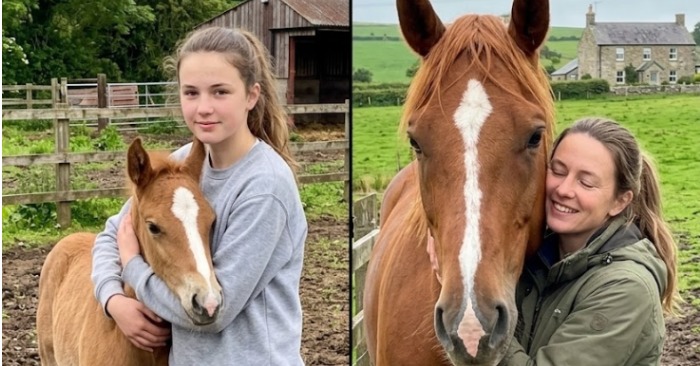
I came home from a work trip and my horse was gone.
No warning. No explanation that made sense.
Just an empty stall.
The air in the barn felt wrong the moment I stepped inside — too still, too clean, like something living had been erased from it.
His halter was gone. The feed bucket untouched. Even the ground looked unsettled, like it didn’t understand what had happened either.
“Spirit?” I called, already knowing the answer.
Silence.
I walked the fence line anyway, like denial could change reality. My boots sank into soft dirt as I whispered his name into the wind, searching for a horse that never wandered on his own.
He was twenty. Gentle. Predictable. The kind of horse that stayed where he felt safe.
So where would he go?
Nowhere.
That was the point.
When I came back inside, my husband was in the kitchen, buttering toast like nothing in the world had shifted.
I asked him straight.
“Where is Spirit?”
He didn’t even hesitate.
“I sold him.”
For a second, my brain refused to translate the words.
“You what?”
“He was old, Willa. It was time. I handled it while you were away.”
Time.
Like he was talking about furniture.
Like Spirit had been an object that expired.
I stood there, waiting for anger to feel real.
Instead there was just this hollow drop inside my chest.
“And you didn’t think I deserved a say?”
He shrugged.
“It’s done. I even got a good price.”
That was the moment something in me stopped being quiet.
Not loud rage. Not tears.
Just clarity.
That night, I didn’t sleep. I searched every listing, every stable contact, every trace of where a horse like him could end up when people treat lives like transactions.
And then I heard him.
My husband’s voice.
Not talking to me.
On the phone.
Laughing.
“She’ll get over it,” he said casually. “It’s just a horse. I already moved it. Made it work for us.”
For us.
Not me.
Not Spirit.
Us.
That was when I understood the second truth — the one that hurt worse than the sale.
He hadn’t just taken my horse.
He had turned him into leverage for something I was never part of.
By morning, I had names. Numbers. A trail.
And by afternoon, I had Spirit back.
He stood in a small holding pen at the edge of town, thinner than I remembered, but still turning his head the moment he heard me.
Like he knew.
Like nothing had changed for him except the waiting.
When I walked up, he didn’t hesitate.
Just stepped forward.
Slow. Certain.
As if he had been holding that movement back for days just for this moment.
I rested my hand on his neck and felt something inside me settle back into place.
“You’re coming home,” I told him.
And for the first time in days, my voice didn’t shake.
I didn’t argue with my husband when I got back.
I didn’t explain.
I didn’t ask permission.
I just changed the locks.
He stood on the porch for a while after that, like he was waiting for the version of me that still negotiated.
But she didn’t come out.
Because some lines, once crossed, don’t lead to conversations.
They lead to exits.
Spirit is back in his stall now.
Not missing. Not “sold.” Not reduced to someone else’s decision.
Just breathing where I can see him.
And every time I walk into that barn, I remember something simple:
You don’t take what someone has loved for years and expect them to stay quiet.
Not forever.
Not ever.