At seventy-five, Mary Elizabeth Sullivan believed the most she could still ask from life was a little respect from the children she had spent decades loving, feeding, and sacrificing for. Instead, she stood on the sidewalk outside the house she had lived in for twenty-three years, watching strangers load her belongings into a donation truck while her own children supervised like they were clearing out storage.
They were not saving her things for later. They were giving them away. Everything she had built, kept, repaired, and carried through the years was being sorted by strangers who had no idea what any of it meant. And the worst part was not even the eviction itself. It was the cold efficiency of her children, who talked about her future as if she were an inconvenience that had finally become too heavy to manage.
Mary had rented that modest yellow house for years from an elderly landlord who had always promised she could stay as long as she needed. But he had died, and his daughter sold the property to developers almost immediately. Without a formal lease, Mary had no legal ground to stand on. Her children could have helped her fight for more time. They could have looked for another place, signed papers for her, or simply taken her in for a while. Instead, they told her she should probably go to a senior residence and stop making things difficult.
Mary refused.
She was not ready to sit in some common room and wait for death with a bingo card in her hand. So when her children made it clear they had no room, no patience, and no real intention of helping, she picked up the one battered suitcase they had allowed her to keep and told them she had somewhere else to go.
It was an old property outside Riverside that had once belonged to her grandmother. The house itself had burned down years ago, but there was still a root cellar dug into the hillside behind it — a place her grandmother had always called *the sanctuary*. Her children laughed when they heard where she was going. They thought she was retreating into a ruin because she had finally accepted defeat.
But Mary remembered something her grandmother had told her half a century earlier, in a whisper on her deathbed: *If you ever lose everything, go to the sanctuary. I left something there for you.*
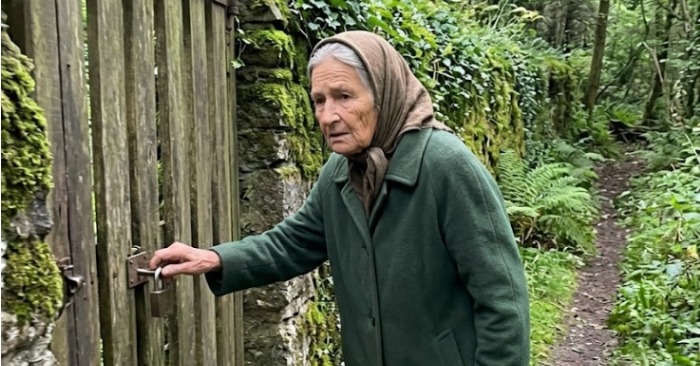
So Mary walked to the abandoned land, found the old cellar door covered in moss and age, and opened it with a tiny brass key she had carried for fifty years without truly understanding why. Inside, beneath dust and silence, sat an old oak trunk sealed with wax. And inside that trunk was not money or jewelry.
It was her wedding dress.
The one she had sewn with her own hands forty years earlier, for the wedding that never happened.
As Mary lifted it, she found hidden letters sewn into the lining — letters her grandmother had concealed long ago. And those letters contained the truth that had been stolen from her life.
When Mary was younger, she had been engaged to a kind man named Thomas Sullivan. They were supposed to marry in the church in the summer of 1985. But weeks before the wedding, the town’s respected pastor accused Mary of making improper advances toward him. In reality, it had been the opposite. He had pursued her, cornered her, and harassed her. When she rejected him, he destroyed her reputation before she could threaten his.
The town believed him.
The church canceled the wedding. Thomas still married her quietly at the courthouse, but the damage was done. Mary became the woman people whispered about. She spent forty years carrying shame that was never hers, while the man who lied kept his power, his title, and his spotless image.
The letters in the trunk proved everything. One was from the pastor’s former secretary, who had heard him harassing Mary through the office door and later heard him inventing the false story. Another was from a townsman who had seen the pastor corner Mary in the church parking lot. The last was from Mary’s grandmother, explaining why she had hidden the letters instead of using them: the pastor had threatened to destroy what remained of Mary’s life if the truth ever surfaced.
Mary sat there in that basement with the dress in her lap and the evidence in her hands, crying not only for what had been done to her, but for how long she had carried it. Then she wiped her face, folded the letters, and made a decision.
The next morning was Sunday.
The whole town would be gathered.
Mary spent the night in the cellar and altered the old wedding dress with her own skilled hands, turning it into something dignified and powerful. Then she walked straight into the town square, where people were gathered before church, and stopped in front of the same pastor who had ruined her life.
In front of everyone, she told the truth.
She read the letters aloud. She named what he had done. She spoke about the wedding he had stolen, the lies he had spread, and the life he had damaged. The crowd went silent. And when Mary demanded that he tell the truth in public, the pastor — old now, but still hiding behind the same reputation — finally broke.
He confessed.
He admitted he had pursued her. Admitted she had rejected him. Admitted he lied to protect himself and destroyed her name in the process.
After forty years, Mary’s innocence was no longer a private ache. It was a public fact.
Her children, standing there in the crowd, were horrified. For the first time, they understood that the mother they had been ashamed of all their lives had been telling the truth from the beginning. They rushed to her afterward, apologizing, offering help, trying to undo in a few frantic moments what they had failed to give her for decades.
But Mary did not let them rewrite the story so easily.
She told them plainly that they had failed her. They had not believed her. They had not defended her. And when she needed help most, they had laughed at her and left her to save herself. Whatever relationship remained between them would now exist on her terms, not because she needed them, but because she might one day choose to let them earn back what they had thrown away.
The story spread quickly beyond Riverside. News stations picked it up. People everywhere were outraged by what had happened to her and moved by the way she had reclaimed her life. A lawyer offered to represent her, and Mary filed a civil case against the pastor. He settled. The amount was enough for her to buy a small cottage of her own, live without fear, and finally enjoy the kind of peace she had been denied for most of her life.
She returned to sewing. She planted flowers. She framed the old wedding dress and hung it in her living room, not as a symbol of loss, but as proof that truth can survive even when it is buried for decades.
Months later, one of her sons came to see her with his young daughter, who wanted to learn how to sew. Mary let them in.
Because by then, Mary had learned something important: forgiveness is not forgetting, and dignity is not weakness. She had survived being lied about, abandoned, humiliated, and pushed out with nothing. And still, she had found a way to stand up, speak clearly, and take back the life that had been stolen from her.
The world had spent forty years treating her like a woman marked by disgrace.
But in the end, Mary Elizabeth Sullivan was not remembered for the lie.
She was remembered for the truth that refused to stay buried.