Inés was mopping the reception hallway when the front door flew open and a woman stumbled in with red eyes, smeared mascara, and a little boy clutching her blouse like he was drowning. Behind them came the husband, pale with frustration, carrying an orthopedic dog bed with the price tag still attached. A bag of premium food dragged against his leg. And at the very end, walking with the silent dignity of an animal that had already been hurt too many times, came Nacho.
The boy broke into tears the moment he saw him.
“Don’t bring him back!” he cried. “He didn’t do anything wrong!”
His mother covered her face. “Honey, we already talked about this.”
“But I love him!”
“He doesn’t love you,” the father snapped, and even Elena, the shelter director, looked up from her desk.
The words landed like a slap. The boy turned to Nacho with wet, pleading eyes. But the Golden Retriever did not wag his tail, did not whine, did not react. He simply walked to the wall near reception, sat beside the umbrella stand, and stared at an empty corner as if something invisible was waiting there.
“Yesterday my son tried to hug him,” the mother said, fighting tears. “That’s all he did. And the dog just walked away. Like my child wasn’t even there.”
“He didn’t growl, he didn’t bite, he didn’t make a scene,” the father added, dropping the bed against the counter. “That almost made it worse. My son cried all night because he thinks the dog hates him.”
“He doesn’t hate me,” the boy whispered. “He’s sad.”
No one answered.
Elena stepped out of the office, calm and professional. She asked a few questions, offered water, and quietly completed the return papers. It was the thirtieth family in less than two months.
Thirty homes. Thirty fresh starts. Thirty families calling him handsome, sweet, gentle, perfect. And every single time, the same ending: Nacho distant, still, silent, staring at walls no one else understood.
When the crying family finally left, the dog did not even watch them go. He simply stood there, frozen in that same heavy silence. Elena led him back to his kennel. He walked in without resistance, turned once, and sat in the far corner with his nose pointed toward the floor.
“I don’t know what to do with you anymore,” she murmured.
But Inés, watching from down the hallway, felt something strange. That was not the silence of an animal giving up.
It felt like the silence of one still waiting.
Nobody at the shelter had forgotten the day Nacho first arrived. He had been brought in by a neighbor from an apartment building on Hidalgo Street after his owner died. She found him sitting outside the man’s door, unmoving, as if he were still waiting for it to open. He had stayed there for two days. No family came. No friend claimed him. No one asked for him.
His intake form was simple: Name: Nacho. Approximate age: 8. Breed: Golden Retriever. Health: good. Background: owner deceased. No known relatives.
Physically, he was in excellent shape. The vet found no injury, no chronic illness, no neurological problem, nothing that explained his behavior. He ate little, drank only when he had to, and barely reacted to anything around him. He did not bark, panic, attack, or resist. He simply withdrew.
Families kept adopting him because he was healthy, calm, beautiful, and supposedly easy. But each family returned him with the same complaint in different words: he would not connect. He stood in rooms staring at walls. He ignored toys. He avoided affection. He seemed absent.
By the tenth return, Elena stopped feeling hopeful.
By the twentieth, it began to hurt.
By the thirtieth, the shelter staff looked at him with that helpless mix of tenderness and defeat reserved for animals no one knows how to save.
Only Inés kept watching him differently.
She was not a vet, trainer, or rescuer. She was the cleaning lady. She arrived every morning with her lunchbox, old sneakers, and quiet routine. She scrubbed floors, changed water bowls, disinfected kennels, and kept the shelter running in the background. And though nobody asked, she knew how to tell when a dog was afraid, angry, or deeply sad.
But Nacho was none of those things.
He did not tremble. He did not lash out. He did not beg.
He just stayed still.
And something about that stillness reminded Inés of home.
She lived with her eighteen-year-old son Tomás, who had been deaf since birth, and with Dante, their aging black Labrador. Tomás’s father had left when the boy was little, unable to handle a house where spoken words were not enough. Since then, Inés had learned to live with her hands.
With her hands she told Tomás to eat, be careful, come home early, and that she loved him. With her hands they joked, argued, and made peace. Dante had grown up in that same world, learning to follow gestures instead of voices.
Maybe that was why one morning, while mopping near Nacho’s kennel, Inés noticed something no one else had. A volunteer hurried past without speaking to the dog. No reaction. A second later, the reflection in her mop bucket shifted on the floor. Nacho’s ears turned slightly.
Not toward sound.
Toward movement.
Inés froze.
After that, she started paying closer attention. Loud doors meant nothing to him. His name meant nothing. Whistles, claps, baby talk — nothing. But sometimes a moving hand or a gesture made his eyes shift for a second.
One day she crouched by the kennel and spoke to him out of habit.
“Hello, beautiful.”
Nothing.
She stood up and absentmindedly lifted her hand in a small motion she often made while thinking. Nacho’s ears rose instantly.
She turned slowly. Lowered her hand. His ears relaxed.
She lifted it again, more carefully.
This time, Nacho stood up.
Not because of fear. Not because of food. He stood as if, after weeks underwater, he had finally felt a familiar vibration.
That night Inés told Tomás everything over dinner. He listened, then signed one simple sentence:
“Maybe he doesn’t understand voices. Maybe he understands hands.”
The next morning she arrived early. Nacho was already awake, watching the entrance.
Later that day, after overhearing the vet tell Elena that Nacho might not have much more time if nothing changed, Inés went back to his kennel alone. She raised her hand and tried a few random gestures. Nothing.
Then, without planning it, she made the sign she had used at home for years to mean good boy.
Nacho sat immediately.
She tried another — lie down.
He obeyed.
Another — wait.
He held still, focused, alert, alive in a way she had never seen before.
Inés felt tears rush into her eyes.
He was not cold. He was not damaged. He was not rejecting love.
He was speaking another language.
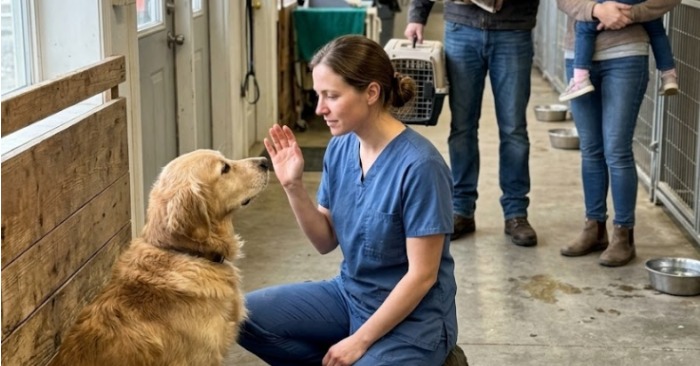
She opened the kennel and sat on the floor. When she repeated the sign for good boy, Nacho came forward, sniffed her hand, then gently rested his muzzle on her knee. For the first time since arriving at the shelter, his tail moved.
She cried into his fur.
Then she ran for Elena and the vet.
Both came expecting something small. Instead they watched in shock as Inés signed sit, lie down, wait, and Nacho responded perfectly every time.
“Dear God,” the vet whispered. “He was never ignoring us. We were the noise. He was waiting for hands.”
A call to the apartment building revealed the rest. Nacho’s late owner, Carmelo Vázquez, had been deaf his entire life. He lived alone, communicated through sign, and wrote notes when necessary. That meant Nacho had spent eight years learning commands, comfort, and love through Carmelo’s hands.
He had not been failing in thirty homes.
Thirty homes had failed to speak his language.
The truth became even clearer when Elena, Inés, and the building manager searched Carmelo’s apartment. It was still and dusty, with dog bowls near the door and photographs on the wall showing Carmelo and Nacho together. Hidden inside an old gardening book, they found a note written in shaky letters:
“If I die and Nacho is left alone, please don’t think he is a cold dog. He doesn’t understand voices. He understands hands. He needs people to face him. He needs patience. If a deaf person can keep him, it will be better for his heart. Don’t give him to just anyone. He is family.”
Elena cried holding the note.
The story spread quickly. Local pages shared Nacho’s picture. People fell in love with the story of the dog returned thirty times. The shelter was flooded with calls, offers, promises, and dramatic messages from strangers who swore they would learn sign language for him.
Elena thanked them all, but she was careful. Nacho did not need attention. He needed home.
Then one message arrived, calm and simple:
“I saw Nacho’s story. I am deaf. I would like to meet him.”
His name was Mateo Saldaña. He was twenty-six, worked repairing phones and computers, rented a modest apartment, and asked for nothing except the chance to meet the dog. During the video call, he did not promise miracles. He simply signed:
“I want to go slowly. If he doesn’t choose me, I will respect that.”
That was enough.
Mateo came on a Thursday morning. Inés asked to be there even though it was not her shift. When he entered the kennel area, he did what no one else had done.
He did not call Nacho’s name.
He did not crouch and smile too hard.
He did not invade.
He simply stopped a few feet away and waited.
Nacho lifted his head.
They looked at each other.
Mateo raised one hand and signed a quiet greeting.
The change was immediate. Nacho stood, took one step, then another, and walked to the kennel door. Mateo signed again, slowly, naturally, not like someone performing a trick, but like someone truly speaking.
Nacho pressed his nose to the bars where Mateo’s hand rested.
Nobody in the hallway breathed.
When Elena opened the kennel door, Nacho stepped out carefully, circled Mateo once, sniffed his shoes and bag, and then lifted his face toward him. Mateo crouched and signed something longer, gentler.
And then Nacho leaned his whole head onto Mateo’s shoulder.
Not just his muzzle.
His entire tired, heavy head.
As if he had finally found somewhere safe to lay the weight he had been carrying.
The adoption took less than an hour.
Before leaving, Elena handed Mateo the note from Carmelo, preserved in plastic. He read the last line — He is family — then looked at Nacho and signed:
“I know.”
They walked out together just before noon, Mateo with his bag over one shoulder, Nacho close by his left leg, calm and steady. At the corner, Mateo stopped, signed something brief, and Nacho looked up at him and wagged.
Then they disappeared around the street.
Nacho’s life with Mateo began quietly. The shelter received photos every few days — sleeping beside the couch, resting one paw against Mateo’s shoe, sitting in the park watching his hands, and finally, in one photo, smiling with his whole face softened in peace.
Mateo later wrote that Nacho did not like being surprised from behind, liked having his paws cleaned before coming inside, and needed eye contact, not just gestures. He did not respond to movement alone. He responded to full attention.
That explained everything. For two months, people had tried to love him without truly seeing him.
Soon Mateo started bringing Nacho to a community center for deaf children and families. Without meaning to, the dog became something beautiful there — not a symbol of tragedy, but proof that different did not mean broken. Children practiced simple signs with him, and he obeyed patiently. Adults watched with tears in their eyes as sign language, so often treated as lack or limitation, became something warm, normal, and full of life.
One rainy night, Nacho woke Mateo by touching his shoulder with his nose. A hose under the sink had come loose, and water was creeping toward an extension cord. Mateo, asleep and deaf in the storm, would never have heard it. But Nacho had sensed the change and got him up in time.
The vet later wrote only one sentence to the shelter group:
“He was always extraordinary. We were just reading him wrong.”
Months later, the shelter invited Mateo and Nacho back for an adoption event for adult and special-needs animals. When they entered the reception area, Nacho paused for a second beside the same wall where he had once sat after being returned again and again. Mateo knelt, signed something calming, and Nacho looked at him.
The tension left his body.
Then he walked forward.
That day, three adult dogs found homes.
After the event, while Inés cleaned the hallway, she thought about Carmelo in his silent apartment, teaching a golden puppy how the world worked through his hands. She thought about the thirty families who may have meant well but loved from the wrong language. She thought about Mateo, who did not rescue Nacho with grand promises, but with understanding.
And she thought about herself — the cleaning woman, the one nobody asked for answers, the one who simply noticed what others had already decided to misunderstand.
It had not taken expensive treatment or some dramatic miracle to save Nacho.
It had taken one tired woman lifting her hand the same way she always did at home.
A small gesture.
A familiar habit.
A language of love already living in her body.
Later, Mateo took Nacho to the cemetery where Carmelo’s ashes rested. He placed a copy of the old note on the grave, then signed something long and private that his sister later translated:
“I found him. Or maybe you sent him to me. He is not alone now. Neither am I.”
That, perhaps, was Nacho’s real secret.
Not that he understood signs.
Not that he had been returned thirty times.
Not that a cleaning lady discovered what no one else did.
His real secret was deeper than that:
Love without understanding can feel like abandonment.
And being seen in the right language is not a luxury.
It is a kind of salvation.