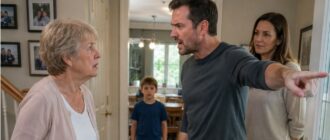
Leonardo Paredes had been living for three months with a kidney that wasn’t his.
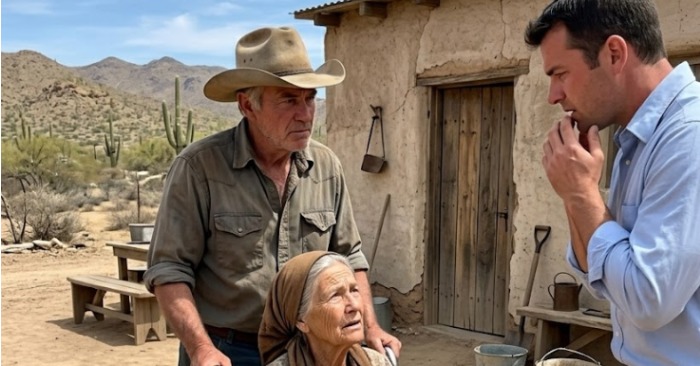
That was all the hospital in Tucson told him. Anonymous donor. Successful transplant. Go home and recover. He signed the papers, went back to Phoenix, and tried to return to normal life. But almost dying had cracked something open inside him. So one morning he rented a truck and drove south, across the desert, back to the adobe house in Sonora where he had grown up — the house where his parents still lived, the parents he had not visited in twelve years.
When he arrived, the first thing he saw was his mother in a wheelchair.
Rosario looked smaller than he remembered, weaker, with an IV hanging from a makeshift metal stand beside her. His father stood behind her, thinner than ever, both hands gripping the chair like it was the only thing keeping him upright. And before Leonardo even stepped out of the truck, his mother was already crying.
He ran to her, bent down, and hugged her carefully. But the moment he touched her, she let out a small cry of pain and pressed a hand to her side.
“What happened to you?” he asked.
“Nothing, son. Just a fall. Old age,” she said quickly.
His father did not look at him. He only muttered, “Come inside. It’s too hot out here.”
Inside, the house smelled like broth, disinfectant, and medicine. There were pills on the table, gauze, and medical notes folded under a cup. None of it matched the story about a simple fall. His mother tried to distract him by warming soup. His father kept silent. And the more they avoided the truth, the more Leonardo felt that whatever had happened in that house had something to do with him.
That night he could not sleep.
Near dawn, he heard his mother groan in pain. He stepped quietly toward his parents’ room and looked through the curtain. His father was changing the bandage on her side, and in the dim light Leonardo saw a long scar across her body.
It was in the exact place his own scar was.
He froze.
The next morning, while his parents slept, he searched through the medical papers on the table and found one from a hospital in Hermosillo. It listed Rosario’s name and one procedure: left nephrectomy.
Kidney removal.
Same week as his transplant.
Leonardo stared at the page until his hands started shaking. He already knew what it meant. He just didn’t want it to be true. He called his cousin Patricia, who worked in a hospital, and demanded answers. She tried to avoid it. That was answer enough.
Then he went to see an older neighbor, Doña Petra, and she told him everything.
Patricia had discovered through a transplant coordination list that Leonardo was dying in Arizona, waiting for a donor. Rosario found out, traveled to Hermosillo, got tested, and turned out to be a perfect match. She insisted on donating anonymously. She did not want her son to know. She did not want him to feel guilty. She only wanted him alive.
She was already in her sixties. The surgery was dangerous. His father had begged her not to do it. But she did it anyway.
And while Leonardo was recovering in Tucson, thinking some stranger had saved his life, his mother was back in Sonora with an infected wound, failing strength, no money for proper medicine, and a body that could no longer recover the way it should have.
He went back home numb with shock and found his father sitting outside.
“I know,” Leonardo said.
His father looked at him with years of anger and grief in his eyes.
“She waited for your calls every Sunday,” he said. “For years. She sat by that phone under the sun just hoping for three minutes from you. Then she found out you were dying from a hospital screen. And she gave you her kidney without even telling you.”
Leonardo dropped to his knees in the dirt and cried.
Not just for the surgery. For the years. For the silence. For every call he never made, every promise he broke, every Sunday his mother waited.
Then he went inside and knelt in front of Rosario.
“Why did you do it?” he asked through tears.
She touched his face the way she had when he was little.
“Because that kidney was always yours, my son,” she said. “I was just keeping it for you.”
That night, Leonardo sat outside the house and called his life in Phoenix. His girlfriend asked if he would be back by Monday for work.
“No,” he said quietly. “I should have come back twelve years ago.”
The next morning, before sunrise, he climbed onto the roof of the old adobe house with a hammer and a box of nails. The roof was broken, just like everything else he had left behind. His father came outside, looked up, disappeared for a minute, then returned with tools of his own. Without a word, he climbed up beside him.
And together, in silence, they began to repair what had been broken for far too long.