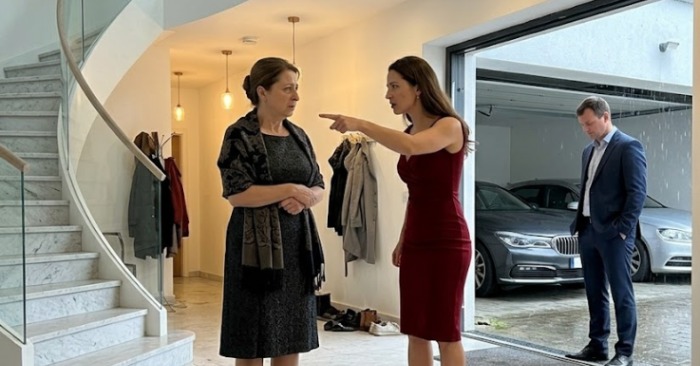
Less than two hours after we returned from the cemetery, Patricia stood in the foyer with rain still on her heels and pointed at my suitcases by the garage as if they were trash. The smell of funeral lilies still clung to my black dress, and I could still feel the cold of Roberto’s hand from before they closed the coffin. Then she looked me up and down and said, “The good life is over, Lourdes. From now on, you sleep where the dog sleeps.”
My son Marcos stood beside her, silent. My only son. The boy I had raised, the man his father had paid everything for. He did not defend me. He did not apologize. He just looked down.
My grandchildren, Emma and Dylan, stared at me from the living room with frightened eyes. Outside, it was still raining. Inside me, something much worse was breaking.
“Patricia,” I said quietly, “I don’t understand.”
“Oh, you understand,” she replied. “Roberto is dead. The will leaves everything to Marcos. This house is no longer yours. We’re letting you stay out of pity, but we’re not going to support luxury for a widow with no income.”
I knew she was lying. I knew the will. I knew Roberto would never have left me unprotected. What I did not know was how cruel Patricia could be, or how weak my son had become.
“Mom,” Marcos finally muttered, “it’s only for a little while.”
Patricia laughed. “Don’t confuse her. She’ll stay in the service room by the garage. We’ll put a little bed there. If Lucky doesn’t need it first.”
Lucky was the Labrador.
I looked around that house — my curtains, my mirror, my kitchen, the bougainvillea Roberto and I had planted together. Every corner carried my hands, my memories, my life. And still she stood there treating me like an unwelcome burden.
“Your things are already outside,” Patricia continued. “And if you’re going to stay here, you’ll earn your place. Cook, clean, help with the children. We’re not carrying a useless woman.”
Emma tried to speak up for me, but Patricia sent her upstairs. Dylan started crying. In that moment I understood this had all been planned. They had waited until Roberto was buried to show me who they really were.
I picked up my suitcase, looked at the wedding portrait above the stairs, and did the one thing Patricia never expected.
I nodded.
I did not fight. I did not mention that the house was also mine. I did not say a word about the inheritance, the trust, the accounts, or the mansion in Cancún whose papers I had found a week before the funeral. I said only, “All right. I’ll do as you think best.”
That night I slept in a damp little room near the garage, fully dressed, holding the documents hidden in my bag: a bank key, a copy of the trust, and the deed to a mansion in Cancún worth millions. I cried for Roberto until my ribs hurt. Then I stopped.
Because in that filthy little room, one clear thought took shape inside me: I would let them believe I had nothing. I would let Patricia feel powerful. I would let Marcos reveal how far he could fall. And when the time came, I would show them the cost of mistaking kindness for weakness.
The next three months were a lesson in humiliation. Patricia turned me into unpaid staff. She barked orders from early morning, demanded perfect meals, and treated me like a servant. She never thanked me. She never called me mother-in-law. To her, I was just “Lourdes.”
Marcos hid behind grief, work, and excuses. Every time I tried to speak to him, he told me not to make things harder. Every time he called it “their house,” I felt something die inside me.
My grandchildren were my only comfort. Emma still came to sit with me in secret. Dylan only knew that Grandma no longer had the nice room and no longer seemed important. One day Emma asked me softly, “Grandma, did you become poor?” I told her, “No, my love. I’m just seeing things now that I couldn’t see before.”
Patricia also loved to play the saint. She invited wealthy friends over, made me cook and serve them, and spoke as if she were nobly sacrificing herself to care for a penniless old woman. Listening to her, I realized something painful: some people forget kindness the moment it stops benefiting them.
But I was not surrendering. I was watching.
At night I studied the documents I had hidden. Roberto had not just left me money. He had left me freedom. The house was under a trust I controlled. There were investments, accounts, properties, and liquid assets. Altogether it came to nearly seventeen million dollars. And the Cancún mansion — white terraces, Caribbean view, private dock — had been a surprise he bought for our fortieth anniversary.
One morning, while Patricia was out and Marcos was at work, I called Roberto’s lawyer, Fernando Álvarez. He told me he had been waiting for my call. When I met with him, he laid everything out clearly: the house, the trust, the accounts, the investments, the deed to Cancún. Roberto had made sure I would never depend on anyone’s mercy.
I returned home knowing I could leave or throw them out at any moment. But by then I wanted more than comfort back. I wanted the full truth.
And soon I got it.
One afternoon Patricia said she was going to yoga, but she was dressed far too elegantly for exercise. I followed her to a boutique hotel downtown. From the bar, I watched her meet a younger man in a navy suit. They laughed, touched, exchanged papers, and kissed. His name, I learned, was David Carrera.
From that day on, I paid closer attention. Hidden calls. Secret receipts. A locked box. Then one afternoon, she left her laptop open. I had not meant to snoop, but I saw my own last name on the screen.
The email was from David.
It said that once they knew how much I really controlled, they could move forward with the divorce. It said Marcos would be easy to squeeze. It said she should keep me crushed and confused for a little longer.
I photographed everything.
There were more messages: Patricia calling me manageable, mocking Marcos for never reading documents, discussing how much money she could take before leaving him, even mentioning the possibility of claiming I was mentally unstable if I became difficult. She was not just humiliating me. She was hunting me.
I called Fernando again. Then, for the first time in my life, I hired a private investigator. Within two weeks she delivered everything: David had gambling debts, a wife in San Antonio, and a history of shady dealings. Patricia had secretly opened credit accounts and consulted a divorce lawyer even before Roberto died. While my husband was still alive, she had already been planning how to take the money.
I still said nothing.
Then fate moved for me.
One afternoon Marcos came home early and found a confidential envelope addressed to me — documents from Fernando that Patricia had tried to intercept. He opened them before she could stop him.
Soon I heard shouting upstairs.
“What does this mean?” Marcos yelled. “What does it mean that Mom controls the house? What does it mean she has millions? What does it mean there’s a mansion in Cancún?”
I stepped into the room as Emma and Dylan appeared on the stairs.
“Mamá,” Marcos said, looking at me like a stranger. “Is it true?”
“Yes,” I said.
Patricia snapped, “You deceived us! You made us think you were helpless!”
I looked at her calmly. “No. You chose to believe what suited you. You lied about the will. You threw me out of my room. You told me I had to earn the right to exist in my own home.”
Then I placed my phone on the table and showed Marcos the photos from the hotel, the emails, and the messages with David. He read them in silence, his face collapsing.
“Divorce?” he whispered. “A big slice? Mental incapacity? My mother?”
Patricia cried then, but not out of shame. Out of fury at being exposed.
“Yes!” she shouted. “I was tired! Tired of living with a man who can’t do anything without thinking about his mother! And she’s no saint either — she let all this happen!”
Marcos turned to me, shattered. “Why didn’t you stop it?”
“Because I needed to know who you all were when you thought I was worth nothing.”
Emma began to cry. Dylan clung to the railing. Patricia threw out one final bitter line: “You won, Lourdes. But you lost your son.”
Marcos pointed to the door.
“Get out.”
She laughed bitterly. “This isn’t even your house.”
Then she left.
The house became quiet, but not peaceful. I returned to the master bedroom, to my closet, to my own bed. Yet the hardest part was not Patricia’s absence. It was my son’s shame.
A few nights later, Marcos sat across from me in the kitchen and finally said, “I don’t know how to live with what I did to you.”
“Then don’t live the same way,” I answered. “Change.”
He cried in silence. He admitted he had chosen cowardice because grief was easier to survive that way. I told him he had failed for a time, but time was not over yet.
Meanwhile Patricia kept fighting. She tried to poison the children against me, blamed me for the collapse of the marriage, and demanded money. I hired lawyers, protected my assets, and gave Marcos all the evidence. The divorce became unavoidable.
But Patricia still was not done.
One afternoon she came back to the house with David while Marcos was away. David carried a black folder, and they sat in my living room as if they owned it. Their “proposal” was simple: I should transfer three million dollars for the children’s benefit, and Patricia would agree to return, repair the marriage, and avoid further emotional damage.
Then came the real threat. If I refused, they would consider legal ways to question my mental stability. After all, what kind of woman with money lets herself be treated like a servant? They thought they could paint me as unstable and use the children as part of the pressure.
I let them finish.
Then I opened another folder — the investigator’s file. David’s debts. His other affairs. His marriage. Patricia’s messages. Her plans. Her timeline. Everything.
“My offer is simpler,” I said. “You leave now. Patricia signs a clean divorce. David disappears. Or this file goes to the police, your wife, your licensing board, and every lawyer who would enjoy tearing you apart.”
That was the first moment David lost his confidence. Patricia did not. She only glared at me and said, “You always were an elegant snake.”
I smiled. “No. I was simply a well-mannered woman. You confused manners with stupidity.”
They left, and two months later the divorce was final.
By then I had made my decision.
I did not want to spend the rest of my life in a house filled with betrayal and grief. I loved Marcos. I loved my grandchildren. But, at last, I also loved myself enough to choose peace. So I told Marcos I was leaving for Cancún.
“Let me make it up to you here,” he begged.
“I don’t need to be taken care of,” I said. “I need to live.”
Before I left, I put everything in order. I arranged the trust. I transferred the Houston house to Marcos under conditions that protected Emma and Dylan. I created strong education funds for them. I even required that each year they write me a letter about dignity, honesty, and responsibility in order to keep certain benefits. My lawyer laughed when he read that clause, but he said it was worth more than any business degree.
The day I left, Emma gave me a blue beaded bracelet. Dylan handed me a drawing of the sea and a crooked sailboat. On the plane, I cried — not from sorrow, but from relief.
The mansion in Cancún was even more beautiful than the photographs. On my first morning there, I woke without alarm clocks, demands, or Patricia’s heels clicking down the stairs. I opened the terrace doors, and the Caribbean flooded in with light. I stood there barefoot, breathing the sea air, and for the first time in months, my life felt like my own again.
The caretakers, María and José, became warm company. I began walking at sunrise, painting, reading, volunteering, cooking, and remembering Roberto without bitterness. Every Sunday Marcos called. At first our conversations were stiff, but slowly they became honest. I stopped trying to fix his life. He started trying to rebuild his own.
Emma and Dylan visited in the spring. We cooked together, built sandcastles, and talked honestly. I never turned their mother into a monster in front of them, but I did tell them the truth: loving someone does not mean allowing them to hurt you.
Patricia tried to contact me once with a long message about regret and second chances. I deleted it. Some people do not seek forgiveness because they have changed. They seek it because they want the door open again.
Six months after I moved to Cancún, I sat on the terrace watching the sunset stain the sea orange and pink. I thought about the woman who had come home from the funeral stunned and grieving. I thought about the woman who slept by the garage with an empire hidden in papers. I thought about the woman who kept cooking while gathering evidence. And then I thought about the woman sitting there now, back straight, no longer asking permission to exist.
That was when I understood something at last: Roberto’s real inheritance was not the seventeen million dollars. It was not the house in Houston. It was not even the mansion in Cancún.
It was freedom.
The power to choose my own future. The certainty that I could rebuild myself without begging for love, approval, or shelter.
Patricia once told me I had won. She was right, but she never understood what that victory really meant.
I did not win because she left.
I did not win because the money was mine.
I did not win because I could humiliate her back.
I won because I finally saw clearly.
I won because I stopped begging for respect where there had only ever been selfishness.
I won because my son, even late, was finally forced to face himself.
I won because my grandchildren will grow up knowing dignity is not negotiable.
And I won because at sixty, when many women believe everything is already written, I discovered that a new life can still begin.
Now Emma and Dylan are coming again tonight. We will have dinner on the terrace. The garden lights are on. The sea is calm. My paintbrush still lies on the table with traces of blue on it. A novel rests open beside my coffee.
And no one sends me to the dog’s room anymore.
No one decides what I am worth.
No one mistakes me for a defeated woman.
Because I learned, late but well, that some silences are born from fear… and some are the quiet preparation of justice.
Mine was the second kind.
And when I finally spoke, I reclaimed not just my house, not just my name, not just my life.
I reclaimed my place in the world.