That single sentence set everything in motion.
The evening at the upscale restaurant had been unfolding exactly as expected — soft golden lighting, quiet music drifting through the air, slow conversations over expensive wine. Everything was controlled, elegant, predictable.
And then came a sound that didn’t belong.
A sharp, desperate cry cut through the calm.
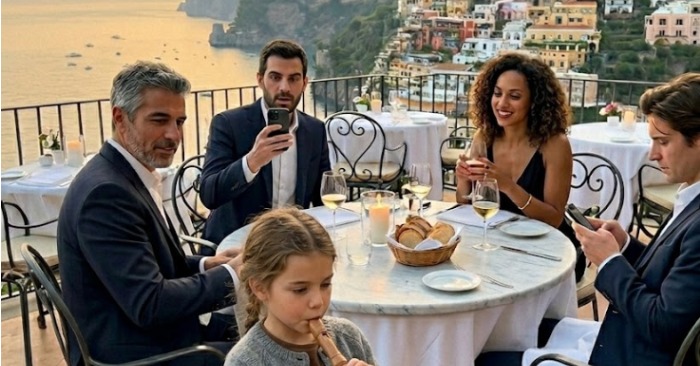
Near one of the tables stood a small girl, no older than nine. Her clothes were worn, her shoes scuffed, her presence painfully out of place in a room filled with polished shoes and tailored suits. In her hands, she held a thin, slightly dented flute. It trembled as much as her fingers did.
She wasn’t asking for much.
Just a little money.
Just enough to eat.
The room fell silent — but not with compassion.
People stared. Some with irritation, others with curiosity. A few already reached for their phones, sensing something unusual, something worth recording.
From a nearby table, a well-dressed man leaned back in his chair, swirling his drink lazily. A faint smirk appeared on his face.
“You want money?” he said, his tone light, almost amused. “Then earn it.”
A few quiet laughs followed.
The girl lowered her eyes for a moment. It seemed like she might turn around and leave — disappear back into the world she came from, unnoticed and unheard.
But she didn’t.
Instead, she slowly raised the flute to her lips.
The first notes were fragile.
Barely audible.
Unsteady.
The kind of sound that makes people doubt whether anything meaningful will follow.
But then something changed.
The melody grew stronger. Not perfect — far from it. There were imperfections, uneven transitions, moments where the breath faltered. But what filled the space wasn’t technique.
It was truth.
Raw, unfiltered, undeniable.
The conversations faded. The clinking of glasses stopped. Even the waitstaff paused mid-step. It felt as though the entire room had been pulled into something deeper than sound.
Tears rolled down the girl’s cheeks, but she kept playing — as if every note carried something she couldn’t say any other way.
And for the first time that evening, no one was watching for entertainment.
They were listening.
Slowly, a woman at one of the tables stood up.
Her expression had changed completely. The casual calm was gone, replaced by something sharper — recognition, mixed with fear.
“That melody…” she whispered, barely able to breathe.
When the music ended, the silence that followed felt heavier than before.
The girl lowered the flute and spoke quietly.
“My mom taught me… before she got sick.”
The woman stepped closer, her hands trembling.
“What’s your mother’s name?” she asked.
“Anna.”
The name landed like a shock.
The woman’s face went pale. The glass slipped from her hand and shattered against the floor, but no one reacted. No one cared about the noise anymore.
Then suddenly — darkness.
The lights went out.
The terrace was swallowed by shadow. Voices rose in confusion. Someone laughed nervously. Phones flickered to life.
But the girl didn’t move.
In the darkness, the flute began to play again.
The same melody — softer now, almost unreal. Without lights, without attention, without any promise of reward. And yet every note cut through the darkness like something alive.
One by one, people raised their phones, turning on their flashlights. Small beams of light filled the space, glowing like scattered stars.
The woman stepped forward, her voice breaking.
“Anna only played that melody for one person… for my daughter.”
The music stopped.
The girl looked up.
“She didn’t have a daughter,” she said quietly. “She told me she lost her.”
The woman covered her face, tears slipping through her fingers.
“They told me she died…”
The world seemed to pause.
“No… my mom is alive,” the girl said gently. “She just can’t walk anymore.”
“Where is she?” the woman whispered.
“In an old house behind the train station. I come here to play… to buy her medicine.”
Everything shifted in that moment.
This wasn’t coincidence.
This wasn’t performance.
This was something far greater.
The same man who had mocked her earlier slowly stood up. The amusement was gone from his face. Without a word, he removed his expensive watch and placed it on the table.
“How much do you need?” he asked, his voice now serious.
But the woman didn’t even hear him.
She dropped to her knees in front of the girl.
“What’s your name?” she asked softly.
“Lia.”
The name was quiet — but it carried weight.
The woman closed her eyes.
“That’s what I wanted to name my daughter…” she whispered.
She reached out her hand, then hesitated, afraid to touch her — as if the moment might break.
“Can I… go with you?” she asked.
The girl studied her carefully, searching her face for something real.
Then, slowly, she nodded.
At that exact moment, the lights came back on — bright, cold, ordinary.
But nothing felt the same anymore.
No one was waiting for entertainment now.
They had witnessed something else entirely — something rare.
The return of something once lost.
The beginning of something that might still be saved.
And the flute in the girl’s hands no longer trembled.
Because for the first time in a long while…
she wasn’t alone.