For several weeks, Mateo came to the same quiet square every day. He blended into the crowd, looking like just another passerby who had stopped for a moment of rest. But his presence there was no coincidence — he was trying to escape something far more difficult than the world around him.
After his father’s death, his life had continued outwardly unchanged: meetings, deals, growing profits, and the respect of others. From the outside, everything was in place. But beneath that surface was an emptiness he couldn’t ignore. Each evening, he returned to his large house, where the echoing silence only made his loneliness more unbearable.
Once, his father had told him: if you ever feel empty inside, go where life is stripped down to its rawest form. At the time, those words felt strange. But one day, Mateo finally understood what they meant.
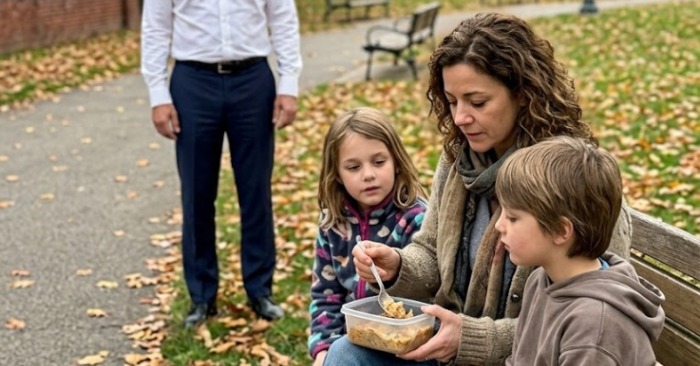
In the far corner of the square, beneath a wide but fading tree, a woman sat with her two children. She wasn’t asking for help. She wasn’t trying to attract attention. In her hands was nothing but an old pot of food.
Mateo stopped without realizing it.
The woman carefully served the children first, generously filling their bowls. For herself, she kept only a small portion — the leftovers. She accepted it calmly, as if she needed nothing more.
The children ate slowly, as though every bite mattered. The woman watched them with a quiet smile, despite the visible exhaustion in her eyes.
There was no performance in that moment. No calculation. Just pure, selfless care.
Mateo had seen plenty of public generosity at charity events, but this simple scene struck him far more deeply than anything staged or applauded.
Then suddenly, one of the girls collapsed.
People nearby froze, unsure what to do.
But Mateo was already moving toward her.
At the hospital, the diagnosis came quickly and without emotion: dehydration and severe exhaustion. The mother stood beside her child, trembling, apologizing for everything — for not noticing sooner, for being poor, for the situation itself.
Mateo didn’t hesitate. He paid for the treatment.
For the first time in his life, money didn’t feel like an advantage — it felt like a responsibility.
Later, sitting in a small café, the woman shared her story: losing her job, being evicted, and the disappearance of the person who had once promised to support her. She spoke calmly, without complaint, as if she had long accepted that she had to fight alone.
Mateo realized something uncomfortable: while he had been grieving in comfort, she had been fighting for her children’s survival with almost nothing — and still giving them everything she had.
That same evening, he offered them a place to stay in his home.
There were no dramatic speeches. Just a simple chance to recover.
With their arrival, the house began to change. The silence gave way to voices, to laughter, to life. The children no longer went to sleep wondering if they would be hungry.
The woman soon returned to her craft — sewing. Her work was precise, delicate, and skilled. Mateo saw not need, but potential.
He set up a workshop for her.
Over time, her creations began to bring in income. Confidence returned. The weight of the past slowly began to lift.
The children started sleeping peacefully through the night.
And between Mateo and the woman, something real began to grow — not rescue, but partnership.
Months later, under a quiet sky filled with stars, he asked her to marry him. But his words were meant not only for her, but for her children as well.
He didn’t promise a perfect life. He promised to stay. To choose them, every single day. To truly see them.
The children were the first to embrace him. The woman cried — not from pain this time, but from a long-awaited sense of relief.
Because the real miracle wasn’t wealth.
It was a mother who gave everything she had.
And a man who finally understood that money only has value when it is guided by humanity.