By the end of my twelve-hour shift, I could barely feel my legs. My mind kept circling the same thought over and over — would I have enough money this month to keep my sister’s treatment going? Every hour at work felt like a race against time, and time was something we were quickly running out of.
That’s when the girl stepped up to my register.
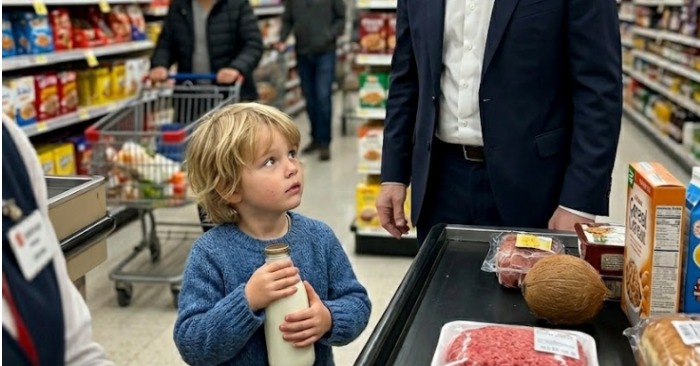
She couldn’t have been older than eight. She was holding a single bottle of milk with both hands, as if it were something fragile and incredibly important. Her sweater was worn thin, her fingers red from the cold, and her eyes… her eyes carried a kind of caution no child should ever have to learn.
“Excuse me…” she said softly, barely above a whisper. “Can I pay for this tomorrow?”
I froze.
In jobs like mine, you hear requests like that more often than you’d expect. And they almost always end the same way — with a polite refusal, a rule, an apology.
I thought the hardest part would be saying “no.”
But I was wrong.
I’m forty-one years old. For the past year, my life has been split between long shifts at the store and hospital bills I can barely keep up with. My sister, Dana, is seriously ill. Her treatment costs more than I earn. We don’t have parents to fall back on. No relatives offering help. Just me — doing everything I can to buy her one more day, one more chance.
I looked at the girl again.
“Please… I’ll pay tomorrow,” she repeated, her voice trembling just enough to betray how afraid she was of hearing the answer.
I opened my mouth, ready to explain store policy.
Then she added quietly, “My twin brother is crying because he’s hungry. My mom… she gets paid tomorrow. Her name is Marilyn.”
Something inside me shifted.
I stepped away from the register for a moment, trying to steady myself. I could hear the line behind her, feel the pressure of time, the expectation to move things along.
But all I could see were her hands gripping that bottle.
I made a decision.
Quickly, before I could second-guess myself, I grabbed a bag and filled it — bread, some basic groceries, a few essentials, even medicine I knew might help. Then I paid for everything out of my own pocket.
When I handed her the bags, she just stared at me, as if she didn’t quite understand what was happening.
“Go on,” I said gently.
Her lips parted, and for a moment, she couldn’t even speak. Then she whispered a thank you and ran out, clutching the bags tightly.
That’s when I noticed him.
A man standing just behind her in line.
He was dressed well — expensive coat, polished shoes, the kind of presence that usually carries confidence without effort. But his expression didn’t match it. There was something unsettled in his eyes, something heavy.
He watched the girl leave as if he had just realized something important.
I didn’t think much of it at the time.
Until the next day.
He was waiting for me outside when my shift ended.
Up close, he looked different — tired, like he hadn’t slept at all.
“My name is Daniel,” he said.
And then he told me something I wasn’t expecting.
When the girl had mentioned her mother’s name — Marilyn — something inside him had shifted. She was a woman he had once loved deeply, years ago. But he had walked away, pressured by his family, choosing expectations over feelings.
When he saw the girl, he couldn’t ignore the resemblance.
So he followed her.
And what he discovered changed everything.
She wasn’t alone. She had a twin brother.
Both children… were his.
Marilyn had never told him she was pregnant.
I could have walked away at that point. Told him it wasn’t my place, that it wasn’t my problem.
But I kept seeing that bottle of milk.
And those small, trembling hands.
He asked for my help — because, in his words, Marilyn would trust me more than she would ever trust him.
After a long pause, I agreed.
We went to her home.
It was small, modest, but incredibly clean — the kind of clean that tells you someone is holding things together with everything they have left.
The girl, Lucy, recognized me immediately. Her brother, Ben, was lying on the couch, burning with fever. Marilyn herself looked exhausted, her face pale, her movements slow.
And when she saw Daniel, everything in the room shifted.
Her expression turned cold in an instant.
There was history between them — pain, silence, unanswered questions that had never found their way out.
I stepped in before it could turn into something worse.
“The kids need a doctor,” I said firmly.
A few hours later, the diagnosis was clear. The children had the flu. Marilyn had pneumonia.
There was no choice — she needed to be hospitalized.
At first, she refused. Pride, fear, exhaustion — all of it held her back.
But when she looked at her children, she gave in.
The next few days were intense.
Daniel covered every expense without hesitation. Hospital bills, medication, food — everything.
But money didn’t make him part of their lives.
The children kept their distance. To them, he was a stranger who had appeared out of nowhere.
He tried — too quickly, too forcefully.
And I had to be honest with him.
“You can’t disappear for years and come back expecting to be their father overnight,” I told him. “Right now, you’re just someone they don’t know.”
He didn’t argue.
For the first time, he listened.
Slowly, things began to shift. Not dramatically, not all at once — but in small, careful steps. Conversations that didn’t end in silence. Moments that didn’t feel forced.
Meanwhile, my own life was still falling apart.
The calls from the clinic didn’t stop. The numbers didn’t change. The pressure didn’t ease.
One evening, he noticed.
“You don’t look okay,” he said.
I didn’t plan to tell him anything. But something in his tone made it harder to hide.
So I told him the truth.
About Dana. About the bills. About how close we were to losing everything.
He asked how much I needed.
I gave a vague answer.
“Enough to ruin lives,” I said.
And I made one thing clear.
“I’m not looking for someone to save me.”
He nodded.
“I’m not trying to save you,” he said calmly. “I just want to repay the kindness you showed my children.”
The next day, he came back.
And he waited for me to finish my shift.
And for the first time in a very long time…
I felt something I hadn’t allowed myself to feel in months.
Not relief.
Not certainty.
But something quieter.
A possibility.
That maybe — just maybe — things weren’t over yet.