My son-in-law shouted, “Is this useless old woman going to eat everything again?”… I left, and my answer the next day left him frozen…
I was seventy years old when I finally understood that silence can be the most dangerous way to disappear.
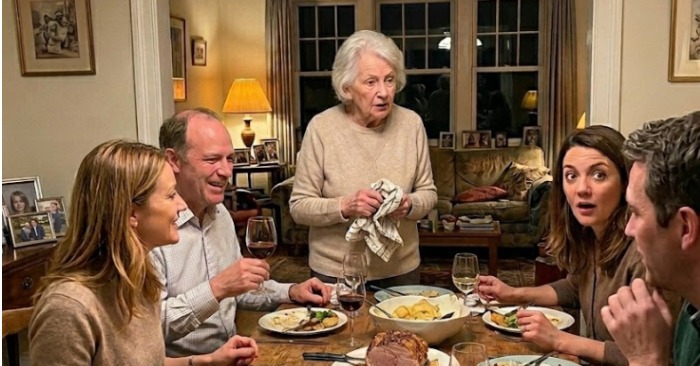
That Thursday night, I was sitting at the same dining table where I had spent decades serving meals to the people I loved. I had set that table with my own hands for birthdays, baptisms, graduations, Christmas dinners, and long Sunday lunches when the house was full and noisy and alive. It had once been my home in every possible sense of the word.
Now it felt like I was renting a corner of it with my dignity.
My name is Sofía Rentería. I have three children, seven grandchildren, and enough memories in that house to fill a cemetery. I lived there for forty-two years with my husband, Héctor. We bought the dining room furniture with his first real paycheck as an engineer. I painted the terracotta walls myself. I raised my children there. I learned how to grow older there.
And then, somehow, after Héctor died, I stopped being the woman who owned the house and became the old woman who happened to live in it.
That night my youngest daughter, Valeria, had made chicken in mole. Her husband, Sebastián, was sitting at the head of the table. My husband’s place. The place where Héctor had sat every evening for more than four decades now belonged to a man who had contributed nothing but noise, debt, and contempt.
I sat near the kitchen, at the side, like hired help waiting to be dismissed.
My grandchildren, Mateo and Regina, barely looked up from their phones. Valeria looked tired, with dark circles under her eyes and her hair tied back carelessly. Sebastián wore a new shirt from one of those expensive brands that cost more than what I used to spend on groceries for the entire week.
I served myself a little more mole. Not much. Just a second helping. I had cooked for people my whole life, but in recent years I had stopped eating comfortably in my own home. I always felt like I was taking too much, using too much, existing too loudly.
Then Sebastián looked at me and said, loudly enough for everyone to hear:
“Is this useless old woman going to eat everything again?”
The whole table laughed.
Mateo smiled at his screen. Regina let out a little giggle. Valeria looked down at her plate and said nothing. Sebastián laughed harder, as if he had just delivered the perfect joke.
My hand froze around the fork.
He waved it off with that tone cruel people use when they want to hurt you and still avoid responsibility. “Relax, suegra, it’s just a joke. But really, you keep helping yourself and then complain your stomach hurts.”
My throat burned. Not from the mole. From all the words I wanted to say and could not force out.
So I did the only thing I could do without collapsing.
I set my fork down carefully. I wiped my mouth with the cloth napkin I had embroidered myself thirty years ago with our family initials. Then I stood.
“Excuse me,” I said.
No one answered.
No one asked if I was all right.
As I climbed the stairs to my room—the smallest room in the house now, the one that used to be my sewing room—I could still hear them laughing downstairs. Then the television came on.
I closed my bedroom door and sat on the edge of my bed.
It squeaked beneath my weight.
And there, in the dark, with the taste of mole still on my tongue and humiliation sitting in my chest like a stone, I made the most important decision of my life.
No more.
I took out my phone, an old model my grandson had called prehistoric the month before, and scrolled to a number I had not used since Héctor’s funeral.
Mauricio Salazar. My lawyer. The man who had handled my husband’s will. The man who knew exactly what I owned and how hard I had worked for every part of it.
He answered after four rings.
“Sofía?”
“I need to see you first thing tomorrow morning,” I said. “And bring every document. Every single one.”
There was a pause.
Then he asked, quietly, “Are you sure?”
I looked at the closed bedroom door. Downstairs, I could hear explosions from some action movie, mixed with laughter.
“More sure than I’ve ever been.”
That night I barely slept.
I lay awake staring at the ceiling, listening to the sounds of a house that no longer felt like mine. The television shutting off after midnight. Sebastián’s footsteps going up the stairs. The bedroom door closing—the door to the room that had once been mine and Héctor’s for more than forty years.
Before dawn, I got up and opened an old metal box I had kept since my marriage. Inside were the documents I had not looked at properly since Héctor died.
And suddenly I remembered exactly who I had been before I became a shadow in my own home.
My full name is Sofía Rentería de Maldonado. I was born in Oaxaca in 1955. I studied accounting when women of my generation were barely expected to finish primary school. I graduated with honors. I worked for fifteen years in an auditing firm before my first child was born. When I married Héctor, he was a newly graduated civil engineer with a modest salary and big dreams.
I kept working.
My money paid the down payment on the house. My salary bought our first furniture, our first truck, and most of the stability we built in those early years. But no one remembers that. To my children, their father was always the provider and I was just “Mom,” the one who cooked breakfast and checked homework.
What they never knew was that when Héctor started his construction business, I was his real partner.
Not on paper, because back then men in suits did not take women seriously, but I handled the books, negotiated with suppliers, and found tax loopholes that saved us thousands. Every peso Héctor earned, I made grow. I bought a commercial property downtown when no one wanted that area. Today it is worth three times what I paid. I invested in stocks. Some failed. Some multiplied.
By the time Héctor died, I had built a serious estate.
And when he died, I made the worst mistake of my life.
I gave my daughter Valeria and her husband access to everything.
She came to me after the funeral and said, crying, “Mom, don’t worry about anything. We’ll handle it all for you.”
And shattered with grief, I believed her.
I signed a limited power of attorney so she could help with the bank, the property taxes, the rent deposits, and the paperwork. Sebastián suggested that they move in with me “so I wouldn’t be alone in a house that big.”
I said yes.
I thought it would be temporary.
Three months. Maybe six.
It had been five years.
Slowly, without noticing, I stopped making decisions.
Sebastián had opinions about everything.
“Suegra, don’t bother renewing that certificate, the bank rates are terrible.”
“Don’t worry about the property tax, I’ll pay it with your card.”
“What do you need to go out for? I’ll bring you whatever you need.”
I convinced myself they were taking care of me.
That I was lucky.
That I was a burden and should be grateful.
But that morning, surrounded by papers and account statements, I saw the truth.
The house was in my name.
The original deeds were still safe in a box only I could open.
The two commercial properties in the Zona Rosa brought in thirty-eight thousand pesos a month in rent, deposited into an account Valeria was “managing” for me.
There was a Banamex investment account.
And worst of all, two years earlier Sebastián had asked me to guarantee a business loan.
“It’s just paperwork, suegra. I need a guarantor to open my mechanic shop. It won’t cost you a peso.”
I signed.
Seven hundred eighty thousand pesos.
The shop failed in eight months.
He told me it had just been bad luck, that a partner had betrayed him, that he would repay me every cent.
He never did.
The loan balance had not stayed at 780,000 either.
It had grown to 1.2 million pesos.
He had refinanced it twice without telling me.
And he had been making the minimum payments using money from my rent accounts.
My money.
Money I never even saw.
I sat on that bed with the papers spread out around me and realized that during the five years I had been trying not to be a burden, they had been draining me dry.
The new car. The expensive school fees. The remodelled kitchen. The vacations. The subscriptions. The clothes.
All of it paid with what I had built while I used ten-year-old clothes and bought the cheapest soap at the supermarket.
I put the papers in my bag and went downstairs.
Sebastián was eating breakfast without even looking at me.
“Good morning,” I said.
He grunted something that was not really an answer.
Valeria came down a few minutes later.
“I’m going out for a while,” I told them.
“What errands?” she asked immediately. “Do you want me to come?”
“No,” I said. “I’m going to see Mauricio.”
“The lawyer?” Sebastián finally looked up. “What for?”
I smiled lightly.
“Old people things,” I said. “Boring papers.”
That was a lie.
It was the most important thing I had done in years.
At Mauricio’s office, I told him everything.
Not just the insult from dinner.
Every slight.
Every quiet cruelty.
Every transaction.
Every humiliation disguised as concern or family duty.
When I finished, he folded his hands over the desk and asked one simple question:
“What do you want to do?”
I took a deep breath.
“I want my life back.”
We worked for hours.
The first thing we did was revoke the power of attorney I had given Valeria.
The second was remove myself as guarantor from Sebastián’s loan on the grounds that I had signed under false information.
The third was begin changing my will.
And yes, I did something none of them expected.
I created a trust for my grandchildren—money that could only be used for education, books, tuition, and future opportunities. Not a single peso of it could be touched by their parents.
When I left the office, I was no longer the same woman who had arrived.
I did not know exactly how the next day would unfold.
But I knew one thing for certain.
The old woman they laughed at the night before had built far more than any of them understood.
And by the next morning, she had started protecting it.
The bank called Sebastián the following morning during breakfast.
I was there when his face drained of color.
“What do you mean the guarantor has been removed?” he said into the phone, his voice already turning sharp with panic. “There must be a mistake.”
He looked up at me.
And that was the moment he understood.
The old woman he had mocked at dinner was no longer going to sit quietly in the corner and take whatever was handed to her.
The old woman had finally remembered exactly who she was.
And that call was only the beginning.