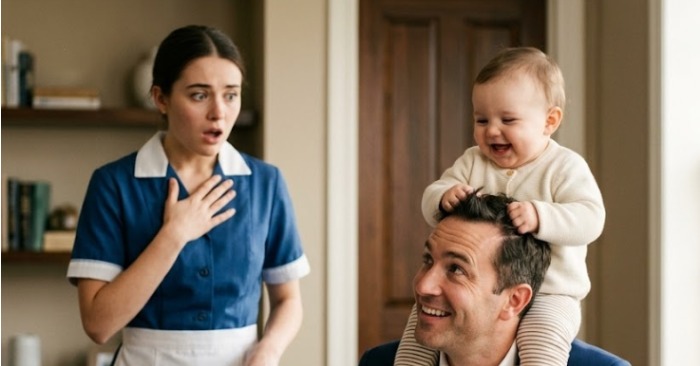
My name is Harrison Vale. By the age of thirty-eight, I found myself alone in a large house on the shores of Lake Michigan. Once, it had been filled with voices, laughter, footsteps echoing up and down the stairs. After my son died, the house sank into a suffocating silence I could never escape.
That morning, I woke to a sound that shouldn’t have existed — the cry of a baby coming from my own bedroom.
At first, I convinced myself it was just my exhausted mind playing tricks on me. But then I heard it again.
When I opened the door, I froze. My housekeeper, Lila, stood by the dresser, clutching a baby wrapped in an old pink blanket. There was no defiance in her eyes — only fear.
Her explanation came out in fragments: the daycare had shut down without warning, she had no money left, her landlord was pressuring her, and she simply had nowhere else to go.
The baby girl looked to be about eight months old. My son had only been four when he passed. Since then, my life had split into “before” and “after.”
I expected to feel anger. Instead, I felt that familiar ache… and something warmer I hadn’t allowed myself in years.
Lila had accidentally discovered something I had hidden from everyone — a closet filled with photographs of babies. It was my strange, quiet way of holding onto the feeling of being a father, something I had lost.
When she began packing her things, certain she would be fired, I stopped her.
“Don’t go. If you ever have no one to leave the baby with again — bring her here. This house has been empty for far too long.”
My sister Meredith reacted harshly. She believed I was trying to fill the void in my life with someone else’s child.
I asked myself the same question… until the little girl reached out to me with complete trust.
That’s when I understood — this wasn’t about replacing anything. I was simply tired of hiding from my own emotions.
But the calm didn’t last.
One day, a woman named Rachel Porter came to the house. She said she worked with an organization that searches for missing children. In her hands was a folder filled with documents.
She showed me a photograph.
The baby in the picture was the same child.
The girl had been abducted from a hospital eight months earlier.
I looked at Lila — and I saw the truth before she even spoke.
She confessed that she had found the baby alone near a church, abandoned in the cold. At first, she had wanted to report it, but she couldn’t bring herself to let the child go.
A DNA test confirmed it: the girl was Amelia Porter. Her parents had been searching for her for months.
When they came to take her, she reached for me, making a soft sound that almost resembled “dada.” In that moment, I barely held myself together.
Love doesn’t disappear just because it isn’t meant to stay.
I accompanied Amelia to meetings with her real family, watching as she slowly began to recognize them.
Her parents were stronger than I expected. Despite everything, there was gratitude in their voices, even through the pain.
Later, I found Lila. She admitted that she had lost a child of her own before and had never truly recovered from that grief.
We decided to try again — this time without lies.
Over time, trust grew between us.
A few months later, Lila told me she was pregnant — with my child.
Our son was born healthy. We named him Owen James — a tribute to the past, but a step toward the future.
Amelia never disappeared from our lives. We continued to see her, to stay connected.
Years transformed the house. Where silence once lived, there were now toys, laughter, and life.
One evening, Lila asked me,
“Do you ever wish things had happened differently?”
I thought about it, then answered,
“I wish there had been no deception. But I don’t regret where it led us.”
Sometimes, it’s pain that opens our eyes to what truly matters:
love isn’t limited by blood,
forgiveness takes strength,
and even a heart shattered by grief can learn how to live again.