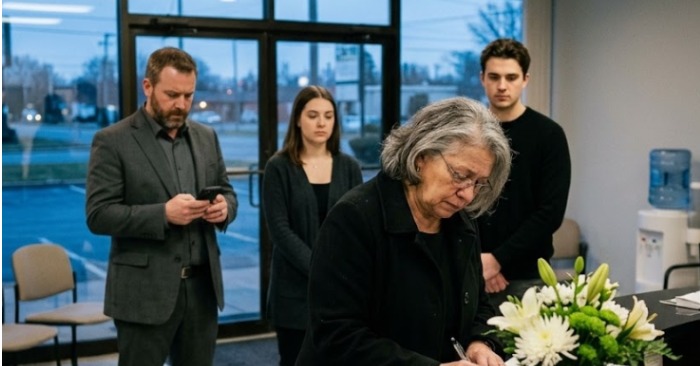
The night my three children left me in a nursing home, I was still wearing the black dress from my husband’s funeral. I had not even had time to change, to cry properly, or to understand that Roberto was really gone. My hands still remembered the cold wood of his coffin. My hair still carried the heavy scent of funeral flowers. And before the grief had even settled, my children had already decided what to do with me.
Rodrigo, the oldest, handled everything like a business errand. Patricia stood there polished and composed, careful not to let her mascara run. Daniel could not even meet my eyes. In that bright, cold reception area, with its smell of disinfectant and fake flowers, I signed the admission papers with a shaking hand. In that moment, I understood I was not signing a routine form. I was signing the quiet disappearance of my own life.
A few weeks earlier, Roberto was still alive. Sick, fragile, and fading, but alive. On his last birthday, I baked the cake he loved, lit the candles, and sang to him alone because none of our children came. I lied and told him they were busy, because I could not bear to let his heart break one last time. He squeezed my hand and asked me to promise him something: that after he was gone, I would still find a way to be happy. I told him not to talk like that. He only looked at me and repeated it.
When he died, I thought our children would come closer. I thought grief might bring us back together. Instead, at his funeral, I overheard them in the hallway discussing me like I was a problem to be solved. Rodrigo said I could not stay alone in the house. Patricia agreed it was “for the best.” Daniel said nothing useful at all. They were not talking about caring for me. They were talking about placing me somewhere convenient so they could all continue with their lives.
Three days after burying my husband, they brought me to the nursing home.
I went with one small suitcase, a few photographs, some old keepsakes, and a lottery ticket Roberto had bought shortly before he died. He had smiled when he came home with it and told me, almost jokingly, that this one felt lucky. I folded it away in my purse and forgot about it. At the nursing home, when the silence became unbearable and I needed something to do with my hands, I checked the numbers.
Every single one matched.
I had won 22 million dollars.
I did not scream. I did not faint. I just sat there in that narrow little room, holding the ticket, while my whole life seemed to tilt. The woman my children had abandoned was suddenly worth something again. And that was exactly when I decided to say nothing.
A few days later, my face was on the news. The story spread fast: a widow left in a nursing home by her children had won a fortune. That was when the calls began. Rodrigo first. Then Patricia. Then Daniel. Not one of them began with, “Mom, are you okay?” Not one said, “We’re sorry.” They all wanted to “talk.” And when they came to see me, it became painfully clear what that meant.
Rodrigo said the money was, in some way, family money. Patricia spoke in that soft, false voice people use when they want to sound loving while reaching into your pocket. Daniel looked ashamed, but he was there for the same reason. They had left me alone when they thought I had nothing. Now they wanted a share of what I had.
That was the day I finally stopped protecting them from the truth.
I told them no.
Not because I had stopped loving them, but because I had finally started respecting myself. Instead of handing over my fortune to the same people who had treated me like a burden, I used it to build something better. I created a foundation in Roberto’s name to help elderly people who had been neglected, manipulated, or abandoned by their own families. I turned the nursing home they left me in into the first place we restored—with better rooms, proper care, gardens, music, legal aid, and dignity.
For the first time in my life, I was no longer living only as someone’s wife or someone’s mother. I was living as myself.
My children did not all react the same way. Rodrigo was angry. Patricia called me selfish. Daniel disappeared for a while. Life caught up with all three of them in different ways. Rodrigo lost his job. Patricia’s comfortable life began to collapse. Daniel, who had spent years running from responsibility, finally hit bottom. And when he wrote to me—not asking for money, but asking for forgiveness—I saw, for the first time, the possibility of something real.
I did not rescue him. I did not give him a check. But I opened the door a little. Slowly, carefully, he began to change. He started working, going to therapy, and showing up. Not as a son expecting to be saved, but as a man trying to become worthy of trust again.
That was the hardest lesson of my life: love does not mean allowing people to destroy you. Sometimes the most loving thing you can do is refuse to keep feeding their worst habits.
Today, I am still Julieta Cervantes. I am still a widow. I am still a mother. But I am no longer a woman waiting to be chosen, remembered, or rescued. The real miracle was not the money. The real miracle was that I found myself again before I disappeared completely.
I thought my life ended the night they left me in that nursing home.
Instead, that was the night my real life began.